Interviews Reviews Guest Stars Fanzine Misc

Friday, April 14, 2017

Super Powers by Erik Tramontana

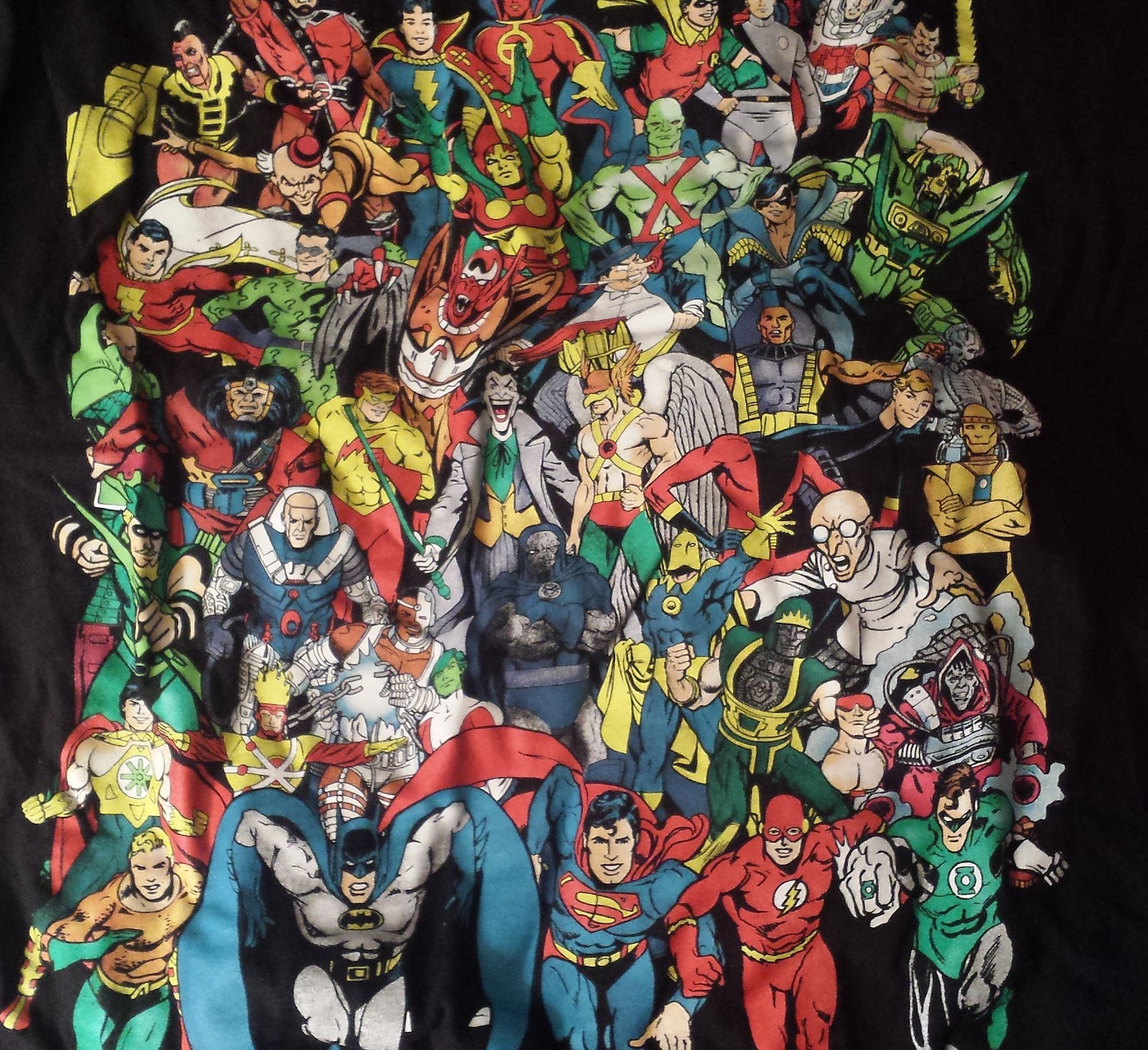
As everybody reading this website surely knows, the Super Powers Collection was an action figure line by Kenner, based on the Justice League of America comics. Super Powers merchandise was everywhere in the 1980s and still shows up today, like on this sick t-shirt I bought at Target:

Target Shirt.jpg
Dope t-shirt I got at Target

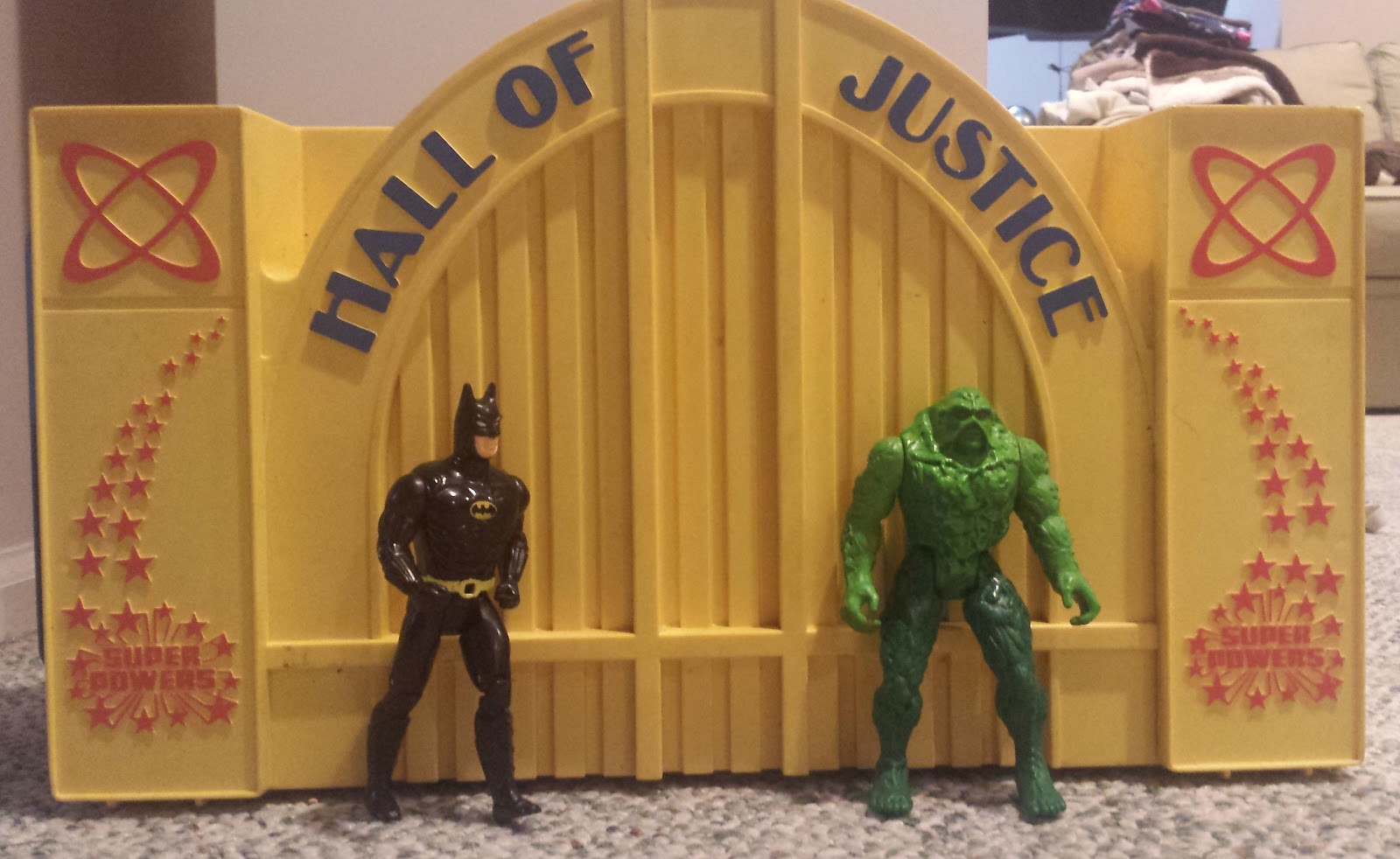
Even though I was a huge fan of the Super Friends TV show as a kid, I somehow missed out on the toys. Here is a picture of the Hall of Justice that I got at a yard sale for my kids, as modeled by Michael Keaton Batman and Swamp Thing:
Hall of Justice.jpg

"So, uh, you ever see Mr. Mom?"

But we don’t care about toys, t-shirts, or lunchboxes, we are here for the comics. And brother, were there ever comics!


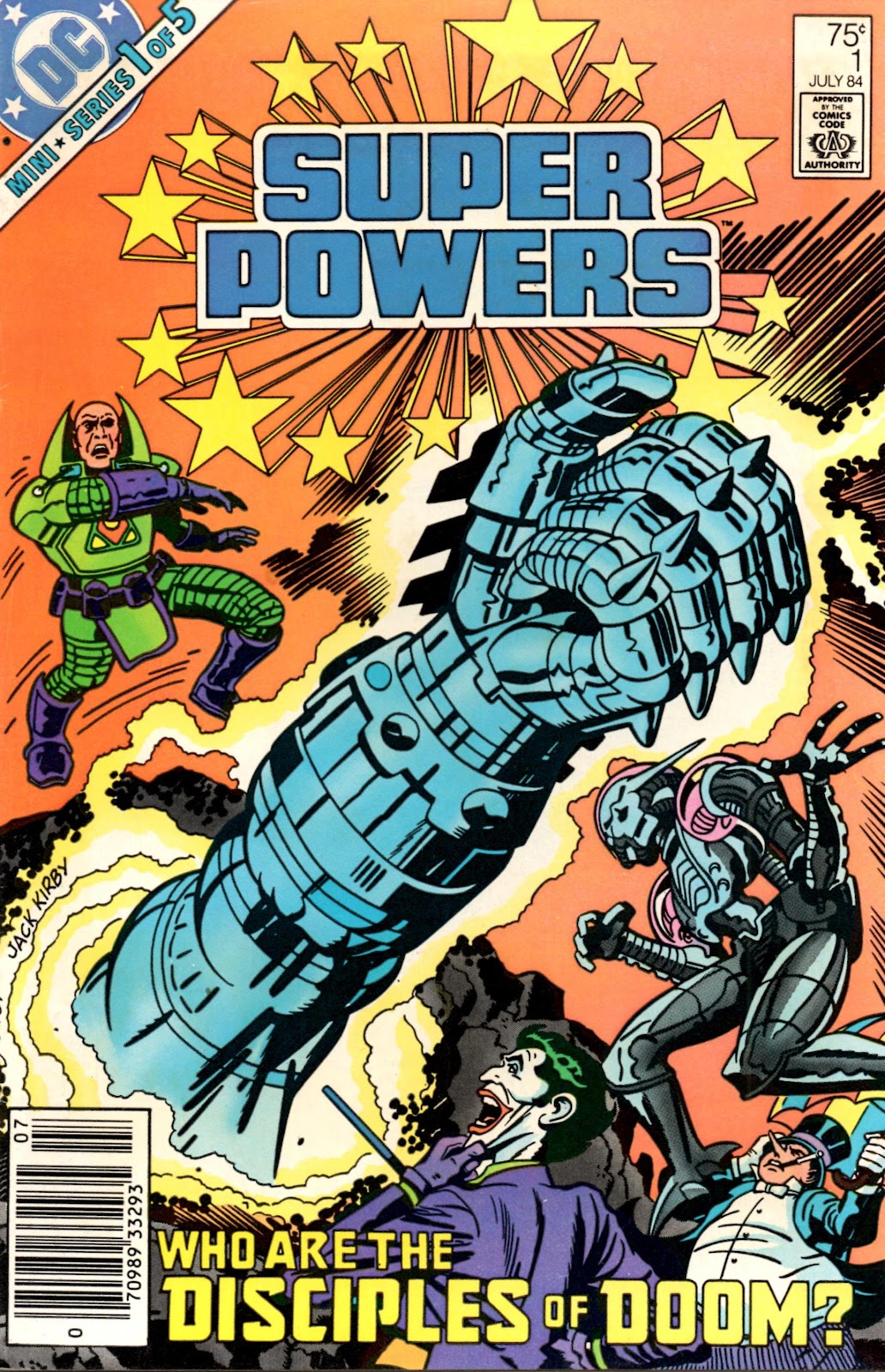
DC put out three series of Super Powers comic books between 1984 and 1986. The first series was plotted by Jack "The King" Kirby and scripted by Joey Caliveri, with Adrian Gonzalez pencils and Pablo Marcos on inks. Kirby also did the covers for this series, and both wrote and drew the concluding issue, #5.
Fist of Doom.jpg
Super Powers - Kirby on covers and plot

For a long time the Super Powers series was ignored by fans -- Kirby was past his prime, it was based on a toy line, it was "out of continuity" (more on this later). I bought nearly the entire run in quarter bins over the years and they never seemed to be in short supply. And, to be fair, the first series isn't really all that great.

Darkseid grants great cosmic powers to the survivors of the gladiator games of Apokolips. These "Disciples of Doom" are sent to Earth to distract the superheroes while Darkseid’s armies take over the planet. The Disciples grant super powers to the world’s worst super-villains: Lex Luthor gets time distortion, The Penguin gets mind control, Brainiac receives the power to activate "racial memories" (yikes), while the Joker gets his own psychoactive dimension to play with. The newly-empowered villains pick fights with the superheroes (Hawkman, Superman, Green Lantern, The Flash, Aquaman, Wonder Woman, Batman and Robin) and lose badly.
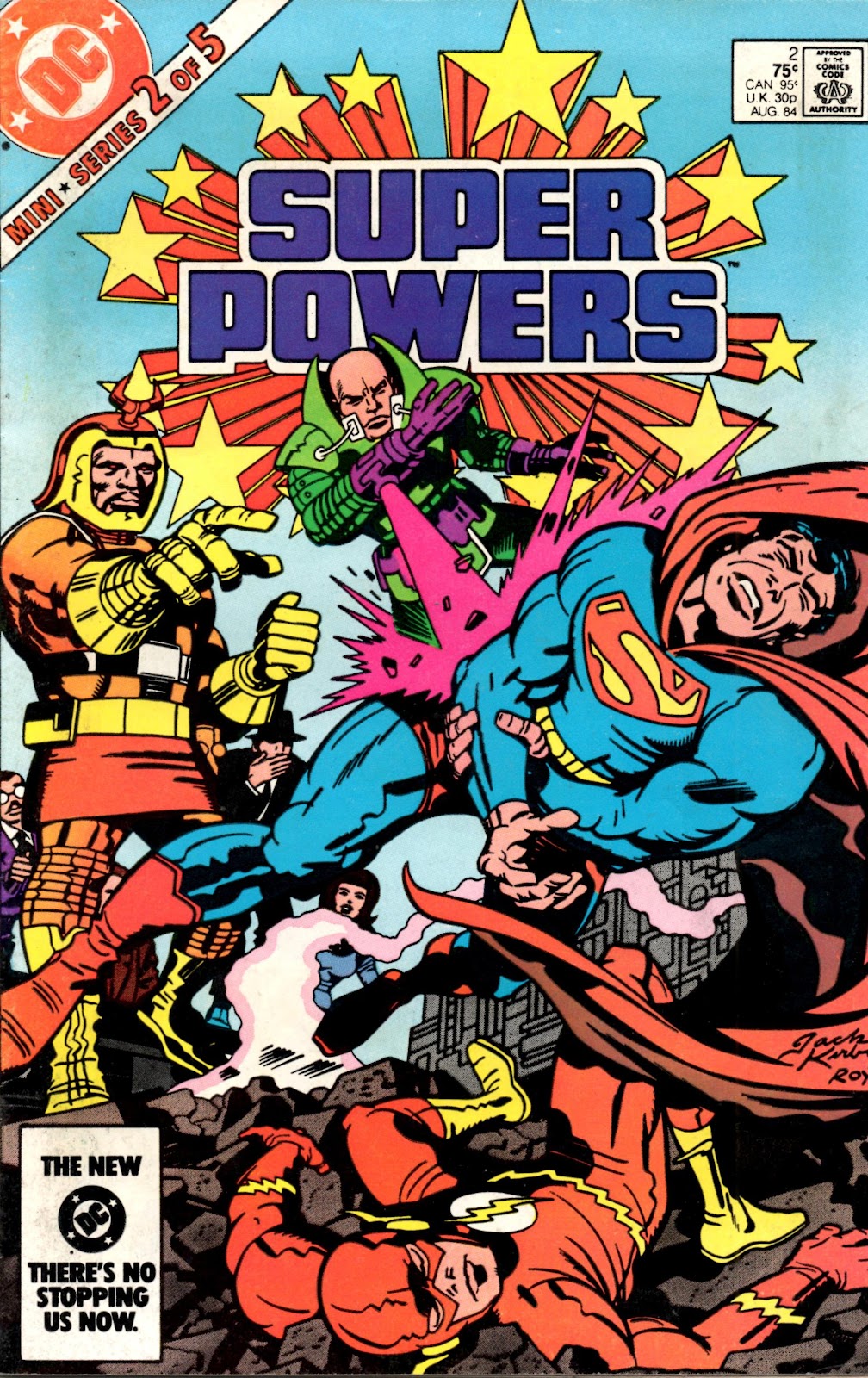

Dead Superman Cover.jpg
Luthor using his brand new powers.


There are some good bits in this series, like Superman the Barbarian...
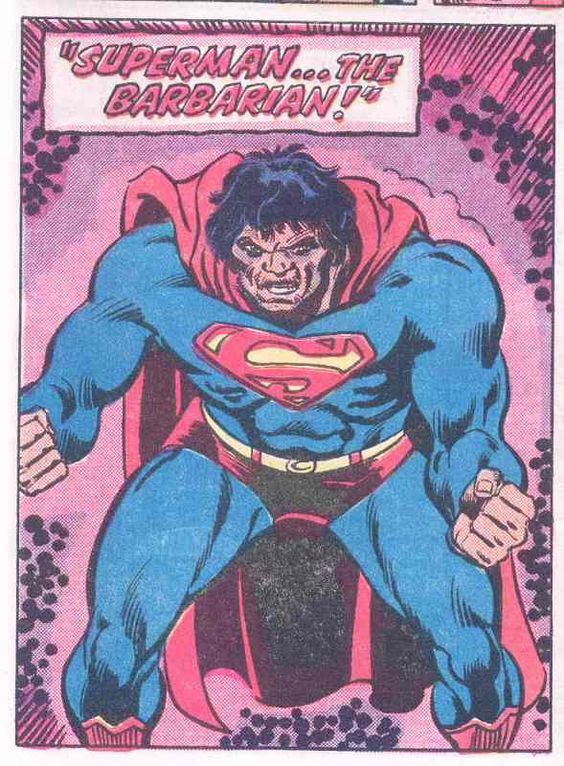


...and The Joker trapping Batman and Robin in a crazy-town dimension, but there is an awful lot of filler before we get to the main event in issue 5.

The concluding issue of the first series is raw, unfiltered Kirby and it undoubtedly blew some little kids' minds back in the day (Spaceship Earth -- We’re All On It!). Stranded in Apokolips, the Super Powers team touch a mysterious object that transports them to several bizarre worlds. The machine is "The Worlogog, a physical manifestation of time and space itself!". The Worlogog was built and controlled by Metron of the New Gods. Metron bounces the super guys around the dimensions to cover their tracks so Darkseid can't follow. Metron is going to use the Worlogog to boost the superheroes' abilities and wreck up Darkseid’s armies. Darkseid uses Boom Tubes to attack Earth at different points throughout history: Metropolis 80,000 AD, Ancient Asia, Atlantis...all defeated by Metron and the Worlogog. Metron sends the super-guys home in Brainiac’s ship, while Darkseid lives to scheme another day.

While it managed to transcend its origins as a toy tie-in at times, series 1 was just a warm up for Super Powers series 2, where things get really crazy. For the second series, Paul Kupperburg takes over as writer, while Kirby pencils and Greg Theakson inks. If you've ever wondered what a Jack Kirby JLA story would be like, you've come to the right place. This is the good stuff.

The first page has a footnote: "Takes place after The Hunger Dogs OGN". This is all the proof I need that this is 100% in New Gods continuity and therefore an official part of the Fourth World saga. After the events of The Hunger Dogs, Apokolips is no longer under Darkseid's rule and the huddled masses want to track down their former ruler and kill him. Darkseid kills some peasants and monologues that the universe will pay for this travesty. Darkseid meets up with Kalibak, Desaad, and Steppenwolf in an underground bunker. They take one last trip in a broken Boom Tube and leave Apokolips behind for good, setting down on Earth’s moon. Darkseid plans to get his mojo back by conquering Earth.

Meanwhile, at the Hall of Justice, Batman informs the Justice League that five "seeds" from outer space have landed in England, Rome, New York City, Easter Island, and the Arizona desert. These space seeds are burrowing into the planet’s core, which surely can’t be good. The League splits into teams, Gardner Fox style: Green Lantern, Dr. Fate, and Wonder Woman travel to Easter Island; Superman and Firestorm head to Rome; Red Tornado, Hawkman, and Green Arrow go to Times Square; Martian Manhunter and Aquaman travel to England; and Batman, Robin, and The Flash haul ass to the desert.

The heroes learn that the seeds are, in fact, evil, and when you so much as touch them they open up a time portal and whisk everyone back into the past. This leads to great bits like Martian Manhunter and Aquaman fighting the Knights of the Round Table, Wonder Woman and Dr. Fate accidentally creating the Easter Island statues (they’re aliens turned to stone! Oh Kirby), and Superman and Firestorm fighting Roman gladiators.
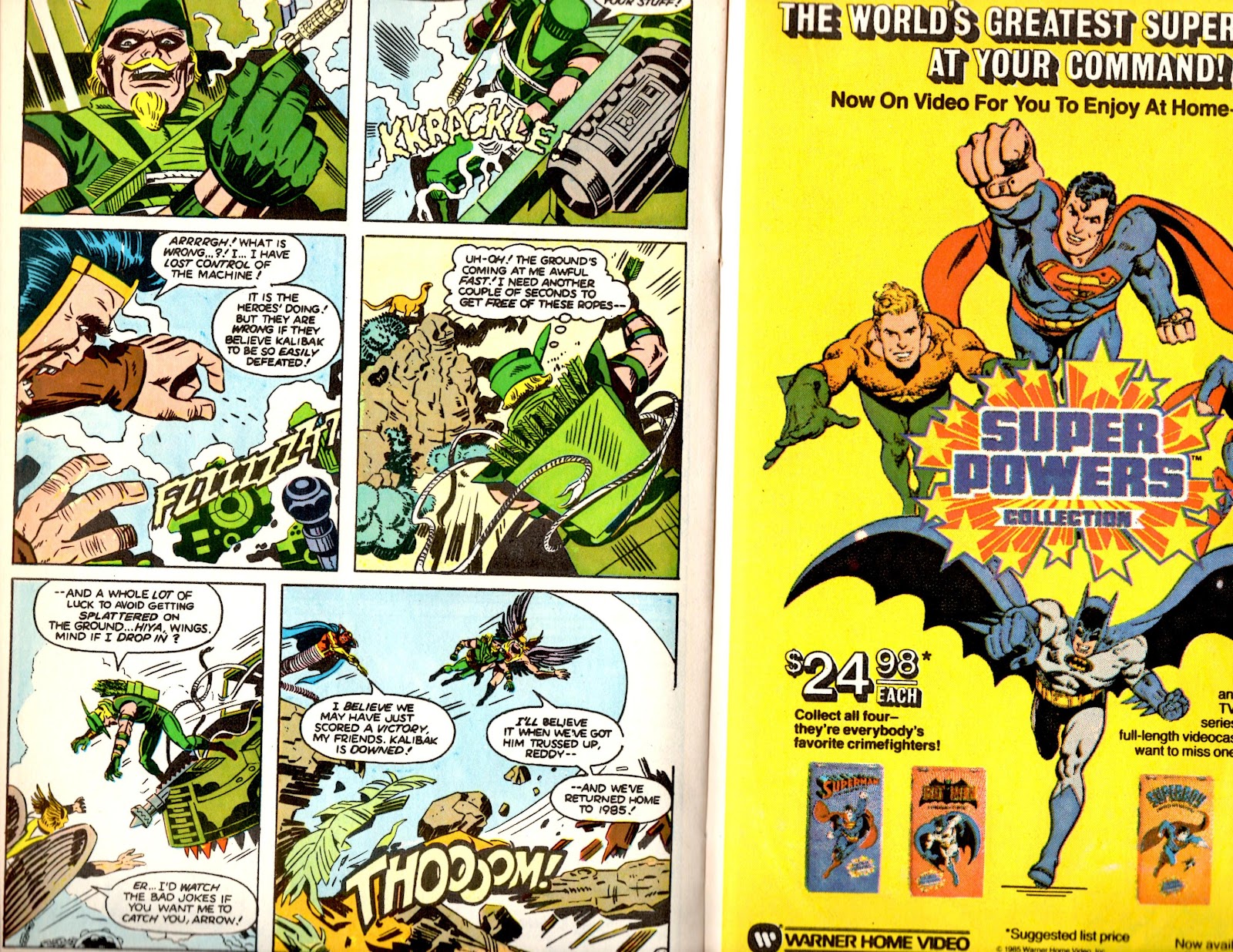
Video ad.jpg
Pretty expensive for a VHS tape!


One terrific bit has Kalibak strapping Green Arrow to the hood of the Boulder Bomber, which -- if you're going to do a toy commercial in your comic -- is absolutely the way to go.

The two best parts in the whole series are undoubtedly the Times Square and Arizona chapters. I have an ironclad rule when it comes to purchasing comics: if there is a dinosaur or a Frankenstein on the cover then I MUST own it. Issue 2 features Martian Manhunter fighting a Tyrannosaurus in the middle of Times Square and it's the Devil Dinosaur sequel we never knew we wanted.
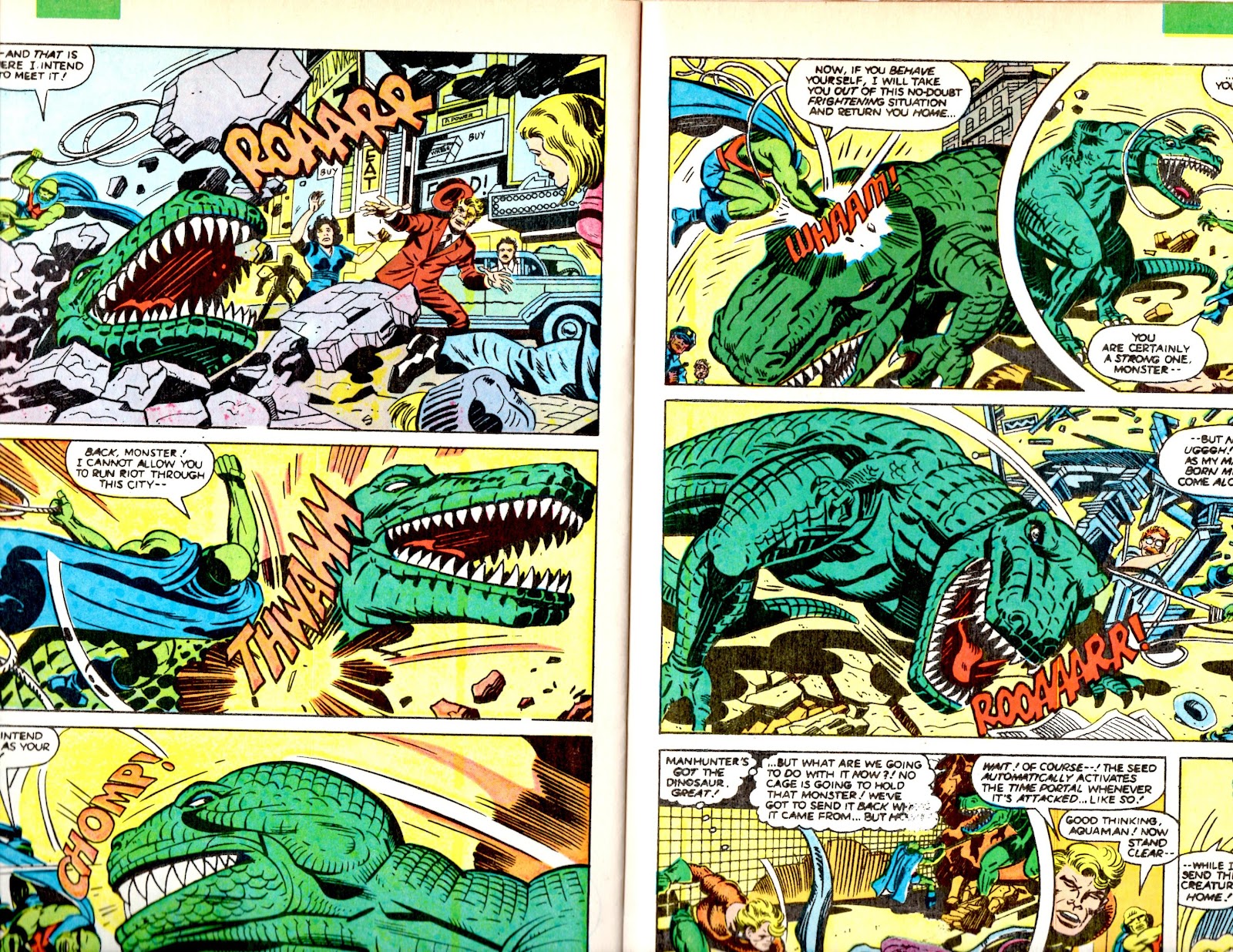
Mnhunter vs Dinosaur.jpg
If the Supergirl season finale doesn’t feature J’onn punching a T-Rex  I am never watching the CW again.


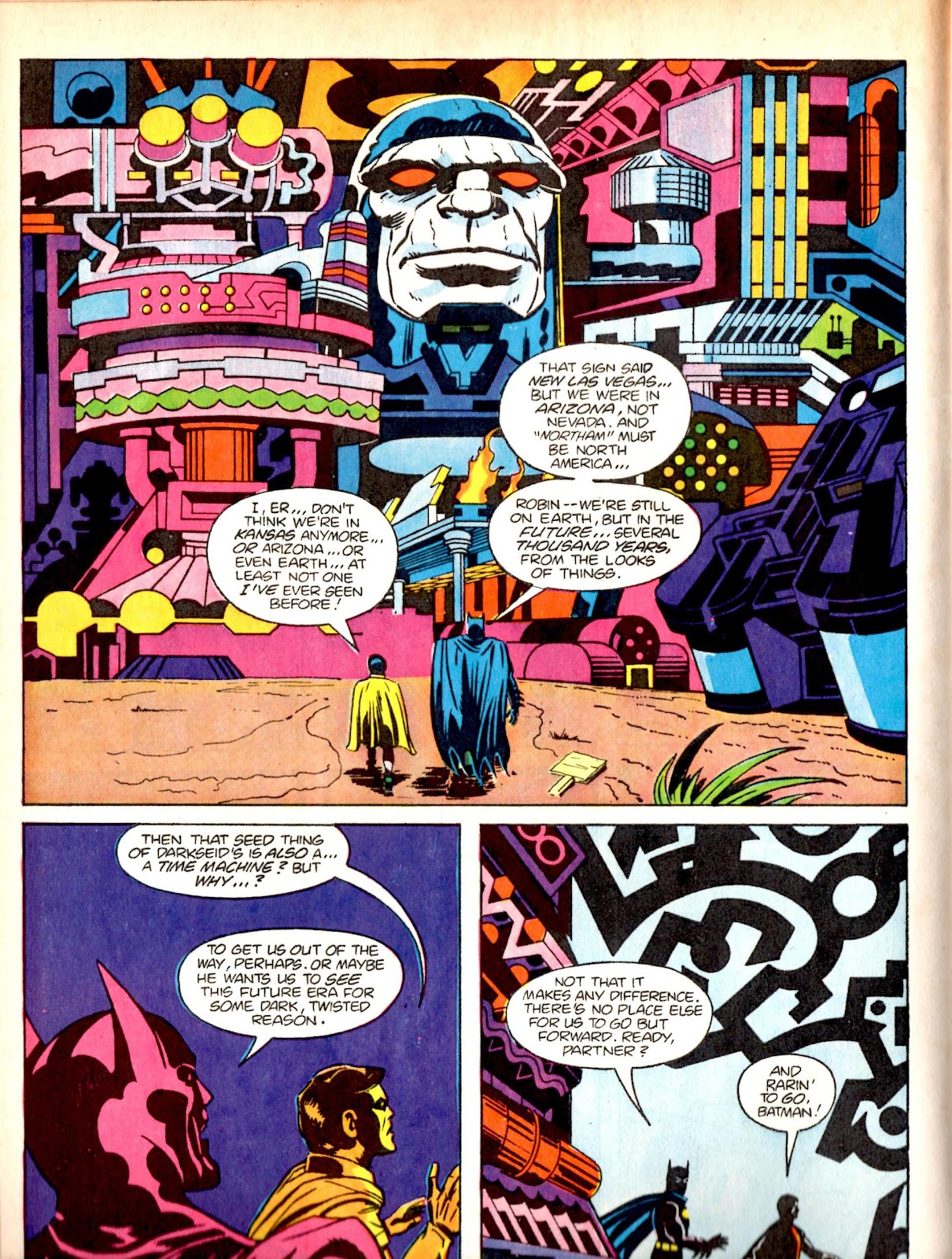
And then there is issue 5. If you ever wondered where Grant Morrison got the inspiration for Rock of Ages, look no further. In this issue, Batman hits the seed with a batarang and hordes of Parademons emerge from a time portal. The portal takes the heroes into a dark future where Darkseid has won and converted Earth into a new Apokolips. "New Las Vegas", in what used to be the Arizona desert, has become a shrine to Darkseid. If you have ever seen images from this series on Tumblr or Twitter or wherever, they are probably from this issue, because it is trippy as hell.
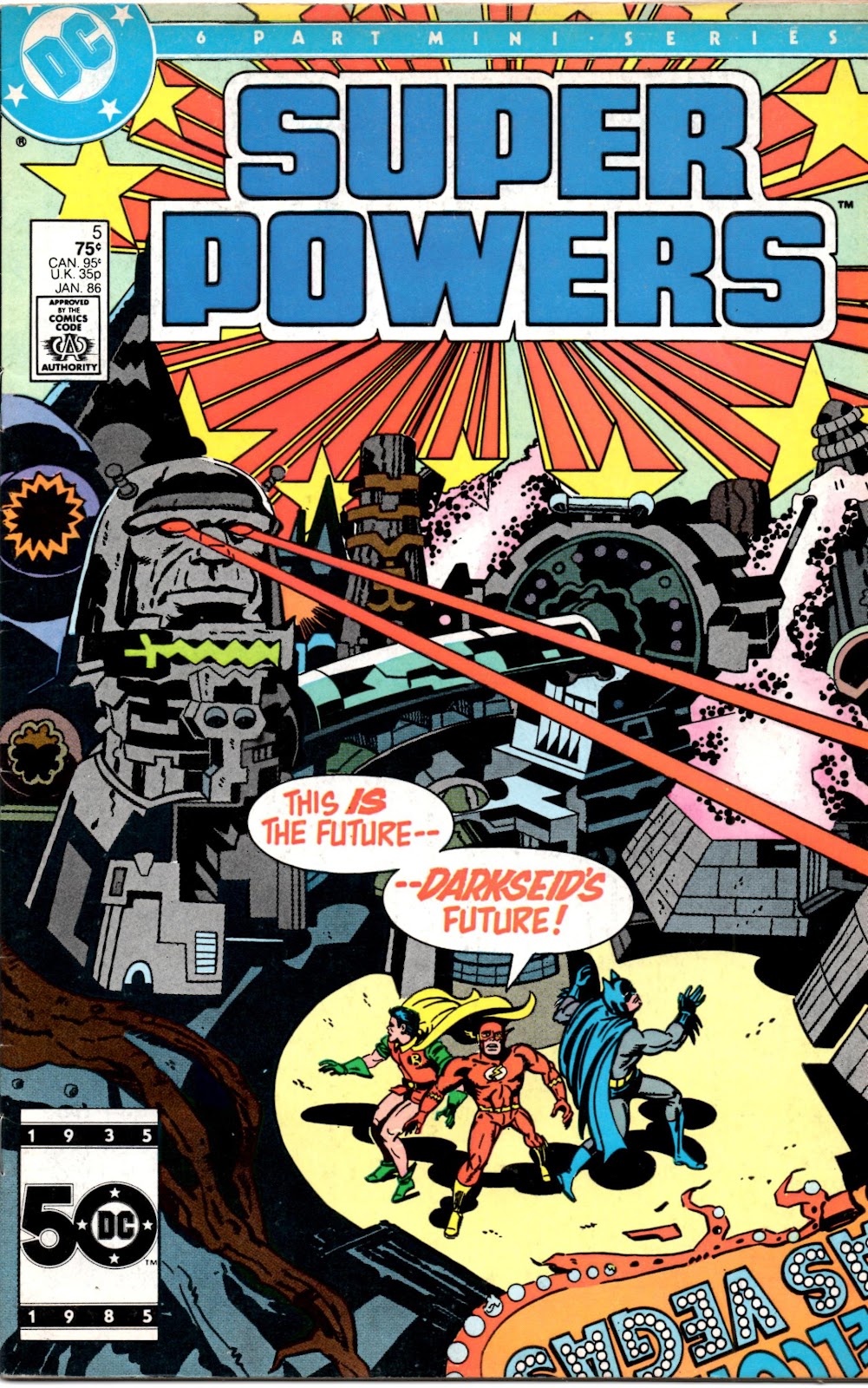

Darkseid Future.jpg
Rock of Ages trial run


Trippy Darkseid.jpg
Black light poster? Yes please.


Civilians attack Batman and Robin for wearing forbidden superhero costumes and the Parademons take the heroes to the Arena, where they have to fight The Hulk -- I mean Mongo "Crusher" Monsoon.
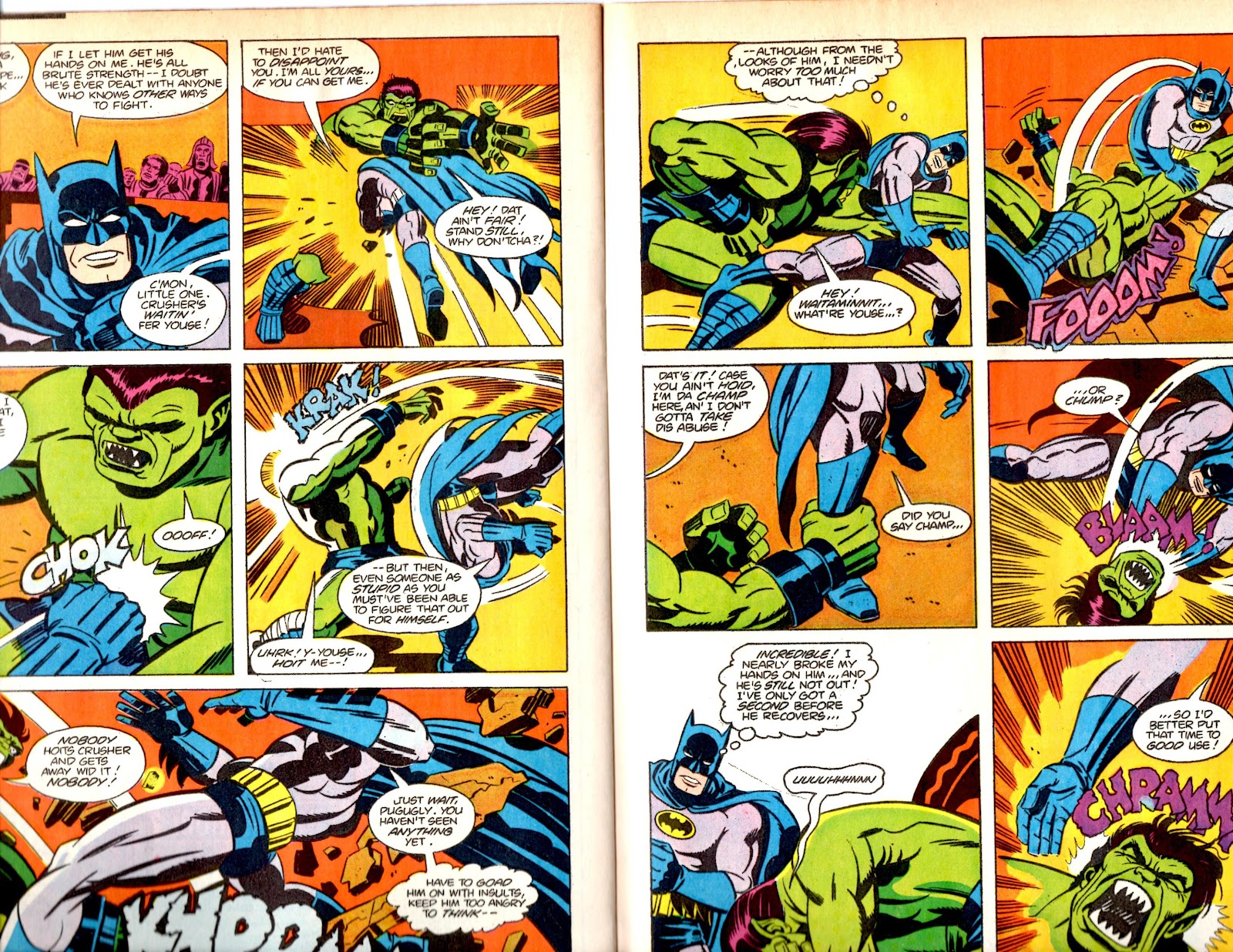
Batman v Hulk.jpg

I wonder what would happen if Batman fought the Hulk and Jack Kirby drew it?


After defeating Crusher, the JLAers are about to be killed by Parademons when The Flash intercedes in the nick of time. They escape the arena, steal a time travel device, and get back to the past.

In the finale, issue 6, the superheroes handily defeat the henchmen and Parademons before tracking down Darkseid. A giant hologram Darkseid offers to make the heroes part of his chosen Elite Guard, but of course they refuse. The hologram hand shoots the good guys with an agonizing neural disruptor ray and traps them in a power-disrupting holding cell. Darkseid monologues that he is going to activate the seeds with an Omega Effect Amplifier and add their super powers into the mix. J’onn J’onnz shapeshifts himself into some kind of freaky non-sentient being without a central nervous system, allowing him to escape the pod and the neural disruptor ray. Once out J’onn is able to shift back to his normal form and free the others. Superman and Dr. Fate race to Earth to deflect the Omega beams, blocking them from making contact with the seeds. Desaad betrays Darkseid by sabotaging the machine. Darkseid disappears thanks to his own Omega Effect, while the other Apokoliptikans escape through the star gate. Earth is safe once again!

Proving you can’t keep a great concept down, Super Powers has seen a revival at DC this year. In addition to the Aw Yeah series for kids, Super Powers has come back as a backup strip in Cave Carson Has A Cybernetic Eye, part of the Gerard Way-led Young Animal line. Written and drawn by Tom Scioli, the auteur behind Transformers vs G.I.Joe, Super Powers uses the toyline and Jack Kirby comics as a jumping-off point for an idiosyncratic and offbeat take on the DC Universe.

When taking notes for this write up, I spent three pages trying to summarize the plot, which is pretty impressive considering each installment is only two to three pages long. The series provides new origin stories for The Wonder Twins and Green Arrow, a look at Etrigan's past as an angel before the fall, a glimpse of Flippa Dippa’s future as an underwater archeologist with the Sea Devils, Captain Marvel Jr. crucified on the Rock of Eternity, an army of Superman clones, the arrival of The New Gods, and a Morrison-esque shattering of the fourth wall.
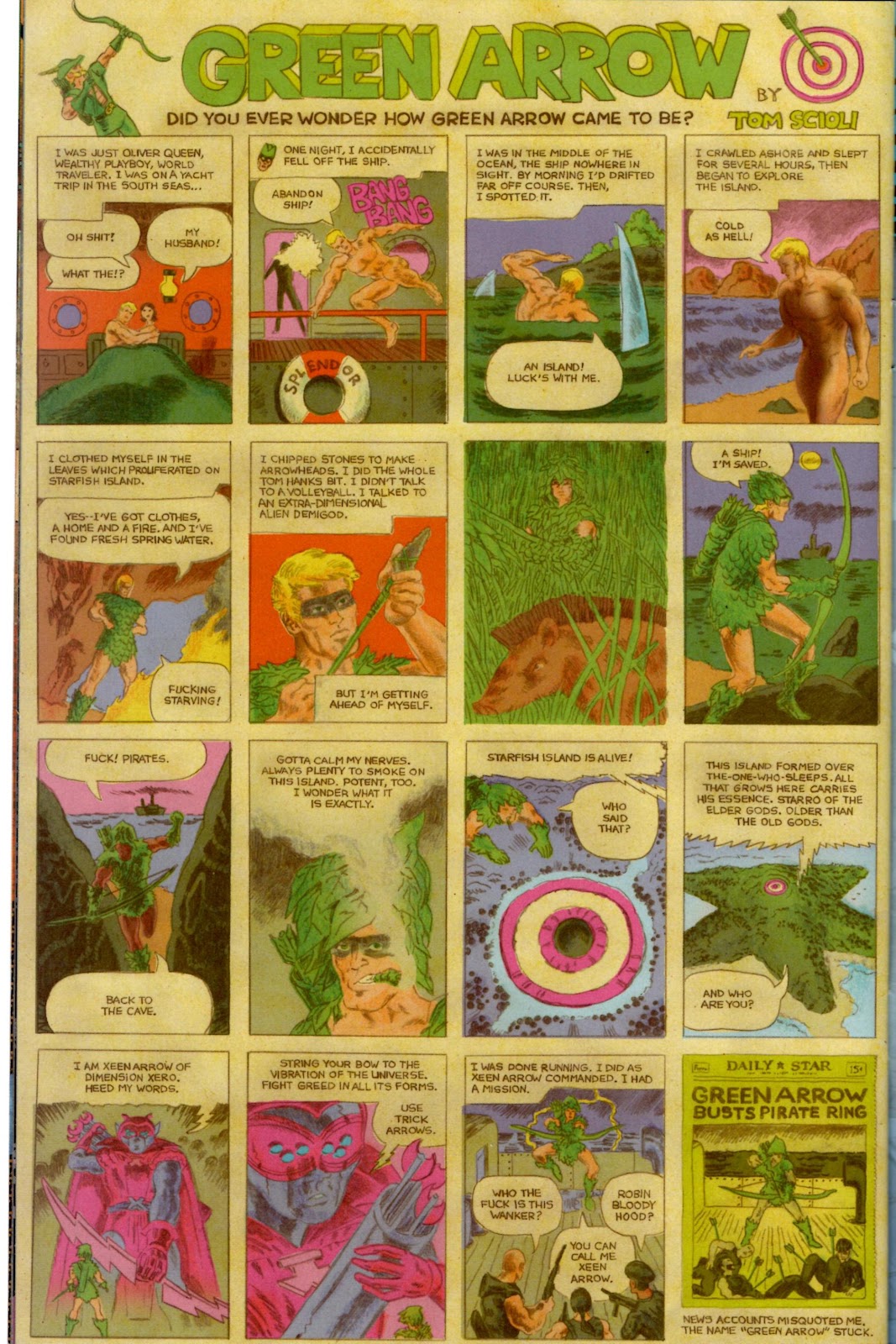
Arrow.jpg
Best Green Arrow origin.

I want to say more about the Scioli series (plot summary, spot-the-reference, theories, you name it), but it's still available and well worth reading on your own. On my blog JLA Classified I have gushed about the Young Animal imprint and called Cave Carson my favorite comic of 2017, and I think you will agree. If you are into 1980s DC and Vertigo comics (and I know you are!) then you owe it to yourself to check it out.
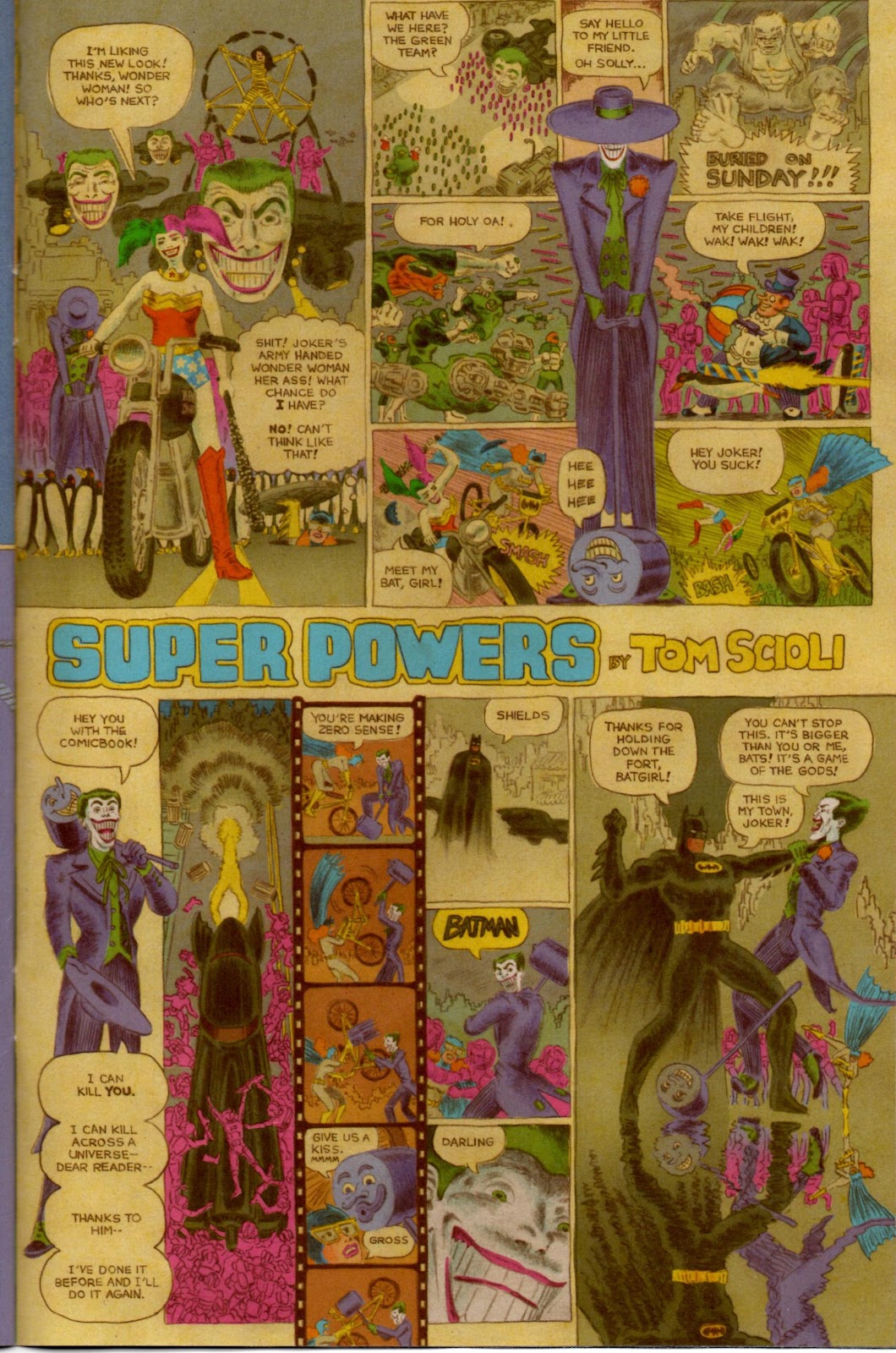
Batgirl.jpg
Batman 89 also Dark Knight and Killing Joke with a bit of Animal Man thrown in.

You can get both Kirby Super Powers series in the Kirby Omnibus cheap on Amazon, and Cave Carson Has A Cybernetic Eye is available wherever fine comic books are sold.

-Erik Tramontana


Erik Tramontana is a teacher, a dad, and a lifelong Batman fan. He blogs about 1990s DC comics at jlaclassified.tumblr.com


Wednesday, April 12, 2017

An informal history of Topps non-sports trading cards [mid '70s to early '90s]

Formerly the American Leaf Tobacco Company (a United States importer of tobacco who sold to other tobacco companies), the Topps Company was created in 1938 when World War I impeded the import of tobacco into the United States from Turkey. This required the American Leaf Tobacco Co. to find a new product to build their company around. The new product would be chewing gum. Remember Bazooka bubble gum? Yeah, that's them. "Topps" was chosen as the company name to imply that they were at 'the top of their game'.

variations of the Topps logos throughout the ages

I'm not too familiar with how lucratively chewing gum was selling throughout the late 30s and 1940s [I imagine the Wrigley Company and the Fleer Corporation presented fierce competition], but in the late '40s Topps started printing comics strips on the reverse side of its gum wrappers with the intent of getting an edge over the competition. (Coincidentally, these comic strips were reprints from DC and Fawcett Comics.) Do you like Bazooka Joe comics? You're in luck -- there's a book about them.

Pre-Bazooka Joe Bazooka bubble gum DC comic strip. Source: http://toppsarchives.blogspot.ca/2012/11/you-never-had-it-so-good.html

The late '40s also saw Topps package temporary tattoos with their gum, in an aptly named product called 'Tattoo Bubble Gum'. Other cool gimmicks from the late '40s included Flip-O-Vision (essentially a flip book that would show a scene from a film), Magic Photo (cards came out blank and you had to add a developing agent to see the image), Funny Foldees (a little booklet you can re-fold to make funny pictures) and X-Ray Roundups (an x-ray insert would reveal hidden image underneath original image). The first non-sports trading cards to be packaged with Topps gum would've been the 1949 Flags of All Nations & Soldiers of the World set. I'm presuming this was successful, because Topps released Hopalong Cassidy cards (packaged with gum) in 1950.

Since this is a site focused on eighties nostalgia, I'm not going to go into full detail about all of the non-sports trading card sets Topps produced from 1950 to 1970 (because there were quite a few) -- but some of the stand-outs you'd probably recognize include 1962's Mars Attacks, 1964's Beatles, 1967's Wacky Packages, and 1969's Planet of the Apes trading card sets. For a DC Comics fan, the collections you'd probably care about are 1966's Batman and Superman trading card sets, Superman in the Jungle trading card 'test' set, and Comic Book Foldees 'trading card' set. Topps also produced a Comic Covers sticker set (featuring covers of popular DC comics) in 1970.


Topps Comic Covers sticker card (1970). Source: http://www.trading-cards.org

The 1970s saw an explosion of TV, film and other pop culture properties covered by Topps. If Topps thought there was a market for it, they jumped all over it -- this is why we now have Bay City Rollers trading cards in circulation out there somewhere. Topps didn't just exclusively cover DC Comics characters, but Marvel Comics characters as well [i.e. 1975's Comic Book Heroes Stickers, 1976's Marvel Super Heroes Stickers, 1978 & 1979's Marvel Comics, 1979 Incredible Hulk trading card sets].

One of the most popular Topps non-sports trading card sets to come out of the '70s was the 1977 Star Wars Series 1 - 5 trading card sets, that -- when all cards were combined -- amounted to a whopping 330 trading cards and 55 stickers. This set is so sought after by collectors that Topps has released a reprint collection of the cards in a hardcover book (complete with behind-the-scenes info and completed puzzles).

1978 Topps Superman  The Movie trading card

The 1978 Superman movie was the first of several DC movies covered by Topps. The rest included:
  • Superman II (1980)
  • Superman III (1983)
  • Supergirl (1984)
  • Batman (1989)
  • Batman Returns (1992)
Unfortunately, neither of the 1980s Swamp Thing films, 1987's fourth Superman film, the 1975 Wonder Woman or 1988 Superboy live-action TV shows received the trading card treatment from Topps. How cool would a Swamp Thing movie trading card set have been?

Most Topps non-sports trading cards shared common characteristics. Here's a run-down of the most quickly identifiable hallmarks of Topps cards from the 1980s:
  • Low price point

  • As previously mentioned, Topps released tons of non-sports trading card sets throughout the seventies and eighties. They especially thrived during the eighties and it seemed like you couldn't go near a cash register in a convenience store without seeing a display box for Topps trading cards. (The convenience store candy counter was typically located near the cash register, and the cards were usuallyon display with the candy.) Prices varied, but a pack of Topps trading cards typically cost less than 50 cents and usually contained about 10 cards, a sticker and a piece of gum. This was quite a bargain and made for an easy impulse purchase when you had some spare change in your pocket.
  • Wax Wrapper

  • The Topps wax wrapper with its bright primary colors and [often] poor color separations immediately stood out on the shelves and magnetically drew us in. Just looking at these wrappers gets you excited imagining the possibility of which cards you might pull. If you run your fingers along them, you can feel the waxy composition of the pack. Why were they wax and not some other sort of paper? I really have no clue. Possibly something to do with the stick of gum in the pack?  Maybe it was the cheapest wrapping paper they could get away with? At one point they used to be cello packs. In the grand scheme of things, it didn't really matter. 


  • Stickers

  • Stickers were more or less the chase cards of the set. With a guarantee of 1 sticker per pack, you really couldn't go wrong here. The sticker came on a trading card and could be peeled off and stuck somewhere. The back of the trading card was usually a puzzle piece, so it still had some value once that precious sticker had been peeled off. Due to the fact that a lot of kids couldn't resist the temptation of sticking these stickers to things, finding a complete Topps set with sticker cards intact is going to be a bit more costly.

  • Puzzles

  • The puzzle cards were truly the highlight of any set. Puzzle pieces were found on the reverse of the card and joined up to make a larger image. In some sets, the base set cards had puzzle pieces on the reverse, and in other sets, it was only the sticker cards that had the puzzle pieces on the reverse. It's a truly a case-by-case scenario. A single puzzle could consist of anywhere from six to twenty-eight cards depending on the set, and it wasn't unusual for a set to have more than one puzzle. I'm not sure if Topps can claim to be the first to use this gimmick -- and I can't even confirm that every Topps non-sports set had a puzzle -- but this was a major selling point that fueled your need to buy more cards. I don't think there has ever been a feeling more rewarding than collecting and completing a puzzle before the rest of your friends do. It's the closest thing I've ever attained to 'celebrity status' among my peers. I was the envy of the neighborhood for at least a whole two weeks when I managed to snag the last card and complete Warren Beatty here...
1990 O-Pee-Chee Dick Tracy completed puzzle

  • Photography on trading cards

  • If it was a trading card set based on a film or TV property, it was about 99% guaranteed that the 'card art' would be direct photographs from the movie or show. This isn't as bad as it sounds -- back in the pre-internet days, screenshots of your favorite movies and TV shows weren't easily available. Unless you owned the film on VHS, you were probably relying on your memory or an official 'movie magazine' when recalling your favorite scenes. These cards immortalized some of your favorite moments. Some sets even included behind-the-scenes photos. 
Rare full glimpse of the Nostromo spacecraft from the 1979 Topps Alien set

  • Flimsy card stock

  • Compared to the Impel/SkyBox trading cards we'd be treated to in the early nineties, the Topps non-sports trading cards from the eighties felt cheap. The front of the card was a little glossy/slick, but the reverse felt like it was printed on pure pulp paper. The exception to this, of course, would be the Wacky Packages and Garbage Pail Kids card sets that were so popular in this era [see below]. Knowing what I know about Topps, this was probably the cheapest card stock they could afford to get away with. To note, a big issue with the Topps trading cards of the seventies and eighties is the poor quality control of the final product -- print defects, poor centering, smudges, corner defects and, in some cases, select cards will have gum stains on the back of them.
The stick of gum left a greasy stain on whatever trading card it was packed next to. Photo source: http://apacktobenamedlater.blogspot.ca/2011/05/1977-topps-star-wars-series-1-no-2.html
     
  • Hot non-sports properties

  • Admittedly, there were a few duds (i.e. 1983's Menudo set, 1984's Baby set, 1987's Harry and the Hendersons set), but Topps covered just about everything worth covering and they still have retro collecting appeal to this day. Masters of the Universe, Nightmare on Elm Street, Rambo, Rocky, Robocop, A-Team, ALF, Back to the Future, Goonies, Indiana Jones, the Simpsons, Teenage Mutant Ninja Turtles, Nintendo, ... if it was big in the eighties or early nineties, Topps probably produced at least one card set about it.   


If you lived north of the border (like me) in Canada, you couldn't get your hands on any Topps trading cards at your local convenience store. Instead, we had O-Pee-Chee brand trading cards -- which were essentially Topps' Canadian counterpart. O-Pee-Chee gave a fairly good representation of the Topps card sets except for the fact that the sticker cards had been replaced with regular cards -- I had only discovered this several years ago and was pretty sour to learn that I had been cheated out of 1989 Batman movie stickers in my youth.


Wacky Packages trading cards had mass collectible appeal in the 1980s and were probably the catalyst that sparked my lifelong obsession (so far) with the acquisition of non-sports trading cards. Wacky Packages had that 'perfect storm' of enticement for the youth of America -- they parodied popular household products (which gave them a counter-cultural feel), they were bright and colorful, and every single card was also a sticker. My ENTIRE elementary school went into a frenzy collecting these, and, for at least a year, it was on par with the Pokemon card collecting craze of the early 2000s (minus the stabbings). Wacky Packages are arguably Topps' most successful non-sports product and are still being produced by the company to this day.

I still love everything about Wacky Packages.

Garbage Pail Kids, a trading card parody of the popular 1982 Cabbage Patch Doll toys, were also a pretty hot commodity among kids in the eighties. The grotesque artwork on the cards pretty much ensured that they were banned from every conservative household in America (especially mine), which probably drove up the desirability of the cards. I was a pretty squeamish kid and found them too appalling -- so I skipped on these. One thing I will comment on is that the adhesive on these stickers were pretty strong as a friend stuck one to his parents' wooden coffee table and they had the hardest time removing it afterwards. There's been a bit of a Garbage Pail Kids resurgence as of late, and Topps still produces new Garbage Pail Kids stickers.

Twenty five years later and I still find these to be in bad taste. Whatever floats your boat, I guess.

Topps wasn't the only company selling non-sports trading cards for a low price point in North America during the eighties. Other non-sports trading card publishers included Fleer and Donruss, but I don't recall them being sold at convenience stores or publishing any DC comics material. (I'm under the impression that Topps was the sole license holder of Batman and Superman trading cards until the early '90s. Topps would produce trading card sets based on the DC movies in the 2000s.)

The day of 'cheap non-sports trading cards in a wax wrapper' quickly died in the early 1990s when other companies started getting in on the act with nicer, glossier cards. Impel -- with its 12-cards-per-pack Marvel Universe Series I set -- was a bit more expensive and did not include a sticker or gum, but you could immediately see the quality of the product. Impel was also distributing its cards anywhere comic books were sold (not just limiting themselves to comic books shops), so this would've been direct competition with Topps, as they didn't have the monopoly over the 'convenience store market' anymore. Comic Images was also selling non-sports trading cards (mainly based on Marvel Comics properties) in the late '80s and early '90s, but they seemed to be exclusively sold in comic book shops, so the average kid who bought his comics from 7-Eleven wouldn't have been aware of them.

It didn't take long for Topps to 'up their game' once the competition was out there. Topps stopped including gum with their cards sometime in the early '90s and switched over to high quality, glossier cards. (A few 'throwback sets' were produced to emulate the Topps non-sports cards of the '70s and '80s.) To Topps' credit, they've always retained the Star Wars license, and have been the sole producer of Star Wars trading cards (in North America, anyways).


There's a bit more to the Topps story that I won't delve into (namely the creation of Topps Comics in 1992 and a Topps company shareholder dispute in 2006/2007), but now you mostly know everything I know about the history of Topps non-sports trading cards.

What is the impetus for tracking down/purchasing/collecting these cards? Nostalgia, mainly. While they weren't the flashiest trading cards, they do bring back a lot of warm, happy memories of simpler times -- like before ultra-rare hologram chase cards were introduced or when a set was considered completed when you finished that puzzle or collected all of your favorite scenes from the film. I still remember when my generous (but misguided) uncle surprised me with a pack of Topps' Voltron Defender of the Universe tattoos and, try as we might, just couldn't get the damned things to stick to my skin. I'm not the only one who still has a fondness for '80s Topps cards, check out this fan-made creation of an imaginary Topps Superman IV trading card set.

Surprisingly, for trading card sets that are thirty or more years old, most of these sets can be purchased as a full set for a reasonable price (less than $30 USD) and some dealers will even throw in an original wax wrapper, too. One word of caution: some dealers will sell the sticker set separately from the full set -- so ask before purchasing if you care about that sort of thing. If you're a savvy shopper, you may even be able to find an unopened box of cards for less than $70 USD. For reasons I don't question, some collectors insist on only picking up a specific print edition of a card (either '*' or '**') for their collections. This is where it could get pricier to collect these cards. There isn't any real noticeable difference between the print editions, and I think the only people who really care are die-hard collectors.


-Justin

So, you're interested in learning more about Topps trading cards, eh? Here are a few links you can check out:
  • The Topps Archives provides a really good resource on older Topps (sports AND non-sports) trading cards from 1939 to the present day. It's a well-curated site with lots of useful information. Check out their "Field Guide to Dating Topps Wrappers" article which gives a pretty thorough guide on what to look for.


Thursday, March 30, 2017

Introducing new contributor Michael Campochiaro

We're very proud to add Michael Campochiaro to our ranks of regular contributors. Michael is a seasoned veteran of retro pop culture journalism and has written for Sequart, The After Movie Dinner, Spectrum Culture and his own blog, Words Seem Out of Place. Typically we don't expect new contributors to provide an essay on why 80s comics were so influential to them, but Michael was so enthusiastic about it that we just couldn't refuse. Alright, that's all you really need in the way of introductions. On to Michael...


As often happens with obsessions formed at a young age, a friend's older sibling played a key role in kick-starting one of mine. By the early to mid 1980s I'd been reading comic books for several years already. I was just a wee lad though, content to read Super Friends, Batman, Amazing Spider-Man, and Justice League of America, mostly, plus whatever other books looked cool on the spinner rack at the local convenience store. Then, somewhere around '83 or '84, my friend's older brother introduced us to his prodigious comics collection. Now, he was a teenager and had his own bedroom/bachelor pad in their finished basement. It was filled with cool comics, movie posters, and art he'd drawn of his favorite characters. For the two of us, who were around eight or nine years old, this made him a God.


We spent countless hours on the floor in his room, completely engrossed in comics. This was also during the real independent comics boom of the early '80s, so he had plenty of issues of American Flagg!, Nexus, Whisper, and Badger, from upstart companies like First Comics and Capital Comics. We were like kids in a candy store, only our candy store stocked comics.

One day my friend's brother mentioned the local comics shop. When I expressed no knowledge of its existence, he implored me to check the place out. When I got home I immediately asked my parents to take me there. They knew comics had inspired my burgeoning interest in art and drawing, so they were fine with encouraging this growing obsession. Off I went, usually with my father, every month (sometimes twice monthly) for the rest of my childhood and on into my teen years. My father was the most patient man I've ever know This patience was on full display every time he'd wait quietly for me at the LCS, while I perused the new issues and dug through the back issue bins, lost in the four-color wonder of it all. Even the shop itself was like heaven to me: it was small and cramped and packed so tight you could barely squeeze around people in it. It was complete sensory overload for a kid like me: posters, toys, memorabilia, and of course thousands of comics.

Nexus meets the Badger: Nexus #7 (1985, First Comics)

I came of age at the exact right time to be a comic book nerd. Shortly after discovering my LCS, a succession of groundbreaking comics were released. One of these was Frank Miller's The Dark Knight Returns in early 1986. I was ten. It astounds me now to think of a ten year old not only reading, but absorbing, the brutality and despair in those pages. Yet I did, and it changed me, made me see not only comics but literature and art differently. Batman had been my favorite character up to that point and would remain so for several more years. I'd never read a Batman story like this before, though. Afterwards, it felt like I'd graduated to the next level. The next level of what, I had no idea, but some small step in the transition through adolescence was occurring.

Another book that changed my life during those years was the graphic novelization of "The Dark Phoenix Saga", collecting Uncanny X- Men #129–137. This released in '84 and I can still see it on an endcap at our favorite local bookstore. The stunningly painted Bill Sienkiewicz cover art, commissioned specifically for the collected edition, beckoning to me: "Buy me!" My mother saw how much I was drooling and said, "Let's get it." These stories had originally been printed a few years earlier, but here, in one gorgeous package was the meat of the saga. A perfect volume for a young reader like me to experience the eye-opening epic grandeur of Claremont and Byrne's Uncanny X-Men. At nine, I was hooked again, this time on the X-Men. To this day, "The Dark Phoenix Saga" remains my single favorite comic book story. I've written about it at my blog before, if you're interested.


This being a blog about DC Comics, I'll refrain from pining any further for the great Marvel Comics of my youth. I'll say this though, during those heady days of collecting as a kid, my go-to titles were always a mixture of DC and Marvel: the various Batman titles, Justice League, Green Lantern, Captain America, Uncanny X-Men, the assorted Spider-Man books, and on and on. I quickly learned that comics nerds liked to choose sides in the eternal DC vs Marvel debate, but I usually played Switzerland because I absolutely adored so many comics from both publishers. Now it's clear to me that I was attracted to DC because their heroes were so iconic, so out of this world and inspiring. They were like living myths, or at least as much as four-color characters on a page can be considered living. Marvel, on the other hand, both satisfied and encouraged my taste for outsider, marginalized characters. They were loaded with characters who reflected my own adolescent awkwardness. They were extremely relatable.

Comic books were the fuel I needed as a kid to explore my own imagination, to encourage my own artistic talents, to take things farther than I'd known was possible before. I was awestruck at the gloriously expressive art in those pages, hooked on characters that I quickly grew to see as inspirational totems (I'm looking in your direction, Rogue and Green Arrow), and constantly amazed at the fantastic adventures that comics took me on. If my comic book origin story sounds familiar, that's probably because it closely mirrors your own.

-Michael Campochiaro

We're looking forward to more Michael Campochiaro submissions in the future. In the meantime, here are some previous articles he's written on various comic book properties: