Interviews Reviews Guest Stars Fanzine Misc
Showing posts with label Cave Carson. Show all posts

Wednesday, January 10, 2018

Reviewing Cave Carson Has A Cybernetic Eye -- one year later

Alright, so we'll admit, we're about a year late on this one. Things happened -- we self-published another fanzine, we interviewed a few more comic pros, we covered a few comic conventions -- that got in the way of covering the new Young Animal imprint we're so stoked for. Besides, I enjoy waiting to read the first few issues in one sitting versus only reading the first issue and deciding if the series is going to be a hit or not... sometimes these things take a few issues to develop momentum.  


First of all, who is Cave Carson? The 1960s were an interesting time for DC comics; as the cultural shift would have it, the early 60s saw super-powered characters gaining in popularity again (thanks mainly to the Comics Code Authority putting a halt to horror and crime comics). Before super-powered characters became the 'big thing' in the Silver Age, DC tried out stories about normal humans (usually adventurers or researchers) dealing with extraordinary situations. Hence, we were introduced to The Challengers of the Unknown (a team of human adventurers), the Sea Devils (a team of human underwater adventurers), Rip Hunter (a normal human who invents a time-traveling device), the Suicide Squad (a group of human military operatives) and Cave Carson (a human subterranean adventurer/researcher).

Created by France Herron and Bruno Premiani, Cave Carson debuted in The Brave and the Bold #31 (1960), and lead his expedition team to explore lost underground civilizations and fight subterranean monsters; the stories were a fusion of adventure and science-fiction. I'm sure these tales had their time and place, but I never really had any interest in them -- because really, how many kinds of stories can you tell about a spelunker before they all start to seem similar?

Panels from Showcase #48 (1964). Art by Lee Elias.

He was featured in a few issues of DC's 'try-out' titles, Showcase and The Brave and the Bold, in the early 60s -- but as super-heroes became more popular, he and the rest of the 'non-powered human adventurers' were shuffled off into comic book limbo.

Roughly twenty years later, Cave Carson was included as a member of the aptly named Forgotten Heroes (the other members were also 1960s characters who had gotten lost in comic book limbo). The Forgotten Heroes only appeared a few times pre-Crisis, and afterwards Cave Carson would remain on the fringes of the DCU and occasionally pop up when a writer decided to use him. With nothing else to offer other than his own natural athletic ability and his Mighty Mole digging machine, Carson doesn't bring too much to the table unless the story required someone with expertise in geology. 

Panels from War of the Gods #4 (1991). Art by George Perez, inker unknown.

It was a bit of a surprise that Cave Carson would be headlining one of Young Animal's launch titles (especially under a mature readers label). I was genuinely curious to see what they could do with this character in an interesting way.

Going into Cave Carson Has A Cybernetic Eye, I'm just familiar enough with the character to feel a bit of nostalgia (probably due to him being around since the 1960s) but not so familiar with him that I'll get outrageously upset if they retcon his entire origin.

Upon diving into the first issue, my first discovery was that this book's art was a little more cartoony than I was expecting -- it's very reminiscent of Bruce Timm's art style (as seen in Batman: The Animated Series and Superman: The Animated Series) -- but nevertheless fit with the atmosphere and mood of the story. Illustrator Michael Avon Oeming's layouts are astounding to look at and really contribute to the fluidity of the narrative. Among other things, Oeming is known for his work on Powers (Image/Icon Comics) with writer Brian Michael Bendis -- so if you're wondering why his art looks familiar, now you know.

While I'm mentioning the visuals, I'm going to remark that colorist Nick Filardi's choices of bright vibrant colors (plenty of purples, pinks, greens and blues) compliment Oeming's psychedelic backgrounds and make the pages 'pop' in all the right places.

Double-page spread from Cave Carson Has a Cybernetic Eye #1 (2016). Art by Michael Avon Oeming

Written by Gerard Way and Jon Rivera, the story itself is fast-paced and absorbing. It's not very wordy, has plenty of action and makes for a quick read. There's a little bit of strong language, but nothing overly offensive. There's a few times that I had to pause in order to take in everything (visually) on the page -- as mentioned before, Oeming and Filardi make a great team. I'm tempted to tear a lot of these pages out of the book and turn them into black light posters [...but I won't, for obvious reasons].

A little bit of Cave's history was expounded on; since the last time readers had heard from him, he'd been married and now has a daughter named Chloe (who is a University student when this story takes place). For the long-time Cave Carson fans, there's a few references to Cave's earlier adventures with Superman and a few recognizable DC characters appear in the story [...including a hero who was introduced in the late '80s, but quickly vanished into comic book limbo. No spoilers, but if you want to know who, click this link].


There's nothing too cerebral about it and it won't make you challenge your belief system or open your eyes to new doorways beyond reality. In short, it's an entertaining sci-fi action-adventure story with a few f-bombs and pop culture references thrown in for good measure. While I thought the entire twelve issue story arc was entertaining as hell and the visuals were quite mesmerizing, I *really* kept reading to see if other legacy DC characters would make cameos (or if any earth-shaking retcons might occur). After reading this series a few times, I positively CANNOT discern whether this is happening in a new DCU, an imaginary world, or a mish-mash of both. Does it really matter? No, it doesn't. It's still an entertaining read.

Why, of all possible C-list DC characters, was Cave Carson chosen to headline his own Young Animal series? Thankfully, Gerard Way explains this in the AFTERWORD of the Cave Carson Has a Cybernetic Eye TPB vol 1: Going Underground (2017). Out of respect to the Copyright Act, I'm going to resist re-typing everything verbatim and give the summarized version. Here goes:

As Way discussed the idea of a new DC comics imprint with Dan DiDio and Jim Lee at the California DC comics offices -- something that re-created the weirdness of the early 90s Vertigo comics -- DiDio suggested that they move in a direction "outside of what Vertigo had done in the past". DiDio explained that a new imprint required a new energy, a different trajectory -- even if it used old characters. DiDio handed Way a copy of The Encyclopedia of the DC Universe and suggested he go digging (presumably for obscure DC characters he could revitalize).

As Way explains it, he's always had an "affinity for obscure characters" because it felt like they were untapped gold mines of potential as far as character development was concerned. Either they were hardly used (so there were huge gaps in their history the writer could fill in), or fans just didn't care about them. Way felt like he hit the proverbial jackpot when he stumbled onto Cave Carson's entry in the DC Encyclopedia. From Gerard Way:

"I check out his stats at the top, and something grabbed my attention:
Special Powers/Abilities: Highly intelligent, with a natural gift for his area of expertise; one eye is cybernetic.
And that's it. There is some history involving his old crew, and a mention of their dip in popularity once the modern age of superheroes began (and a bit about him stealing a vehicle called the Mighty Mole from his employers), but statistically he was just a smart expert in geology with a cybernetic eye. I was in love." 

Preliminary research on the origins of the cybernetic eye yielded nothing, so DiDio got involved and discovered that Cave Carson and his cybernetic eye first appeared in the last few issues of Resurrection Man v1 (1997). Upon further inquiry, it was revealed that the Resurrection Man creative team (Dan Abnett, Andy Lanning and Jackson Guice) never explained how or why Cave Carson had a new cybernetic eye, and the reader was left to assume that it had happened in some sort of off-panel adventure -- essentially leaving an opening for a new creative team to tell that tale. So now you know the rest of the story.

Cave Carson from Resurrection Man v1 #24. Art by Jackson Guice

As an added bonus, the first six issues of Cave Carson Has a Cybernetic Eye include 3-page excerpts from Thomas Scioli's Super Powers volume 1. Scioli has a knack for making our childhood toylines entertaining again (see: 2014's Transformers vs GI Joe maxi-series by IDW comics), and this time he works his magic on the Super Powers Collection toyline we grew up with.

In contrast to Cave Carson's vibrant digital coloring and crisp inks, Scioli's back-ups look like they were drawn on yellowing parchment paper and colored with coloring pencils -- the entire effect gives it an organic D-I-Y feel that brings up nostalgic memories of that really talented kid back in elementary school who was writing, illustrating and coloring his own in-house comics. [Don't let that last line mislead you, I really dig Sciloi's work.] Erik Tramontana, a major Super Friends enthusiast, wrote a really nice run-down of the Scioli Super Powers back-ups for us back in April 2017.

we're not actually sure who this image belong to, but it's not ours. It's either property of Thomas Scioli or DC comics. The characters in this image are all property of DC comics.
Super Powers proof-of-concept page. Everything by Thomas Scioli.

The elusive Scioli [we *tried* to interview him] actually explained his whole creative process in one of his blog posts. As before, we'll give you the short version:

Originally, for his Super Powers back-ups, Scioli wanted to use all the characters you saw in his proof-of-concept page (as shown in the image above), but DC editorial told him most of the characters on the page were not available for use. So, Scioli re-started from scratch and dug up obscure DC characters he could build a story on [are you seeing a pattern here?]. He managed to dust-off quite a few early Jack Kirby creations, but ultimately settled on Arin the Armored Man, the evil Sphinx, a BMX-riding Batgirl, a bunch of Green Lantern Corps members we hadn't seen since the '80s, and the Wonder Twins (with Gleek). As Scioli's 3-page scripts were being approved by DC editorial, he was gradually able to slowly sneak more A-list DC characters into the story.

Among other things, Scioli revealed that he had about 3-years worth of Super Powers-inspired storylines he hopes to someday see in print. He also dropped this little factoid:
"Gerard [Way] told me that early on in the curation of the Young Animal line, he wanted me to do a Demon series, but that the character was unavailable. I remembered Alan Moore and Joe Orlando’s Phantom Stranger origin story that featured Etrigan the Angel. It’s one of those things that seems simple and makes total sense, but it takes a genius like Moore to point it out: like all demons, Kirby’s Demon began life as an angel. I wrote a superhero action adventure for the character. But what does a superhero fight at a time when even Satan is an angel? I figured it would have to be something Lovecraftian. I was weaving an elaborate Bayeaux tapestry of the DC Universe."

As a side note, Gerard Way and fellow My Chemical Romance band-mate Ray Toro recorded an original song called 'Into the Cave We Wander' (an obvious nod to Cave Carson). This song was distributed on Young Animal Record Store Day vinyl records and cassette tapes (with the B-side being a dramatic reading of a fictitious geology documentary called 'Poggy's Cavern'.

Young Animal vinyl LP. Photo source: discogs.com

I really have to give credit where credit is due: between the release of the ashcan, vinyl record and cassette, Gerard Way and company did an exemplary job of keeping Cave Carson (and the Young Animal imprint) true to the spirit of being bizarre, entertaining and unpredictable in a 'make comic books worth talking about' kind of way.

I have high hopes for the Young Animal imprint -- much like the Berger-edited Vertigo of the early 90s I grew up with, they are taking older, obscure DC characters and breathing new life into them. Since current Vertigo is mainly created-owned characters, I'd argue that Young Animal is more 'Vertigo' than Vertigo is. I can't wait to see what the future holds for Cave Carson, and if we're going to get any full-length Scioli Super Powers comic books or anthologies in the near future.

Justin


If you liked this article, we also wrote a non-spoiler review of Young Animal's Doom Patrol, too

Oh, and there's a review of Shade the Changing Girl you can check out as well.
Friday, April 14, 2017

Super Powers by Erik Tramontana

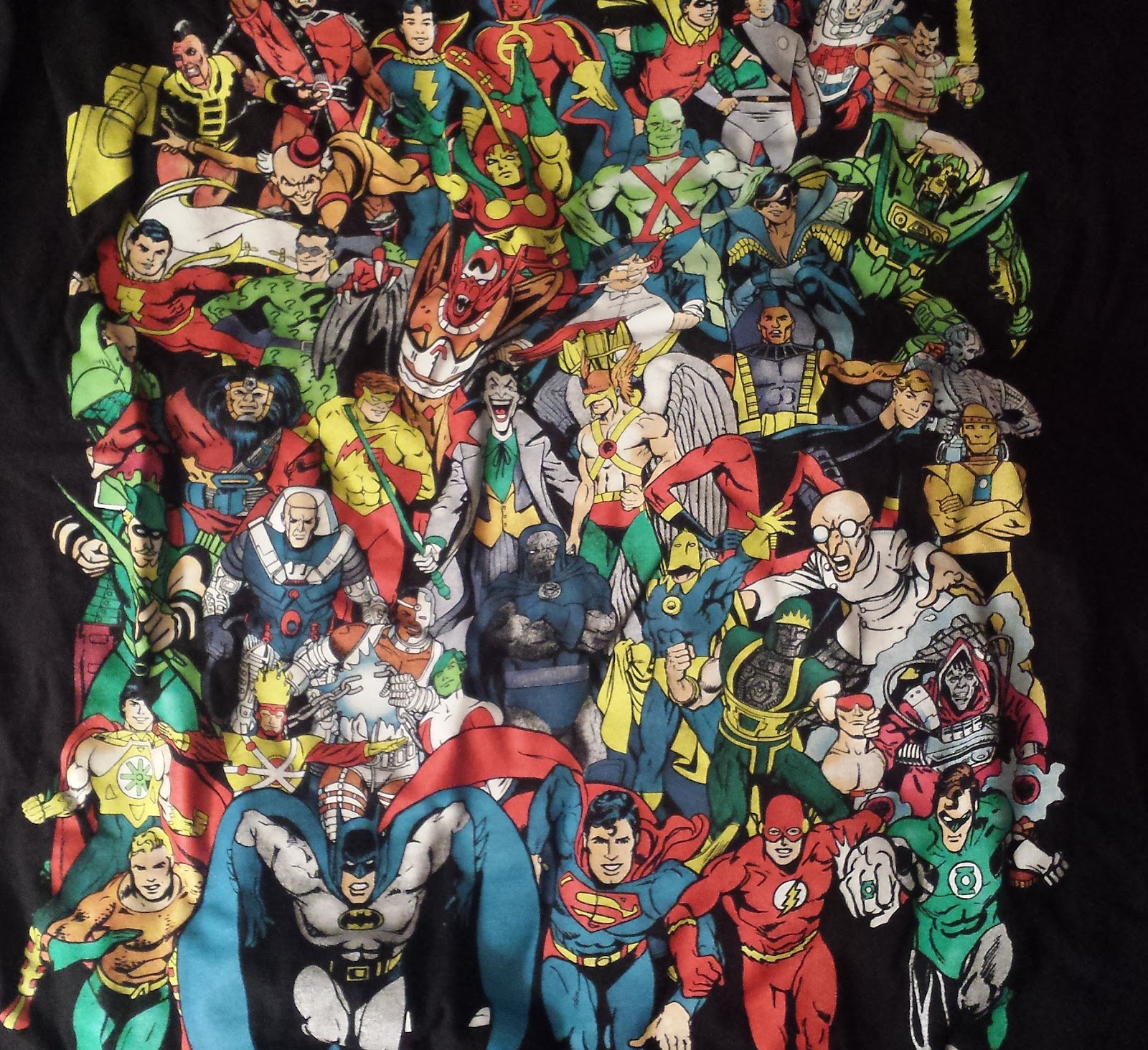
As everybody reading this website surely knows, the Super Powers Collection was an action figure line by Kenner, based on the Justice League of America comics. Super Powers merchandise was everywhere in the 1980s and still shows up today, like on this sick t-shirt I bought at Target:

Target Shirt.jpg
Dope t-shirt I got at Target

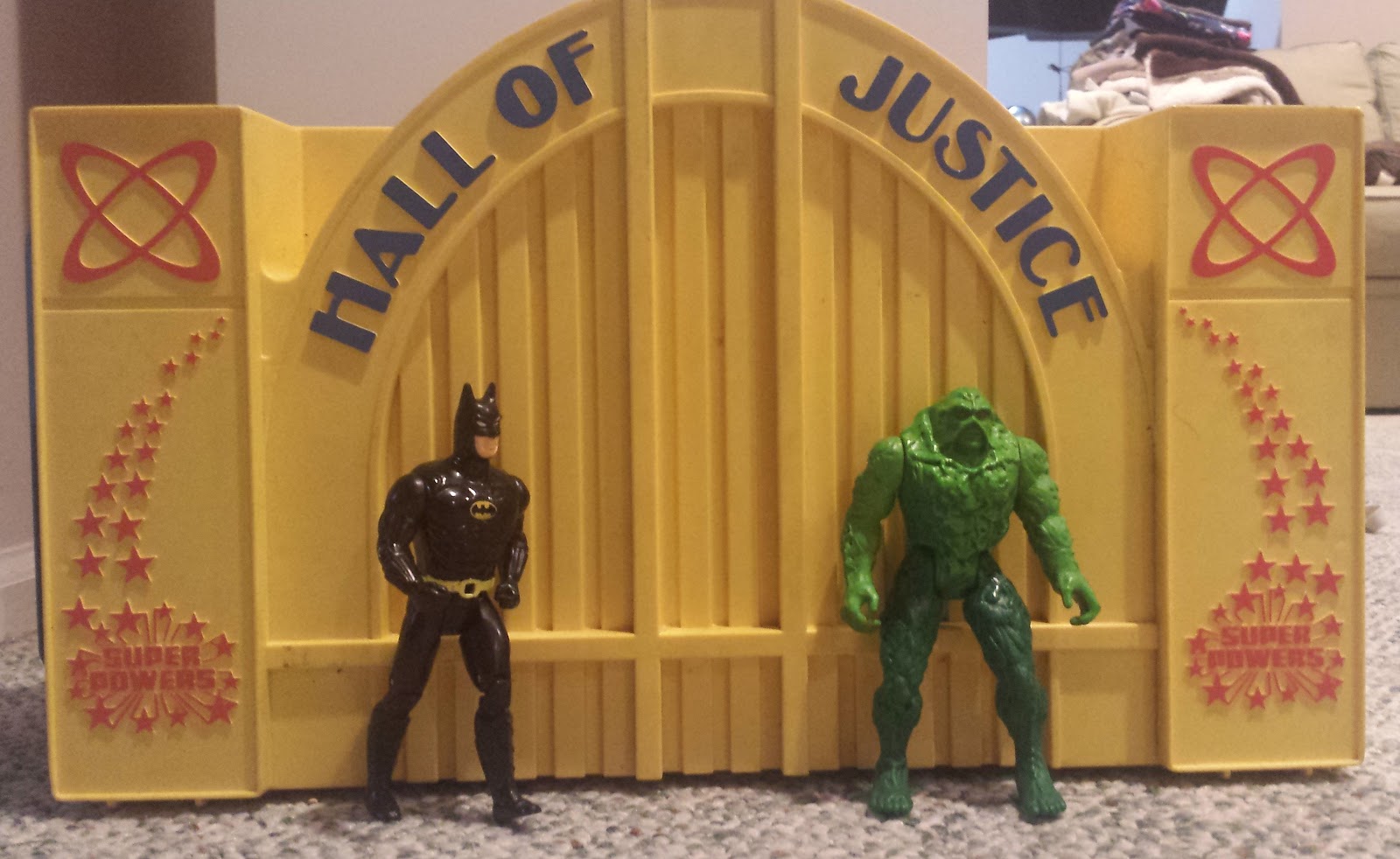
Even though I was a huge fan of the Super Friends TV show as a kid, I somehow missed out on the toys. Here is a picture of the Hall of Justice that I got at a yard sale for my kids, as modeled by Michael Keaton Batman and Swamp Thing:

Hall of Justice.jpg

"So, uh, you ever see Mr. Mom?"

But we don’t care about toys, t-shirts, or lunchboxes, we are here for the comics. And brother, were there ever comics!


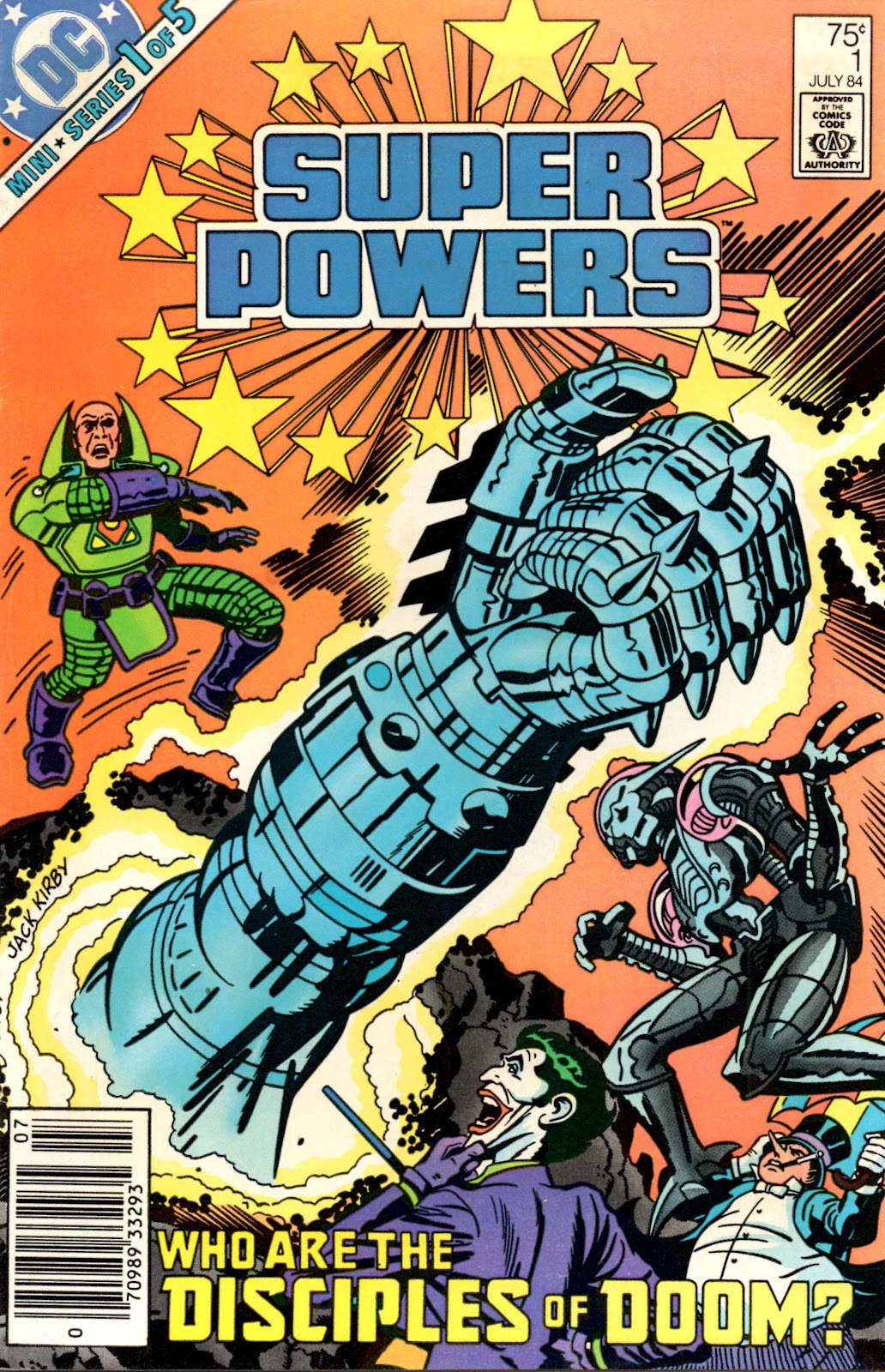
DC put out three series of Super Powers comic books between 1984 and 1986. The first series was plotted by Jack "The King" Kirby and scripted by Joey Caliveri, with Adrian Gonzalez pencils and Pablo Marcos on inks. Kirby also did the covers for this series, and both wrote and drew the concluding issue, #5.

Fist of Doom.jpg
Super Powers - Kirby on covers and plot

For a long time the Super Powers series was ignored by fans -- Kirby was past his prime, it was based on a toy line, it was "out of continuity" (more on this later). I bought nearly the entire run in quarter bins over the years and they never seemed to be in short supply. And, to be fair, the first series isn't really all that great.

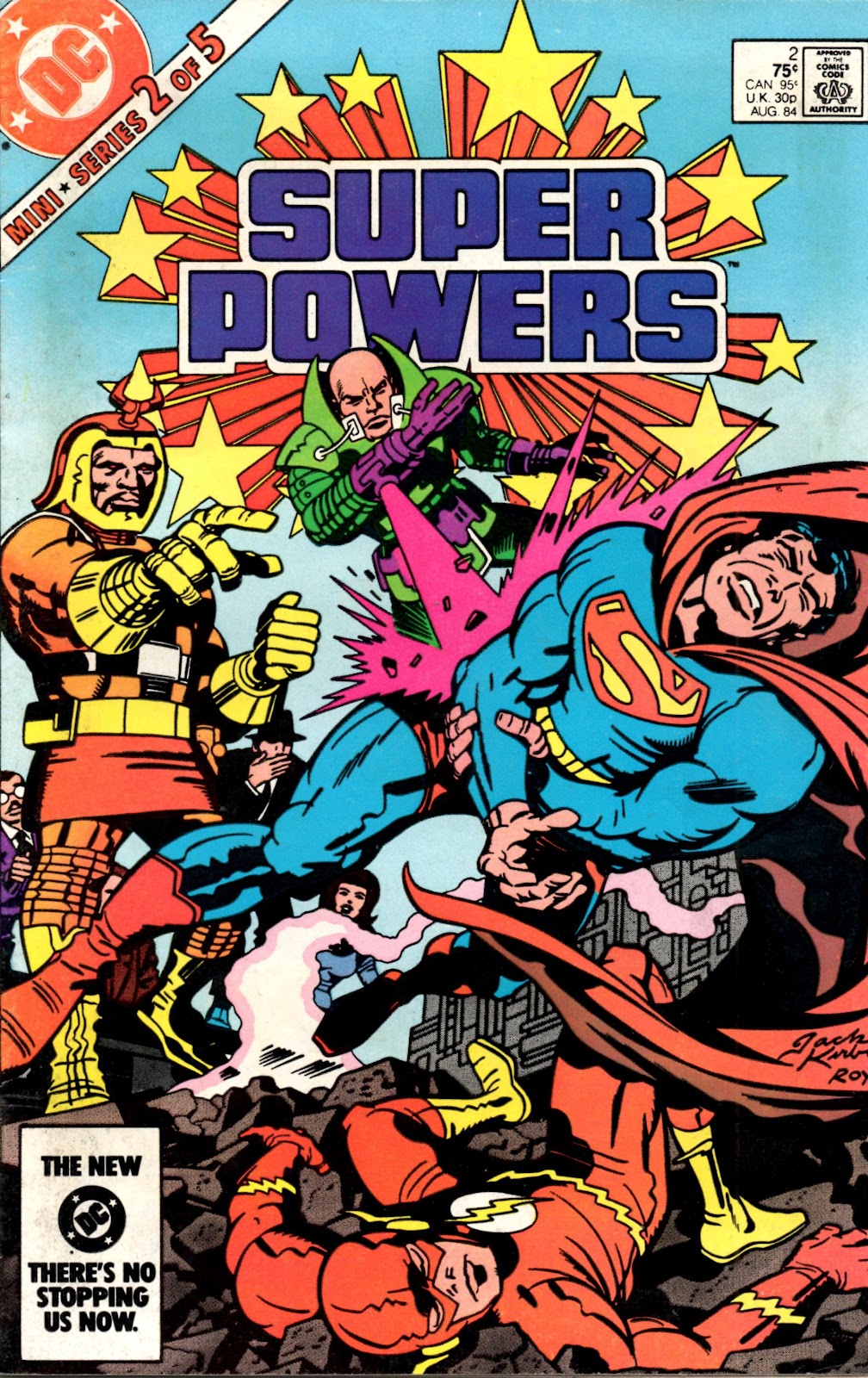
Darkseid grants great cosmic powers to the survivors of the gladiator games of Apokolips. These "Disciples of Doom" are sent to Earth to distract the superheroes while Darkseid’s armies take over the planet. The Disciples grant super powers to the world’s worst super-villains: Lex Luthor gets time distortion, The Penguin gets mind control, Brainiac receives the power to activate "racial memories" (yikes), while the Joker gets his own psychoactive dimension to play with. The newly-empowered villains pick fights with the superheroes (Hawkman, Superman, Green Lantern, The Flash, Aquaman, Wonder Woman, Batman and Robin) and lose badly.


Dead Superman Cover.jpg
Luthor using his brand new powers.


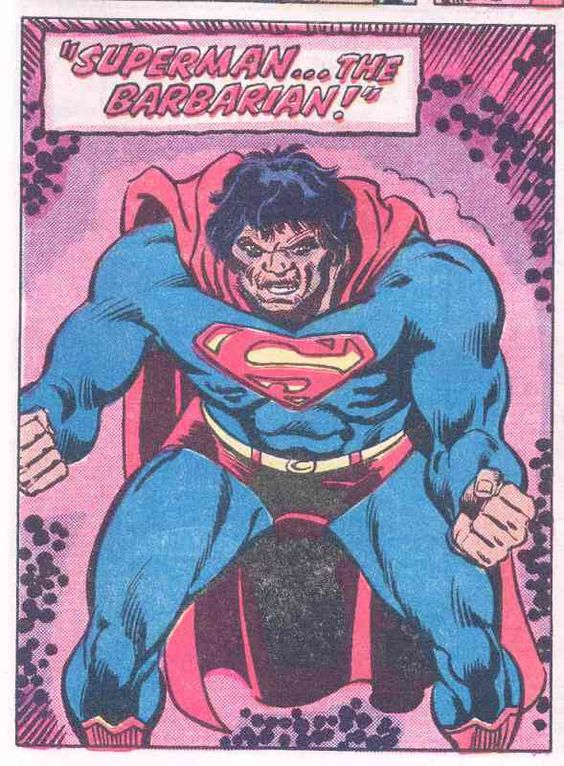
There are some good bits in this series, like Superman the Barbarian...


...and The Joker trapping Batman and Robin in a crazy-town dimension, but there is an awful lot of filler before we get to the main event in issue 5.

The concluding issue of the first series is raw, unfiltered Kirby and it undoubtedly blew some little kids' minds back in the day (Spaceship Earth -- We’re All On It!). Stranded in Apokolips, the Super Powers team touch a mysterious object that transports them to several bizarre worlds. The machine is "The Worlogog, a physical manifestation of time and space itself!". The Worlogog was built and controlled by Metron of the New Gods. Metron bounces the super guys around the dimensions to cover their tracks so Darkseid can't follow. Metron is going to use the Worlogog to boost the superheroes' abilities and wreck up Darkseid’s armies. Darkseid uses Boom Tubes to attack Earth at different points throughout history: Metropolis 80,000 AD, Ancient Asia, Atlantis...all defeated by Metron and the Worlogog. Metron sends the super-guys home in Brainiac’s ship, while Darkseid lives to scheme another day.

While it managed to transcend its origins as a toy tie-in at times, series 1 was just a warm up for Super Powers series 2, where things get really crazy. For the second series, Paul Kupperburg takes over as writer, while Kirby pencils and Greg Theakson inks. If you've ever wondered what a Jack Kirby JLA story would be like, you've come to the right place. This is the good stuff.

The first page has a footnote: "Takes place after The Hunger Dogs OGN". This is all the proof I need that this is 100% in New Gods continuity and therefore an official part of the Fourth World saga. After the events of The Hunger Dogs, Apokolips is no longer under Darkseid's rule and the huddled masses want to track down their former ruler and kill him. Darkseid kills some peasants and monologues that the universe will pay for this travesty. Darkseid meets up with Kalibak, Desaad, and Steppenwolf in an underground bunker. They take one last trip in a broken Boom Tube and leave Apokolips behind for good, setting down on Earth’s moon. Darkseid plans to get his mojo back by conquering Earth.

Meanwhile, at the Hall of Justice, Batman informs the Justice League that five "seeds" from outer space have landed in England, Rome, New York City, Easter Island, and the Arizona desert. These space seeds are burrowing into the planet’s core, which surely can’t be good. The League splits into teams, Gardner Fox style: Green Lantern, Dr. Fate, and Wonder Woman travel to Easter Island; Superman and Firestorm head to Rome; Red Tornado, Hawkman, and Green Arrow go to Times Square; Martian Manhunter and Aquaman travel to England; and Batman, Robin, and The Flash haul ass to the desert.

The heroes learn that the seeds are, in fact, evil, and when you so much as touch them they open up a time portal and whisk everyone back into the past. This leads to great bits like Martian Manhunter and Aquaman fighting the Knights of the Round Table, Wonder Woman and Dr. Fate accidentally creating the Easter Island statues (they’re aliens turned to stone! Oh Kirby), and Superman and Firestorm fighting Roman gladiators.

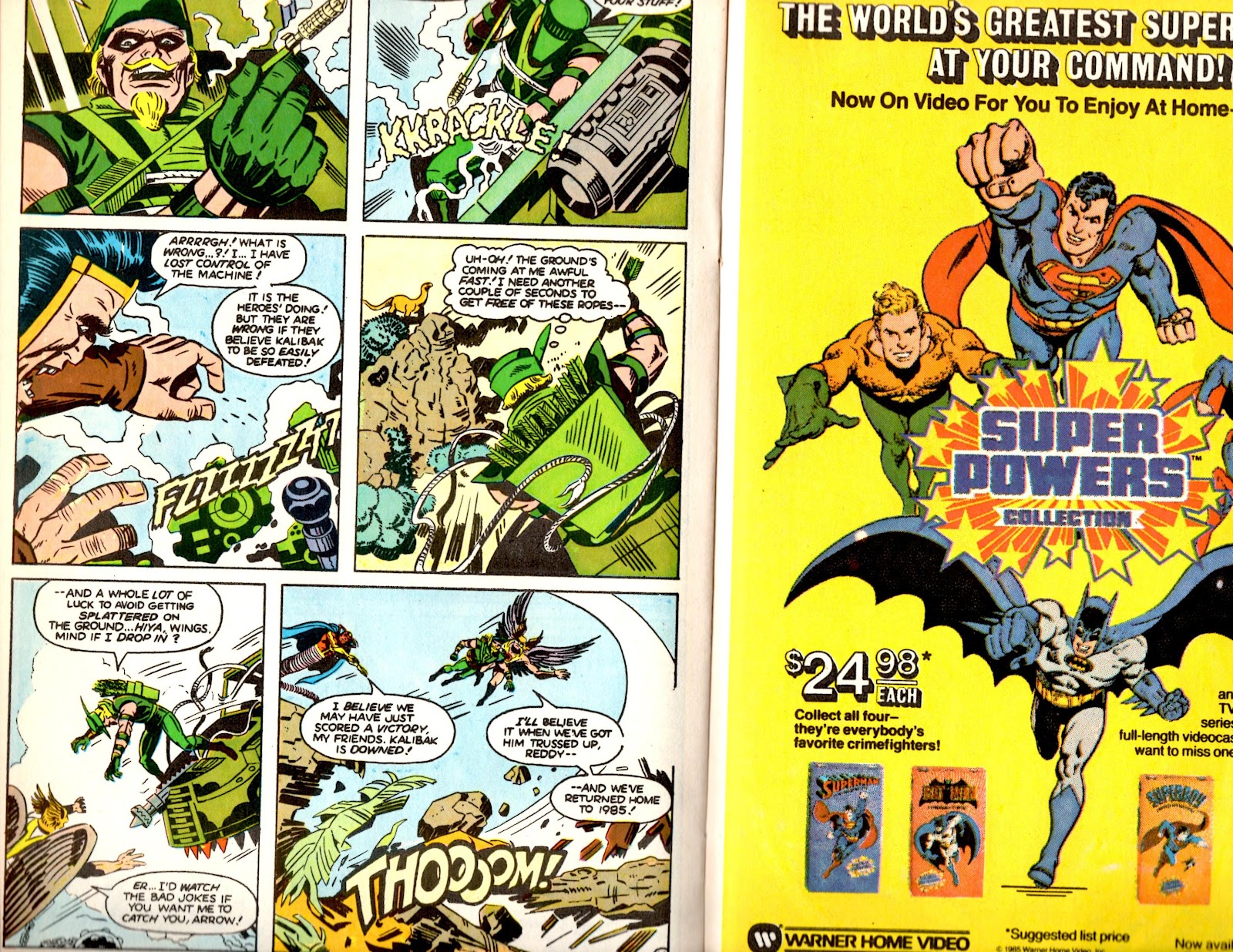
Video ad.jpg
Pretty expensive for a VHS tape!


One terrific bit has Kalibak strapping Green Arrow to the hood of the Boulder Bomber, which -- if you're going to do a toy commercial in your comic -- is absolutely the way to go.

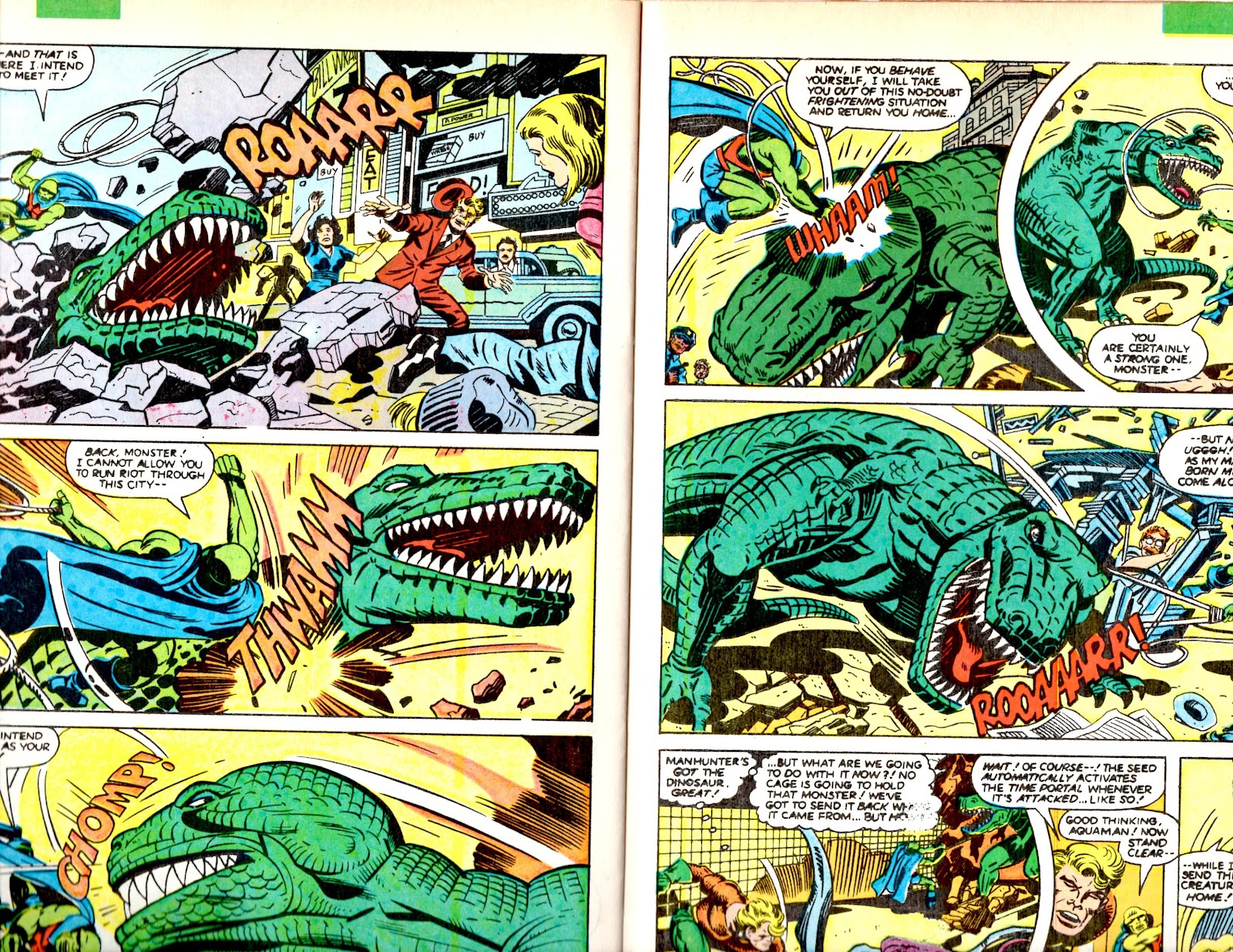
The two best parts in the whole series are undoubtedly the Times Square and Arizona chapters. I have an ironclad rule when it comes to purchasing comics: if there is a dinosaur or a Frankenstein on the cover then I MUST own it. Issue 2 features Martian Manhunter fighting a Tyrannosaurus in the middle of Times Square and it's the Devil Dinosaur sequel we never knew we wanted.

Mnhunter vs Dinosaur.jpg
If the Supergirl season finale doesn’t feature J’onn punching a T-Rex  I am never watching the CW again.


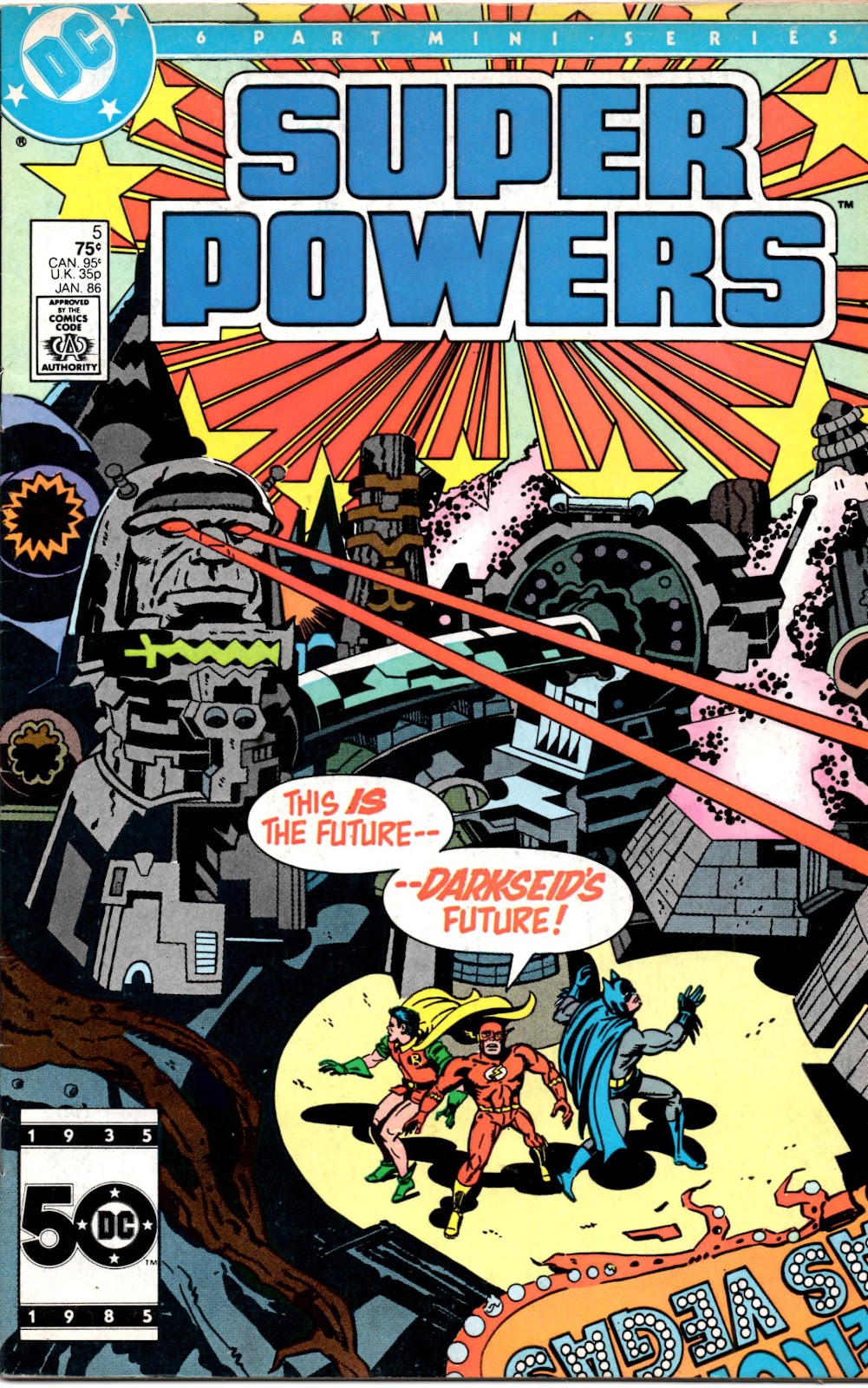
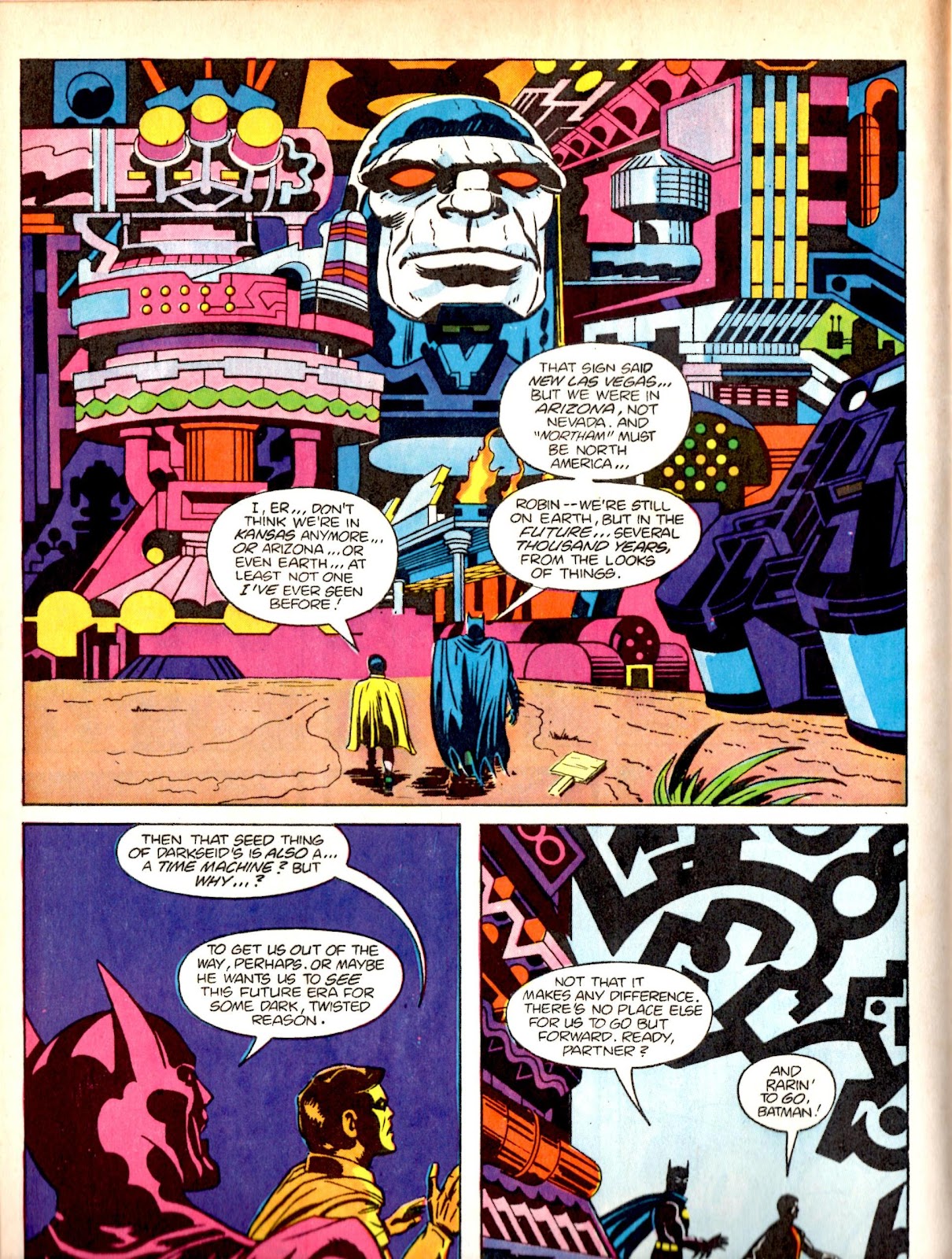
And then there is issue 5. If you ever wondered where Grant Morrison got the inspiration for Rock of Ages, look no further. In this issue, Batman hits the seed with a batarang and hordes of Parademons emerge from a time portal. The portal takes the heroes into a dark future where Darkseid has won and converted Earth into a new Apokolips. "New Las Vegas", in what used to be the Arizona desert, has become a shrine to Darkseid. If you have ever seen images from this series on Tumblr or Twitter or wherever, they are probably from this issue, because it is trippy as hell.


Darkseid Future.jpg
Rock of Ages trial run


Trippy Darkseid.jpg
Black light poster? Yes please.


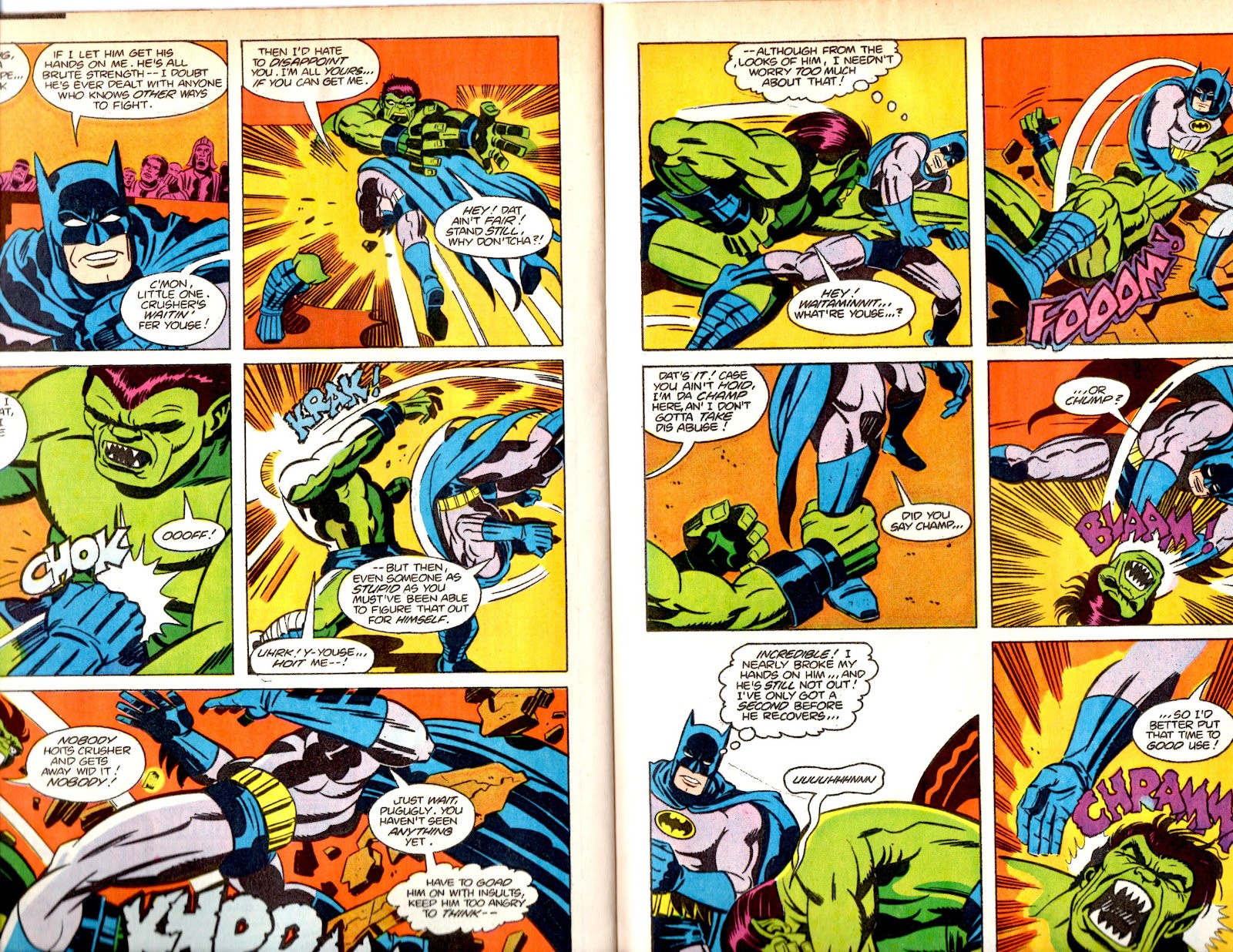
Civilians attack Batman and Robin for wearing forbidden superhero costumes and the Parademons take the heroes to the Arena, where they have to fight The Hulk -- I mean Mongo "Crusher" Monsoon.

Batman v Hulk.jpg

I wonder what would happen if Batman fought the Hulk and Jack Kirby drew it?


After defeating Crusher, the JLAers are about to be killed by Parademons when The Flash intercedes in the nick of time. They escape the arena, steal a time travel device, and get back to the past.

In the finale, issue 6, the superheroes handily defeat the henchmen and Parademons before tracking down Darkseid. A giant hologram Darkseid offers to make the heroes part of his chosen Elite Guard, but of course they refuse. The hologram hand shoots the good guys with an agonizing neural disruptor ray and traps them in a power-disrupting holding cell. Darkseid monologues that he is going to activate the seeds with an Omega Effect Amplifier and add their super powers into the mix. J’onn J’onnz shapeshifts himself into some kind of freaky non-sentient being without a central nervous system, allowing him to escape the pod and the neural disruptor ray. Once out J’onn is able to shift back to his normal form and free the others. Superman and Dr. Fate race to Earth to deflect the Omega beams, blocking them from making contact with the seeds. Desaad betrays Darkseid by sabotaging the machine. Darkseid disappears thanks to his own Omega Effect, while the other Apokoliptikans escape through the star gate. Earth is safe once again!

Proving you can’t keep a great concept down, Super Powers has seen a revival at DC this year. In addition to the Aw Yeah series for kids, Super Powers has come back as a backup strip in Cave Carson Has A Cybernetic Eye, part of the Gerard Way-led Young Animal line. Written and drawn by Tom Scioli, the auteur behind Transformers vs G.I.Joe, Super Powers uses the toyline and Jack Kirby comics as a jumping-off point for an idiosyncratic and offbeat take on the DC Universe.

When taking notes for this write up, I spent three pages trying to summarize the plot, which is pretty impressive considering each installment is only two to three pages long. The series provides new origin stories for The Wonder Twins and Green Arrow, a look at Etrigan's past as an angel before the fall, a glimpse of Flippa Dippa’s future as an underwater archeologist with the Sea Devils, Captain Marvel Jr. crucified on the Rock of Eternity, an army of Superman clones, the arrival of The New Gods, and a Morrison-esque shattering of the fourth wall.

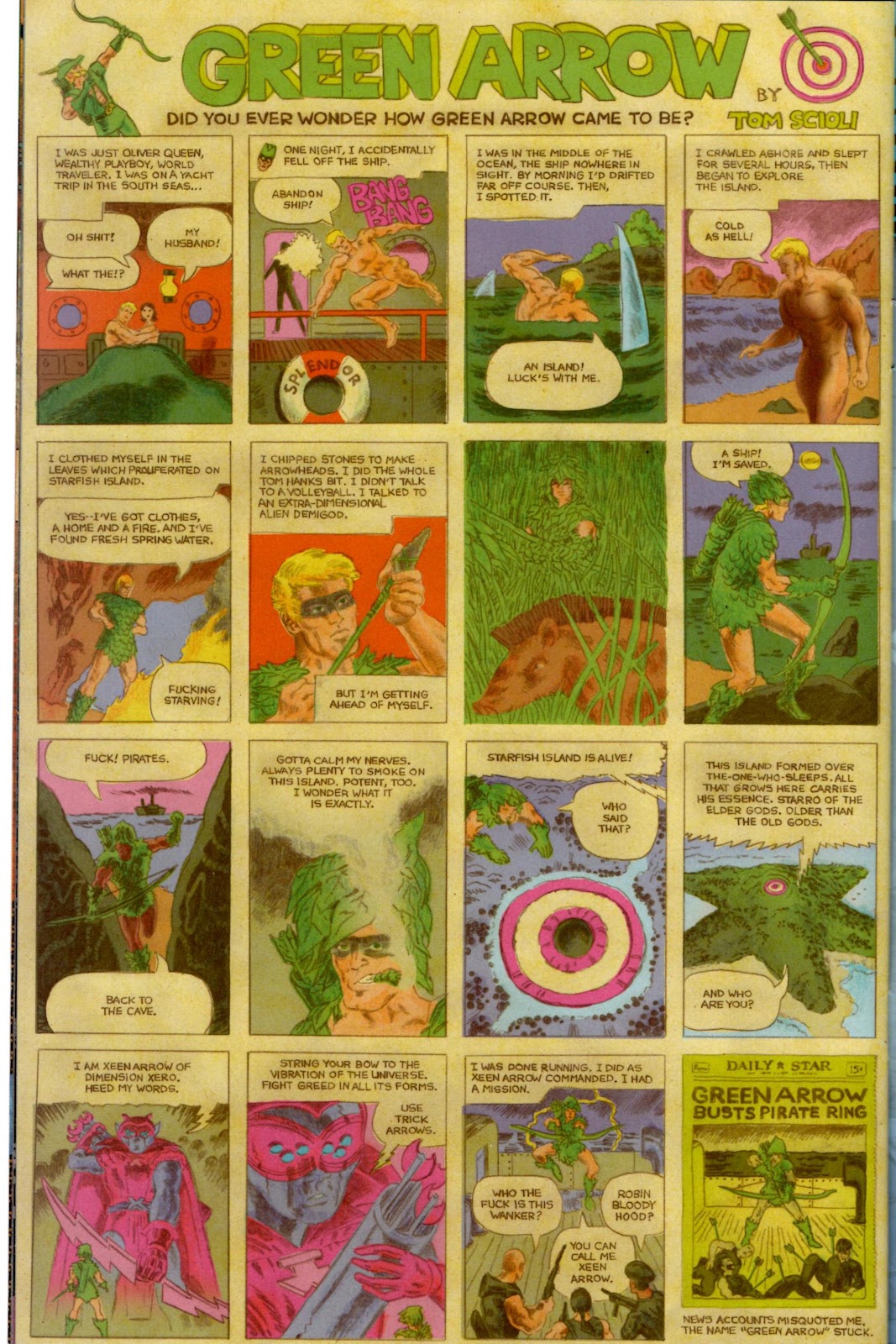
Arrow.jpg
Best Green Arrow origin.

I want to say more about the Scioli series (plot summary, spot-the-reference, theories, you name it), but it's still available and well worth reading on your own. On my blog JLA Classified I have gushed about the Young Animal imprint and called Cave Carson my favorite comic of 2017, and I think you will agree. If you are into 1980s DC and Vertigo comics (and I know you are!) then you owe it to yourself to check it out.

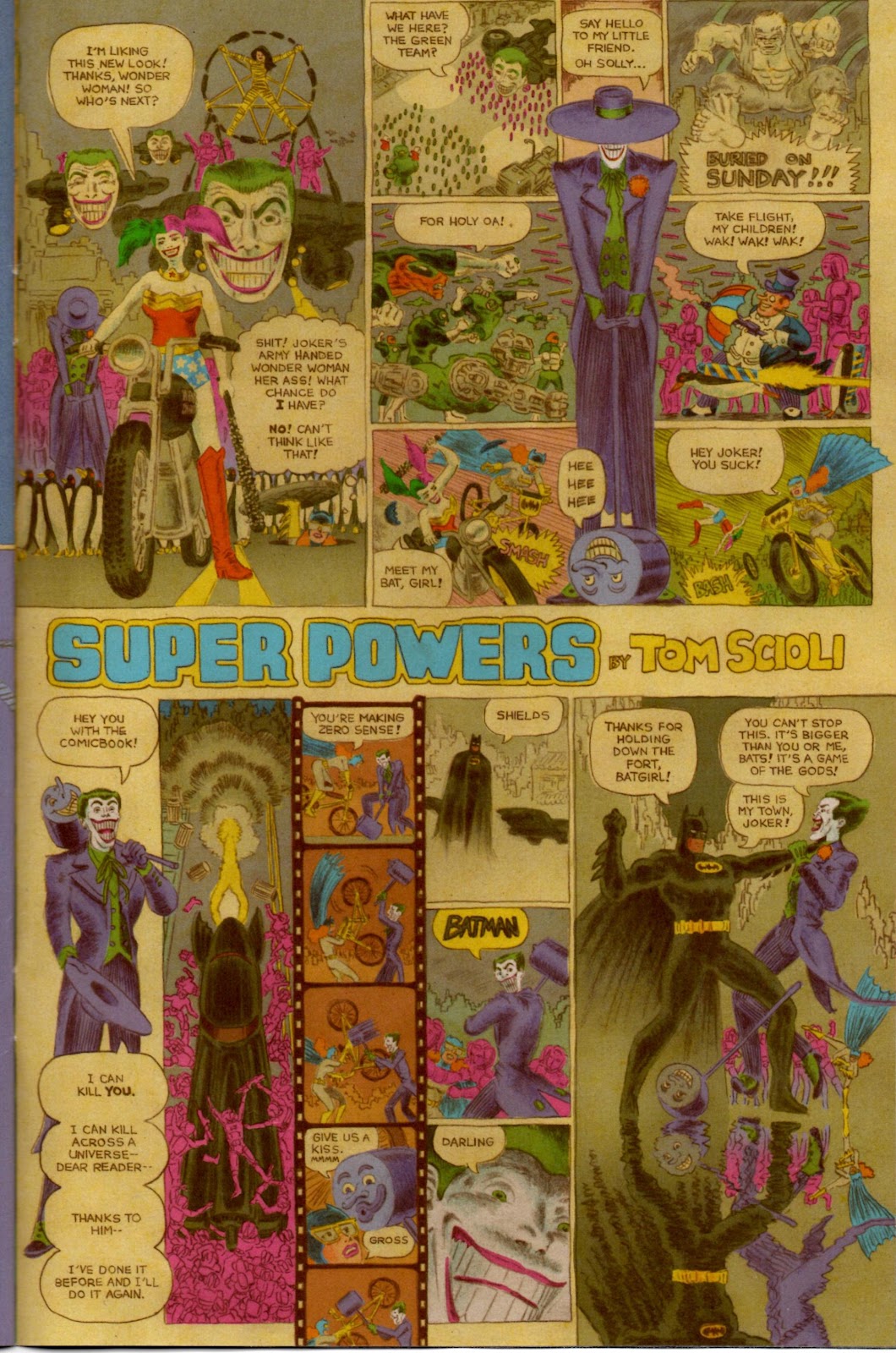
Batgirl.jpg
Batman 89 also Dark Knight and Killing Joke with a bit of Animal Man thrown in.

You can get both Kirby Super Powers series in the Kirby Omnibus cheap on Amazon, and Cave Carson Has A Cybernetic Eye is available wherever fine comic books are sold.

-Erik Tramontana


Erik Tramontana is a teacher, a dad, and a lifelong Batman fan. He blogs about 1990s DC comics at jlaclassified.tumblr.com


Wednesday, August 31, 2016

Examining DC's Young Animal ashcan

I don't think any new material that DC comics has released in the last three years has excited me as much as this Young Animal ashcan I picked up at my local comic book shop last month. This eight-page sampler gives us a glimpse of the new DC 'for mature readers' imprint that Gerard Way will be ringleading.

I'd first like to point out the wrap-around cover of this beaut — which is a fantastic throw-back to the Who's Who wrap-around covers I fondly remember from my eighties comic book collecting childhood:

Wrap-around cover of DC's Young Animal ashcan (2016). Cover by Paul Rentier.

A few of the Who's Who wrap-around covers for quick comparison:

Cover of Who's Who v1 #12 (1986) by Paris Cullins and cover of Who's Who v1 #24 (1987) by Eduardo Barreto


Moving past my love for DC's Who Who series, the cover art has a very nice 'early 90s pre-Vertigo' feel to it. Bonus that it's in black & white. Bonus that there's random fonts in different typefaces floating around — like someone really messed up at the printing press and decided 'nah, let's distribute it anyways'. The bizarre array of characters on the cover remind me of the excitement of reading early Vertigo comics. "New characters! Who are they? How do they relate to current or legacy DC characters? Tell me more!", or even the feeling of counter-culture rebelliousness I felt I projected as I thumbed through my copy of Dark Horse's Tank Girl.

I'm feeling that the Robotman illustration is an exact swipe of a previous Who's Who entry...

Hey, I was right! Doom Patrol illustrated by John Byrne

Moving beyond the cover, which seems to speak more than a thousand words, the interior cover page treats us to a message from Gerard Way with an accompanying photo, followed by a few full-page Who's Who entries and a few pages from the flagship titles that will be launching this imprint. The whole package concludes with a page of head shots of the creative teams working on this imprint, and an interior back page cover with teasers of what the covers of the 1st issues will look like.

Let's start with Gerard Way. I've never read the Umbrella Academy (apparently it won an Eisner Award), nor did I listen to My Chemical Romance very much ["It's not okay (I Promise)" received a lot of airplay on our local rock station back in 2004] and I don't know anything about his personal likes or dislikes in comic books. His 'Letter from Gerard' mentions that 'the past is just as important to Young Animal as the future' (in a comic book context), so this gives me high hopes. He also throws around the word 'collaborative' a bunch of times — I'm interpreting this as him telling us he's not going to go all "1980's Jim Shooter" on us.  [Not that that was necessarily a bad thing.]


Shade, the Changing Man #51 (1994). cover by Sean Phillips


The Who's Who entries introduce us to a few new characters (and re-introduces us to one revamped oldie). 'Shade, The Changing Girl' is making me want to dig out my Peter Milligan Shade, the Changing Man Vertigo issues from 1990. 'Space Case', a new Doom Patrol member, looks suspiciously like she was illustrated by Mike Allred. 'Mother Panic' is an interesting character, if only for the Bat insignia floating in the background of her bio pic and the implication that she's a bisexual. Cave Carson seems to be the legacy hero they plucked out of obscurity to be revamped for a new audience (while still respecting his roots) via a new cybernetic eye. So far, all four of these titles have my interest — with Shade, The Changing Girl and the Doom Patrol leading the pack.

Brave and the Bold #41 (1962). A Cave Carson adventure.

There are a few black and white preview pages from each of the four new books, but there's no dialogue — so that doesn't really tell me much. The art is clean and uncluttered, except for the Mother Panic excerpt, which appears to be a 2 page ink-wash drawing. This all looks very good so far.

I'm reviewing the last page's Young Animal Creative Team roster, and there's not one name I recognize. Oh wait,... there's Todd Klein, He's lettering Doom Patrol.

This ashcan makes a strong first impression. If this webzine were ever to be published as a print 'zine, this is how I'd want it to look. Publishing a new imprint with a cast of relative unknowns could be viewed as a risky proposition, but IF they can tap into the creative energy that fueled the late 80s/early 90s pre-Vertigo rush that led to the publication of so many great comics that we STILL talk about today, then we may have a winner here.

This is definitely an imprint I recommend keeping a (non-cyberentic) eye on.

-Justin