Interviews Reviews Guest Stars Fanzine Misc
Showing posts with label Jason Todd. Show all posts

Wednesday, July 12, 2017

Reviewing 1983's Batman #366 — the first pre-Crisis appearance of Jason Todd as Robin

Batman #366 was written by Doug Moench, and edited by Nicola Cuti and the legendary Len Wein. Don Newton, Adrienne Roy, and Alfredo Alcala rounded out the art team with John Costanza handling the lettering duties.

The year 1983 brought about young Jason Todd’s debut as Robin. In fact, it was Batman #366 that featured the first appearance of Jason Todd in the Robin suit. Let’s see how Jason does his first time out in the field.

cover of Batman #366 (1983). Property of DC comics.
cover art by Walt Simonson and Anthony Tollin


We open the issue with the ominous title of “The Joker Is Wild!” and right away I’m getting a vibe of things to come in the following years ahead. Jason’s at home alone at Wayne Manor and boredom’s starting to set in so he begins to explore his surroundings. Now I’ve seen two different copies of this issue over the years and for the life of me I’d bet that Jason’s hair color is blonde. There are other versions that feature him with red hair in some panels. Either way, there appears to have been a lack of consistency. (Then again, maybe I just got a bad copy.)

panel from Batman #366 (1983). Property of DC comics.
Don Newton and Alfredo Alcala art


Anyway, we cut to Central America where we see the Joker fuming over his recent altercation with Batman. It quickly comes to light that the Joker is planning an assassination of a General named Diaz. We then cut to Batman with Vicki Vale in tow in the middle of the jungle. They’re picked up by some locals who question the Dark Knight in regards to his identity. There’s much going on in this issue but to make things a little more concise, we learn that Batman’s in pursuit of the Joker to foil his assassination attempt of General Diaz. Alfred Pennyworth has a fateful meeting with his daughter Julia, and Commissioner Gordon’s been in a coma where he’s visited by his daughter, Barbara.

Batman is able to thwart the attempt on General Diaz’s life and pursues the Joker to a site of ancient ruins. Joker’s about to cut down the Batman with some machine gunfire. At this moment Jason Todd (as Robin) swoops in and kicks the Joker, causing the clown to drop his weapon. The Joker is incensed and screams in anger that he’ll kill Robin. I found this scene to foreshadow events that would occur quite a bit some years later. Robin fields the Joker to Batman who quickly incapacitates the criminal. The issue ends with Batman giving the new Robin a verbal chastising.


panel from Batman #366 (1983). Property of DC comics.


I wasn’t too keen on the dialogue in this issue, and the execution of Jason Todd’s debut as Robin was handled poorly at best. From the get-go, we find out that Jason dyed his hair black to look like his predecessor, Dick Grayson. Already, it feels like Jason’s being set up to fail in the long term. In fact, you could’ve just cued up the Joker right then and there and given him a crowbar to put Jason out of the reader’s misery. 


panel from Batman #366 (1983). Property of DC comics.

There wasn’t really a shred of originality to the Jason Todd character when he was initially presented. This issue pretty much sank any chances of the Jason Todd character getting over with the audience in a long-term setting. Even though Jason arguably saved Batman’s life, Jason’s efforts were immediately dismissed by his mentor. In a sense, Jason’s career as Robin was over before it could really begin, and the frustration and aggravation that he would be known for would come into play sooner rather than later. The decade of the 1980’s served as a time when more rebellious characters would come to light in comics. Jason Todd could be looked at as a forebearer in this regard, however he’d later but snuffed out for a time afterwards. This issue is important for its historical significance alone in the Robin franchise. It serves as a precursor of the events to follow in the Batman mythos.

-Deron Murphree

Deron Murphree is a sucker for the more forgotten heroes and villains of DC Comics. He is an advocate for Jason Todd and Earth's True Green Lantern, Guy Gardner. Deron's new website is currently still under construction but you can follow him on Twitter @DeronMurphree or you can message him care of this website.

Tuesday, October 11, 2016

On our radar: Dark Knight III: The Master Race


Telling you that Frank Miller's The Dark Knight Returns had a profound impact on me would be lying since I was around 5 years old when this four-issue prestige series was originally published. By the time I was really *into* Batman, I had already seen the 1989 Tim Burton Batman film and the 'grim & gritty' tone of Batman had already been a fixture in the comics for a while. What really makes me re-visit and re-read The Dark Knight Returns every so often is the dystopian alternate future-reality Miller had dreamed up. TDKR introduced us to an older and more brutal Batman (who now uses guns and has no issue beating up cops), who lives in a North America that seems to be perpetually on the brink of a nuclear war with the Soviet Union (Reagan is still president, evidently) and the Justice League of America is nowhere to be found. Of course we get some brilliantly written/illustrated stories about Batman facing future versions of Two-Face and the Joker, training a new Robin sidekick and confronting government-lackey Superman - but it's the process of looking for clues to piece together how things had gotten so bad in the first place that had me hooked. In essence, Miller gave us our first Elseworlds book.

The Dark Knight Returns. Book 3.

TDKR was published several months before Alan Moore and Dave Gibbon's Watchmen - which more or less also explored the same themes (ex: a world that doesn't trust super-heroes and is perpetually on the brink of a nuclear war) - and both pieces of work seemed to help set the tone for the trend in 'darker' super-heroes that would permeate the early modern age of comic books.

The Dark Knight Returns. Book 2.
This was all well and good as far as a 'one and done' alternate future-reality Batman story went; it left us wondering whatever happened to the aforementioned missing heroes, but concluded with the possibility that there was hope for the future. This would have to satiate Dark Knight fans for 15 years until the sequel, The Dark Knight Strikes Again, was published in 2001.


The Dark Knight Strikes Again was noticeably different from The Dark Knight Returns as it tended to give more attention to the *other* characters of the DCU (e.g., Superman, Wonder Woman, The Atom, The Flash, etc) rather than Batman himself. It was for this reason - and some of you are probably going to judge me here - that I enjoyed 2001's The Dark Knight Strikes Again (also by Frank Miller) maybe even more so than The Dark Knight Returns.

A writer working in an 'alternate universe' sandbox gives them carte blanche to destroy, mangle, and/or distort long-loved characters as they see fit, and nobody can really get upset about it because it's just an alternate universe (and not really canon with the DCU). Hence, with a morbid curiosity, I enjoy reading about the fates of some of my favorite DCU characters. Admittedly, Miller has an interesting take on specific characters [see: Superman] that may offend longtime fans of said character, but that's a lot of the entertainment value right there. I've always admired that Miller has no qualms with pissing fans off.

Apparently, the Creeper didn't live to see TDKSA book 3.

Dark Knight III: The Master Race is set three years after The Dark Knight Strikes Again, and six years after the events of The Dark Knight Returns. This is ordinarily something I'd wait to be released as a collected version before purchasing, but my sheer anticipation for this third installment in the Dark Knight franchise couldn't be extinguished. So far, I'm about halfway into this nine-issue series and I'm already seeing a lot of attention given to the 'next generation' of super-heroes (i.e., Batman and Superman's successors) as well as some equal attention to former Justice League members (in the form of back-up features). I'm a little excited to see which former JLers meet gruesome deaths (or get horribly mangled) and which ones live long enough to see the end of the nine issue run. The art is visually appealing and the story REALLY starts to pick up by issue two, so these are all pluses as far as I'm concerned.


There are a few other reasons DK III is something I'm following with great interest:

  • Frank Miller is co-writing this (along with Brian Azzarello). Miller's reputation precedes him, and if you're one of the few people out there who aren't familiar with his work, I'm just going to mention Sin City, 300 and Robocop vs Terminator and hope you know what I'm talking about. It's not often that a story line that was begun thirty years ago is still being written by the same writer. As of this writing, I'm a little vague but it would seem that Azzarello is the primary writer on this and Miller is consulting, but Miller has asserted that he does have a lot of input into the characters. I'm kind of curious just how close it stayed to Miller's original 'vision' for Batman and if his evolution as a writer is obvious in his new work.
  • Frank Miller is also illustrating (along with Andy Kubert) and Klaus Janson is inking. This may be a moot point since I can't actually determine where Miller's art begins or Kubert's art ends, but it all looks great. There's also no denying the Janson's inks always brings out the best in everyone's work. Many of these pages are 'rip out pin-up' worthy [see image above].
  • It has been revealed that Miller's All-Star Batman and Robin, The Boy Wonder (2005) is considered as a prequel to The Dark Knight Returns. Remember All-Star Batman and Robin, The Boy Wonder? The series where Batman actually comes out and says "I'm the G*ddamn Batman"? When I bought the collected version of this series about a decade ago, I just thought it was another one-shot series, but now it actually has some sort of context in the grand scheme of things (as far as the Miller Dark Knight Universe is concerned). I'm suddenly re-reading it in a whole new light and hope that we get an issue #11 someday...

  • ...until then, there's 2016's Dark Knight Returns: The Last Crusade #1 (also written by Frank Miller and Brian Azzarello), which gives us the Jason Todd Robin story the character has always deserved, and serves as a prequel to 1986's The Dark Knight Returns.

Unless DC comics decides otherwise, Miller has stated that he'll be writing a fourth chapter to the Dark Knight Universe sometime in the near future. In a recent interview with Entertainment Weekly, Miller revealed that he had future plans for Carrie Kelly (Robin from The Dark Knight Returns) but is still hashing out the details with DC. Based on all of these recent announcements, it looks like there's going to be a lot of new Dark Knight Universe material slated for release in the near future.

-Justin

Friday, July 29, 2016

Know Your Suicide Squad: Killer Croc

The new Suicide Squad film is fast approaching and, well, I'm not even up-to-speed on the histories of all of the characters on the roster. This article is just as much for myself as it is for you, so hopefully you'll enjoy...

Know your Suicide Squad: Killer Croc


[Killer Croc has been heavily active in DCU Continuity for the past two decades, but for the sake of keeping 'on theme' with this webzine, we're only going to focus on his 80s appearances all the way up to the very early 90s. - editor]

Created by Gerry Conway and Gene Colan, Killer Croc first appears in Detective Comics #523 (1983). He's a slim gangster in a trench coat and fedora who goes by the name of 'Croc' and spends most of his time skulking in the background. I'm going to set the scene here: it's the early 80s and Gotham City gangsters Rupert Thorne and Tony Defalco have been dethroned, so there's a bit of a power-vacuum within the Gotham Underworld. Dick Grayson is still Robin, but he's an active member of the Teen Titans, and his relationship with Bruce Wayne is starting to show some strain. Bruce seems to be getting a bit more tense and is currently juggling two women in his life: Selina Kyle and Vicki Vale. On the editorial side, Len Wein had recently started editing both Batman and Detective Comics and intended on merging the continuities of all Batman titles (i.e. Batman, Detective Comics, Brave and the Bold, and World's Finest) to keep everything feeling like it's occurring in the same universe.


In his third appearance (Detective Comics #524), Croc's fedora gets knocked off in an altercation and we get the first full-view of his scaly face:

Despite the scales, he is still rather 'human-looking'

Croc was first presented as a 'smooth operator' making moves to take control of Gotham City's underworld, and his first major murder within Gotham City was performed using a long-range sniper rifle. Croc's debut appearance had him involved in a six-issue story arc running between Batman #357 - 359 (1983) and Detective Comics #524 - 526 (1983). [It wasn't unusual for Batman stories to continue from one title to the next.] It's kind of interesting to note the progression of Croc going from a tactical criminal mastermind to a berzerker hand-to-hand combatant within these six issues. At his worst, he's an experienced alligator wrestler who is really trying hard to break Batman's back - he's not trying to eat people, yet. At least one reader picked up on this rapid evolution of the character and wrote in to comment on it. Wein replied with "We got the impression that Croc's dual nature was somehow tied in to his reptilian appearance. Half of the time he was clever, manipulative, a real snake. But still being half human, he was given to all-too-human fits of rage. Made sense to us!" [It should probably also be noted that Killer Croc only goes berserk after Batman infiltrates his 'home'. More on this later. -J]


Killer Croc's pre-Crisis origin is summarized in Batman #359 (1983): he was born with a hideous skin disease in a lower-income area of town and had a dead-beat aunt as his only care-taker. Croc spent most of his youth in and out of prison, and kills another inmate when he's a young adult. After spending an additional 18 years behind bars he gets paroled and joins the carnival as an alligator wrestler. Some time after joining the carnival, he decides to leaves and start getting his revenge on those who did him wrong in the past - ultimately deciding to take over the Gotham Underworld. In so many panels, Conway depicts Killer Croc as a "victim" of the system - perhaps even a villain to sympathize with. Any sympathy the reader may acquire for Croc pretty much goes out the window after the events of the next few issues.

Detective Comics #526 (1983) was Gerry Conway's last issue in this Batman saga before he went over to start working on The Fury of the Firestorm. Doug Moench would replace Conway as regular writer for Batman and Detective Comics. Conway's run ended with Killer Croc meeting with the rest of the Batman Rogues, and the addition of a new Batman Family character.

The reason why Killer Croc's first recognized appearance (Batman #357, 1983) will cost you a little more on the back issue market is because Batman #357 is also the first appearance of the pre-Crisis Jason Todd. No, not that fiesty dark-haired scamp who stole our hearts (and the Batmobile's tires) during Max Allan Collins' Batman run, we're talking about this guy:


You see, in pre-Crisis history, Killer Croc was instrumental in Jason Todd becoming Batman's new Robin because Killer Croc kills Todd's parents. Prior to Crisis on Infinite Earths, this was Killer Croc's greatest claim to fame. This was taken away from Croc after the Jason Todd origin was rebooted. Todd's father was still killed by a Bat-Villain, but this time it was Two-Face instead of Killer Croc (Batman #410, 1987). Why was Croc bumped for Harvey Dent? Batman: The New Adventures starts at Batman #408 (1987) immediately following Batman: Year One. Is it possible that DC editorial wanted to re-introduce Harvey Dent/Two-Face as quickly as possible in the "new Batman reboot" in order to establish him as an important fixture in Bat-lore? Writer Max Allan Collins reached out to us and told us that he was instructed to "make Jason Todd wholly independent from the previous version". The Two-Face arc, which Collins' mentioned that he would've resolved very differently, was his own idea. DC editorial pretty much gave Collins a carte-blanche to re-imagine Jason Todd's origin any way he saw fit, so there was no intentional effort on DC's behalf to omit Croc from Jason Todd's history.

If you get the sense that I'm focusing a little too intently on Killer Croc's first six-issue story arc from 1983, well... that's because I am. Croc didn't do very much for the rest of the 80s.

Killer Croc's next appearance was in 1986's Batman #400. This anniversary issue was a superb self-contained story that featured all the major Bat-Villains and boasted an all-star cast of artistic talent. A few sentences cannot adequately explain what a visual treat this issue is, so we'll need to save that for another day. Instead, we'll just mention that all of the Bat-Villains are freed from their various methods of incarceration and Killer Croc gets another shot at Batman. Killer Croc is still a vengeance-fueled monster, albeit a human-sized one. Truthfully, he looks like a professional body builder with a horrible skin condition. At some point, Croc has the audacity to break into Wayne Manor and attack Alfred. (If you're seeing a lot of parallels with 1993's Knightfall, please note that Doug Moench wrote both this issue and was also part of the Knightfall writing team.) For anyone keeping track, this issue occurs after Crisis on Infinite Earths, but before the 1986 Batman reboot. The pre-Crisis Jason Todd (who now suspiciously looks like a dead-wringer for the Dick Grayson Robin [ex: black hair, wears a traditional Robin costume]) appears in this issue and Batman goes to great efforts to keep him away from Croc. The reader is briefly reminded that Croc killed Jason's parents and, in a struggle, Batman ends up defeating Croc with a gas pellet from his utility belt. [While doing research for this article, I discovered that Detective Comic #566 and Batman #400 are inter-connected. How cool is that? -J]

Croc's first post-Batman reboot appearance would be brief [an entire 3 pages] in Swamp Thing v2 #66 (1987) written by Rick Veitch. By this point, he's more or less regressed to a reptile state and has trouble stringing together sentences with proper nouns and verbs. Still human-sized, but unbelievably ferocious, Batman ends up subduing him with nerve gas. It's alluded that Croc is now crippled due to Batman's actions. Croc and Batman's very brief and abrupt appearance (they literally come in crashing through a window) served as an 'action break' in an otherwise very dialogue-heavy story about Swamp Thing and Abby working out relationship issues.


Secret Origins #23 (1988), also written by Veitch, is a recap on the origin of Dr. Jason Woodrue - aka the Floronic Man - told from the point of view of a wheelchair-bound Killer Croc. The Floronic Man, who in the past few years has had strong ties to Swamp Thing thanks to Alan Moore, was slated for bigger things in 1988 thanks to the Millennium cross-over event and his inclusion in 1988's The New Guardians series - so clearly, a recap was in order to re-familiarize readers with the character. Throughout Killer Croc's narrative, we realize he's a lot more intelligent/cognitive than he appears and by then end of the story it is revealed that he has recovered from his nerve gas induced paralysis (it's hinted that's it's due to his 'reptilian' abilities). I'd like to think that this was Veitch's way of tying up any loose ends for both Croc and Woodrue before letting go of the characters for new creative teams to use.


Killer Croc's next appearance would be in 1991's Batman #471 written by Alan Grant and edited by Dennis O'Neil. Grant decided to portray Croc in a sympathetic light for this issue - we get a Croc who just wants to belong and feel like he has a home, so he takes up in the sewers of Gotham City with a group of homeless people. We get a quick recap of his back-story in this issue: this includes a lot of electroshock therapy, a serious hate for Batman, and a brief mention that he never knew his parents and was raised by a neglectful aunt - of course there's no mention of Croc killing Todd's parents, because that's been retconned. Grant very craftily kept most of Croc's pre-Crisis origin intact while giving us a bit of rationale explaining why Croc acted the way he did. This was one of Grant's signature story-telling devices - to provide a 'human element' to a story or character.  The issue ends with Croc seemingly 'sacrificing' himself to save his adopted family from an environmental disaster and Batman looking like a heartless chump who just won't leave Croc alone. Croc's search for 'a home' retroactively syncs with his debut where he goes into hysterics at Batman for breaking into his private residence [way back in the Croc's first 1983 story arc].


While Killer Croc no longer being associated with the origin of the new Robin may have diminished his importance as a Bat-Villain, it made him easier to sympathize with - especially since he'd been so sparsely used in the DCU throughout the mid-to-late 80s and early 90s. To a new era of readers brought in by 1989's Batmania, he was still a relatively new character that only Batman fans who had been following the series for the last decade may remember. That was all about to change in 1992.


Batman: The Animated Series, episode 23 (1992) "Vendetta"

Batman: The Animated Series, with it's neo-noir atmosphere and intelligent storytelling, really opened up the Batman universe to a new fan-base of television watchers in 1992. Despite being a long-time Batman fan with a functional knowledge of Batman's rogues gallery (mainly via Super Friends and The Adventures of Batman cartoons), this was my first exposure to Killer Croc. In the animated universe, Killer Croc goes by the name of 'Morgan' (not 'Waylon Jones') and seems to have some sort of history with Detective Harvey Bullock. His origin is also slightly altered as he's apparently had a career as a professional wrestler prior to becoming a criminal. I'm not going to dwell too much on his Batman: TAS appearances, but the show was a fantastic vehicle for introducing previously forgotten Bat-Villains and making them relevant again.

The last big Killer Croc appearance we'll cover is this installment will be his inclusion in the Knightfall event. Quite possibly thanks to his Batman: TAS appearance, Croc had more than a bit part in this 1993 event — first appearing in a few Knightfall 'prologue' issues (Batman #489 & #491) and then in an entire chapter (Detective Comics #660). Knightfall was THE Batman comic book event of the early 90s and spiked a renewed interest in Batman-related characters among comic book collectors everywhere [not just the readers/collectors, but the speculators, too].

Detective Comics #660 (1993). cover by Sam Keith

Readers hailed #660 as one of the best appearances of Killer Croc in nearly a decade, demonstrating just how dangerous of a Bat-Villain he had the potential to be. Coincidentally, Detective Comics #660 was Croc's most reptilian appearance in this list of appearances. It would seem that as time goes by his appearance progressively becomes more and more crocodile-like (this is evidenced by his new 52 appearances with his elongated crocodile-like snout and gigantic hulking frame).

Killer Croc in Detective Comics #660 (1993)

With the exception of Bane and Clayface (and maybe even Man-Bat), Killer Croc holds the distinction of being one of the few Bat-Villains who can physically overpower Batman in physical combat. I've always found Batman's villains to be more interesting than Batman himself. While not my favorite Bat-Villain (that honor would go to the Penguin), Killer Croc always stood out as being a green scaly monster among a group of relatively normal-looking people in costumes. So, suffice to say, his later evolution doesn't feel like a 'realistic threat' but more of a 'fantastic creation' that brought a horror/sci-fi feel to the Batman mythos [to be fair, Clayface, Solomon Grundy and Gentleman Ghost made me feel the same way]. What was Conway's 'grand plan' for Killer Croc, you wonder? Well...

In a 2009 interview with Gerry Conway on Cary's Comics Craze, Cary Ashby spoke with Conway about Croc's success:
“It’s a big surprise to me,” he said about Croc becoming more prominent in Batman’s Rogues Gallery of Villains since his first appearance in DETECTIVE COMICS No. 523 (dated Feb. 1983). “It was a surprise to everybody.”

Conway considers Croc “a good foil for Batman,” because Batman is intelligent while “Killer Croc is brutality and straightforward violence.”

“A lot of Batman’s Rogues Gallery is clever. He’s not clever,” he said. “It gave them (the Batman: The Animated Series creative team) a neat way to get into the underground.”


This is as far as we're going to go regarding the history of Killer Croc, but we have more articles about the Suicide Squad if you're so inclined:


Tuesday, July 26, 2016

Batman v1 #408: The New Adventures begin


Batman #408 takes place immediately after Frank Miller’s Batman Year One storyline (Batman #404 - #407) which, as we all know by now, was essentially the post-Crisis reboot of Batman. DC wanted you to realize the continuity of this series had changed drastically, so they made sure to re-name it to Batman: the New Adventures starting with this issue. What’s interesting is that this issue re-introduces Jason Todd to the post-Crisis DCU.


If you were reading Batman during the 80s you are probably well aware that Jason Todd debuted in Detective Comics #524 (1983). Jason Todd was introduced back in 1983 because Dick Grayson (the previous Robin) had gone on to star in his own team book (The New Teen Titans) and didn’t really fit the 'youthful sidekick' role anymore. (Dick Grayson is first and foremost a Batman character, so any control over his characterization had to go through the Batman editorial team first. Somehow, Marv Wolfman [writer of New Teen Titans] managed to get then-Batman writer Gerry Conway to agree to Wolfman’s plans for Dick Grayson.) Jason Todd was introduced as a near identical clone of Dick Grayson (ex: part of a circus trapeze family, orphaned after parents were murdered, nice enough kid) when it was determined that the Batman series didn’t really work unless Batman had a sidekick to banter with. The pre-Crisis Jason Todd became a member of the Batman Family shortly after his 1983 debut, but he pretty much disappeared after Crisis on Infinite Earths in 1985.


Batman #408 starts with Robin (Dick Grayson) and Batman fighting the Joker, and Robin getting wounded and left dangling for his life - the image of Robin hanging by his legs in the ad is an exact replica of a panel found on the second page of the issue. After all action is resolved, Batman tells Dick Grayson that it’s too dangerous to be Batman’s sidekick and that Dick should move on with his life (and we get a brief cameo of Dick as Nightwing). The rest of the issue goes onto to describe Batman’s first encounter with the new, younger Jason Todd. This issue is the first in a four issue story arc that concludes in Batman #411 - the end result is Jason Todd becoming the new Robin. Max Allan Collins wrote all 4 issues introducing the new Jason Todd. He wrote one final issue before Jim Starlin picked up the title and pretty much concluded the saga of Jason Todd. Starlin managed to resolve a dangling plot-line left open by Collins’ story arc, and included what I consider the epilogue of the re-intro to Jason Todd storyline: Batman #416. In Batman #416, Dick Grayson (as Nightwing) returns to confront Batman for kicking him out of his life and replacing him with Jason Todd. In this issue we get the summarized version of the origin of the post-Crisis Nightwing (remember, Nightwing was first introduced in 1984’s Tales of the Teen Titans #43). Crisis on Infinite Earths did not affect Dick Grayson/Nightwing THAT much, however his tenure as Batman’s sidekick had been shortened to 6 years and Batman booted Dick Grayson out when he was 18 years old. Immediately after this issue we go into Starlin’s Ten Nights of the Beast story arc.


Fan reaction to the new post-Crisis Jason Todd was not that positive. Collins’ gave us a Robin that was completely different from the status quo. After the Crisis On Infinite Earths there was a chance to reboot Jason Todd and make him his own character rather than a Dick Grayson clone, and Collins decided to take a chance and try something new. Jason Todd was brash, he was angry, he was excessively violent, he charged into battle without thinking, and he had none of the traits his previous incarnation had (ex: no circus background). Anytime you try something new there is always potential of a backlash from 'purists’ - and the fan reaction to Jason Todd was one of those examples.

Collins had already written two issues of Batman prior to re-introducing Jason Todd - he wrote Batman #402 and #403 (with some assistance from Jim Starlin). Collins had previous experience writing for detective/mystery comics (ex: Ms Tree, Mike Danger, Dick Tracy) which led to him being hand-picked by editor Denny O'Neil to darken the tone of the series to set it up for Frank Miller’s Year One storyline (both #402 and #403 have excerpts of an essay Collins wrote comparing Batman to Dick Tracy). I can’t imagine following up anything Frank Miller wrote would be very easy, since Miller was the fan-favorite at the time and would've been a tough act to follow. Fan reaction to Collins’ more traditional Batman stories didn’t go so well when compared to Miller’s newly established grim-and-gritty tone. Collins quit before DC could fire him. Toys R Us would later reprint the Collins' Batman issues and repackage them with Batman action figures they were selling in the early 90s.

Collins' essays from Batman #402 & #403. Click to enlarge and read.


For whatever reason, I completely forgot everything about this story arc, and it felt like I was reading it for the first time when I finally got around to re-reading it for this review. I was most surprised that Max Allan Collins wrote it, and if I had known, I probably would’ve waited a month or two since I just wrote an article about Mr Collins (see: Wild Dog) and I normally try to space things out a bit. I really enjoyed the re-intro to Jason Todd story arc and felt like the issues just flew by as I read them (as in: it was fast-paced, suspenseful and left me wanting more). Denny O'Neil mentioned that he had scheduling problems for that book and that a few issues fell behind schedule - this becomes apparent as you realize the Jo Duffy issue (Batman #413) was a fill-in. I don’t know why Jason Todd received such a bad rap, I liked where the story was going and was curious to see how things would resolve themselves. It seemed like the other writers after Collins weren’t sure what to do with Jason Todd - some would downplay his violent angst-y tendencies, and some would disregard them completely.

There were a few continuity problems with the story arc, but O'Neil quickly explained that issue #408 was a flashback tale that occurred 3 years in the past (at the time the story was written) - and if you do some DCU math, that kinda sorta syncs up with the post-Crisis Teen Titans continuity. A popular example of everything that was wrong with the Jason Todd character was a scene in Batman #415 (a mandatory Millennium cross-over story that disrupts the whole flow of the story arc - I can imagine Starling being pretty irritated that he had to include a story about Commissioner Gordon being a robotic imposter - but I digress) in which Jason Todd wields a shotgun and starts shooting at some armed guards trying to attack them. This was absolute Batman blasphemy, many Batman fans felt, as Batman never condones the use of guns - not even for his sidekick. Despite what the 'true' Batman fans felt, I think this was my favorite scene from the whole story arc and an indicator of the direction comics would be moving in the future - pushing things to the extreme even if they didn't make much sense for the character.


This article original published on the DC in the 80s tumblr in Nov 2013. 

Friday, February 26, 2016

Cosplay male pin-up: Nightwing


Nightwing was cosplayed by Brian Milne (aka Test Subject B Labs) and photographed by David Ngo (aka DTJAAAAM) at FanimeCon 2013.
 
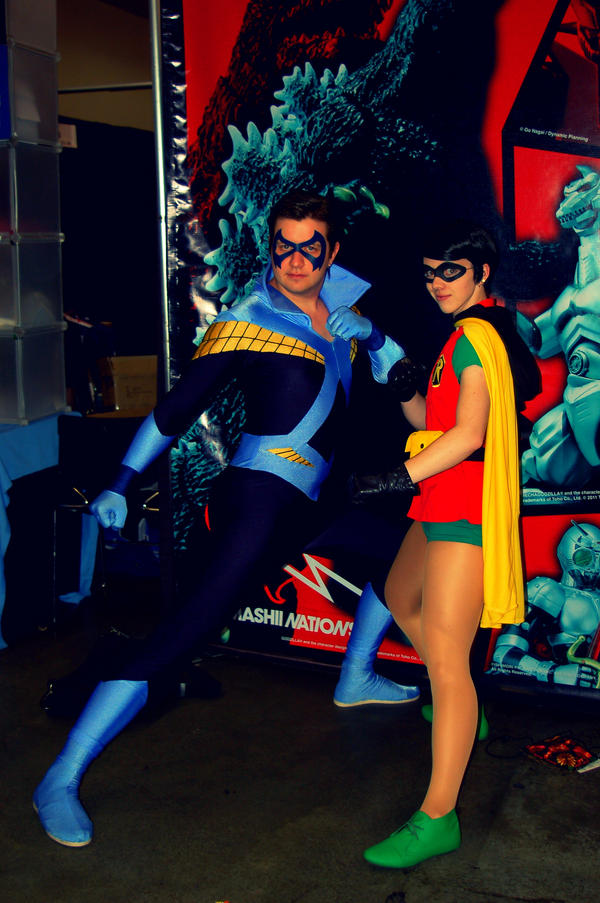
We couldn't just post the above photo without adding the next photo to compliment it. Also taken at FanimeCon 2013, but this time by Emilia Mccabe (aka iizel). This photo has Brian Milne posing with Skip cosplaying as Robin.


The New Teen Titans ongoing series (which debuted in 1980) saw Dick Grayson evolve from Batman's teen-aged sidekick to a competent young adult who would lead the Teen Titans (and arguably be known as one of the greatest leaders in the DC Universe). Actually, the whole series is about these former sidekicks and young adults 'coming into their own' which is what made the New Teen Titans so appealing to fans - kind of like those 1980s teenage 'coming-of-age' films John Hughes was so well known for.

Of all the different iterations of Nightwing out there, THIS is my favorite costume. This is the costume Dick Grayson wore when he debuted his NEW Nightwing persona back in Tales of the Teen Titans #44 (1984). I honestly can't visualize the 1980s Teen Titans without Nightwing in the group pic. (Maybe it's the garish blue costume? I don't know.)

The big "reveal" from Tales of the Teen Titans #44 (1984)


Regardless, this particular costume is affectionately known as the "Disco Nightwing" costume thanks to the body-hugging properties of the outfit, the flamboyant patterns, the HUGE pointed popped collar and the open neckline that starts at the chest (designed as a nod to Grayson's circus roots, I'm sure), but the similarities to the 70s Disco suit are undeniable.

The Disco Nightwing is a difficult cosplay to pull off correctly, and what I like the most about these pics is that this is exactly how I would've imagined Dick Grayson to look if he were a real person and existed throughout the 1980s. How old was Dick when he first donned the Nightwing costume? Well, it's kind of tough to say - series creator Marv Wolfman places Grayson somewhere between the ages of 16 and 18 years old when he first began leading the New Teen Titans as Robin, so I'd be guessing Grayson becomes Nightwing sometime in his early 20s (the whole Crisis On Infinite Earths thing makes it difficult to gauge an actual age).

For anyone who didn't catch it, David Ngo's photo is a clever jab at all those 'posterior shots' Nightwing is so famous for - Nightwing has consistently been voted as having one of the nicest backsides in comics and is frequently being positioned in panels to exploit that. David Ngo takes a lot of fantastic cosplay photos and we plan on showcasing more of his work in the future.

Emilia Mccabe's photo is brilliant because a) it features Nightwing with Jason Todd Robin*, b) they are both in a fighting stance and kind of look how I'd imagine if Dick Grayson and Jason Todd were about to throw down against you, c) Skip (cosplaying Robin) looks exactly how I'd imagine a 12 to 14 year old Robin would look in juxtaposition to a twenty-something year old Nightwing, and d) the color filter on the photo makes it looks like it was taken from sometime in the 80s. Absolutely smashing.


We managed to track down Brian Milne and ask him about this very kick-ass tribute to Dick Grayson and his love of the Teen Titans.

"I chose that Nightwing because I grew up loving the original Teen Titans. When I was putting that costume together I was originally working on the 90s Knightfall-era costume but I decided to switch it up", Brian told us.

Born in the late 80s, Brian grew up with a brother who was ten years his senior who was already well-experienced with comicdom, and thus he was raised on 80s and 90s comics along with old sci-fi and horror movies (which are basically the best things to be raised on).

When asked about his favorite Teen Titans story line and if he's still reading the title: "Favorite story line is a tricky one [laughs]. I always loved the entire Judas Contract story line, that was one of my faves. I haven't been reading the newer stuff due to always being busy." Brian is a HUGE Teen Titans fan and even went so far as to show us a photo of his comic book collection.

And then we asked him when he thought the series peaked? [I volunteered that I thought it was just before the early 90s when baby Wildebeest joined the team. -J] Brian replied "For me it was around the same time. I did like the reboot series featuring the new team led by teen Atom. The one right after Zero Hour."

Brian's favorite Robin (Dick Grayson, Jason Todd, or Tim Drake)? "When I started Drake had just become Robin and Dick was already Nightwing, so Tim had a bit more of an edge there. Along with the new costume made by Neal Adams."

And finally: "The Classic Nightwing suit took me about a week to make from beginning to end. The toughest part was laying out the little black elastice into place for the chest details - that took a day on it's own."


We were also lucky enough to also get a hold of Skip and ask her about her cosplay choice. Skip is a MAJOR BatFamily fan and told us "I chose Dick Grayson/Robin because I love the character and I think the costume is really funny (like all costumes from the 80s). I'm a huge fan of the BatFamily and Batman comics. I've been following the comics since I was very young and it would almost be easier to say which comics I haven't read! My favorite comics would probably have to be Nightwing: Year One and the Impulse series from the 90s. I also really enjoyed Batman: No Man’s Land and Dick’s run as Batman with Damian as his Robin before the reboot. Like I mentioned, it’s almost easier to say what I haven’t read and it’s really hard to pick a favorite!"

iFanBoy.com wrote a really in-depth history of Dick Grayson (with images) that we couldn't help feel inadequate if we didn't include: http://ifanboy.com/articles/dc-histories-dick-grayson-robin-i-nightwing-ii-batman-iii/

*Skip later told us that she was actually cosplaying Dick Grayson Robin in that photo. I'm choosing to overlook that. Dick Grayson and Jason Todd being photographed together is more comic accurate, and why crush our fanboy dreams of having Nightwing posing with the angriest pre-teen ever in a vintage photograph?