Interviews Reviews Guest Stars Fanzine Misc
Showing posts with label review. Show all posts

Thursday, December 15, 2022

Cryptozoic Challenge of the Superfriends Card Game

Christmas came a bit early this year. Someone who knows me very well gifted me the Challenge of the Superfriends card game by Cryptozoic, knowing that I'm a pretty big fan of any game based on retro DC comic properties.  

Front of box

This is not a new game -- it was released in 2019 and I tried to convince Cryptozoic to send me a sample copy to review for this webzine [ha!] but had no luck. Them's the breaks. Anyone who tells you that blogging is a lucrative side hustle probably isn't referring to DC in the 80s. I like Cryptozoic and when I was experiencing an impulsive DC trading card collecting binge back in 2016 I picked up a few of their trading card sets which I reviewed here, here and here. They produce quality products, and I think they're based out of Montreal, and I know writer Martin Pasko was working with them in some capacity for a while before he passed away. Cryptozoic also created a few board games (i.e., Ghostbusters) and DC comics Deck-Building games that seemed to resonate with fans, so I was curious to see what Challenge of the Superfriends was going to be like. Truthfully, this was on my radar to pick up -- but life got in the way and I completely forgot about it. Better late than never.

Back of box

First up: this is NOT a Deck-Building game. It plays 2 to 4 players, and each player gets 10 power cards to play with throughout the game. In contrast, a Deck-Building game has players start with a small number of cards, but as the game progresses, you add cards to your deck thus altering your strategy. This just means that you only need to buy Challenge of the Superfriends to play it -- it's a complete game, and there are no expansions necessary/available. This is it.    


SET UP:

The game comes with 82 cards: four 10-card Player decks, one 10-card Challenge deck, and one 32-card Objective deck. The Challenge and Objective decks go in the middle. Each player picks a Player deck. You have four Player decks to choose from: Superman, Aquaman, Wonder Woman, and Batman & Robin. Each Player deck has three Special cards unique to the character, while the other seven are cards that every other Player deck has as well. 

In this scenario, there are three players -- one picked the Superman Player deck, another picked the Aquaman Player deck and the third player picked the Wonder Woman Player deck.

Okay, now that each player picked a Player deck, give your 10 cards a shuffle, pick 3 for your hand and don't show anyone. Now you're ready to play.


GAME PLAY:

This game is based on an old playing card game we all played as kids because we didn't really have the patience or strategic thinking to play cribbage or gin or any other games that required more complexity and understanding of statistics. It was a game called 'war' and was usually played against another opponent who had a stack of cards equal to your cards, and you'd both just simultaneously flip playing cards and the highest-valued playing card would win the 'match'. Challenge of the Superfriends is 'war', but with more reading involved.

Okay, you're all sitting at the table and paying attention? Good. Flip a number of cards from the Objective cards face-side up on the table proportional to the amount of players playing. There's two of you playing? Flip two cards face-side up. There's three of you? Flip three cards face-side up. If there's a card with a negative value face-side up on your first round, put it to the side and flip another card until all cards face-side up have positive values. Shuffle those negative value cards back into your deck. You only do this for your first round

Three players = three Objective cards flipped up. Since Grundy is worth the most points, the dominant strategy is to win Grundy by playing the most powerful card. Second place would most likely grab Manta, and third place would end up with Cheetah. 


Okay, you've got x Objective cards face-side up? And they're all positive value? Great. Each player selects a card from their 3-cards in hand, puts in face down on the table, and then you'll all flip your cards at once. Just like 'war'. And, just like 'war', the highest value card wins, and that player gets first pick of which face-side up Objective card they want to add to their score pile. 

In this case, the Superman player flipped a Green Lantern card, the Aquaman player flipped the Flash card, and the Wonder Woman player flipped the Hawkman card. Green Lantern is worth '10', so he's the highest value in play. Ordinarily, he'd win the match and get first pick.

...but wait, there's more! As Player cards are flipped, there's text on the card that needs to be resolved -- sometimes the outcome will give you a bonus, screw over an opponent, or a bit of both. Some cards are only activated if you are the first player. Sometimes this will involve giving someone (even yourself) a Challenge card. Challenge cards typically aren't good things, so try to avoid receiving them. It's usually a negative modifier or something that will make your gameplay slightly more challenging. Objective cards with negative values will also have text on them, but that only starts to be an issue round two and beyond.
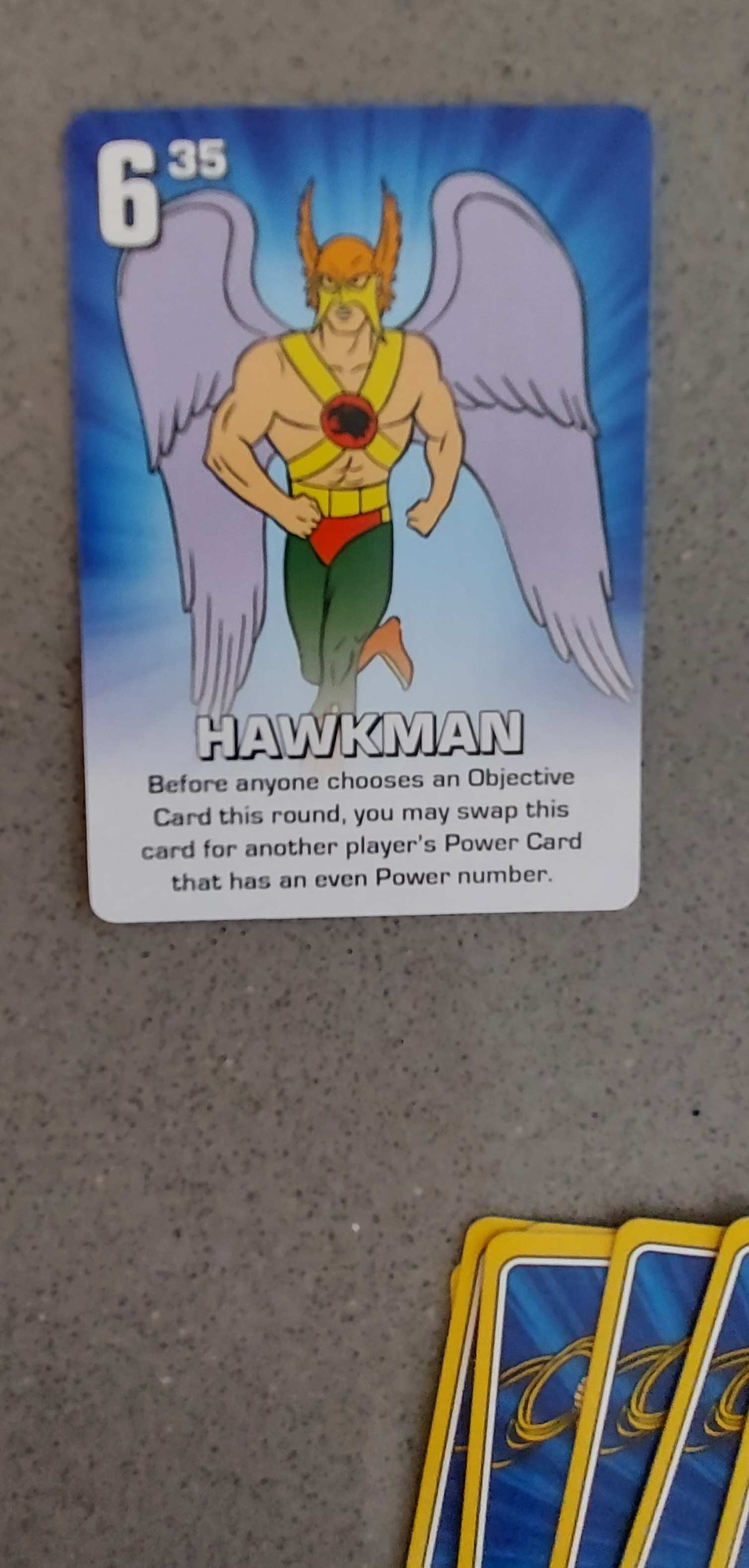
Hawkman's card says that he can swap for another player's card with an even value, so...


The Wonder Woman player now has the Green Lantern card, and Superman now has the Hawkman card. The Wonder Woman player also needs to pick up a Challenge card, as per Green Lantern's card text.

One last thing: If, while flipping your Power cards, two or more players play a card with the same value then it's a tie. The tie-breaker will be whoever has the highest secondary number following their primary number. 

If the Superman player and Wonder Woman player had both played their Green Lanterns, it would've been a tie since both are equal to 10...

...so they'd both need to compare the secondary number to determine the tie-breaker. Superman's Green Lantern has a higher secondary number than Wonder Woman's Green Lantern, so Superman would win this one. Note: both player still need to pick up a Challenge card, as per Green Lantern's text.

Okay, that's everything you need to know. Play for six rounds. and the player with the most points in their score pile at the end wins the game.


HOW DOES IT ACTUALLY PLAY?

The first time I played this game, out-of-the-box, was with one other player as we were 'test-driving it', so to speak. We read the rules, and did our best to follow the gameplay as outlined in the rulebook. Our first few rounds involved a lot of reading as we were trying to determine in what order the text on various Player, Objective and Challenge cards activated (hint: some are activated 'when revealed', some are conditional, and some last until next round) and what to do if a specific scenario came up where two or more text cards contradicted each other. Thankfully, the rulebook included in the game had all the answers -- and it was only 12 small pages. After a few rounds, we quickly got the hang of the game and then it was off to the races. 

After a few games a third player joined us. Of note: it's way easier to learn this game when someone shows you how to play. The game got a lot more interesting when there were three of us playing. We weren't able to recruit a fourth player, but played a few rounds and had a good time nonetheless. I'd describe the game as spontaneous and hard to strategize for. It's really a quick, chaotic little game. 


FROM A SUPERFRIEND FAN'S PERSPECTIVE

Alright, first of all, Cryptozoic wisely decided to go with the third season of the Hanna-Barbera cartoon: there was a larger cast of villains, more heroes, and Marvin & Wendy were noticeably absent (and replaced by the far more interesting Wonder Twins). Thankfully, the third season of the cartoon also saw more of the recently-introduced Apache Chief, Black Vulcan and Samurai featured in episodes. They're ALL accounted for in this game -- so, I'm very pleased with that.


The game's 4 starting Player decks (Superman, Wonder Woman, Aquaman and Batman & Robin) make sense since these were the 'original' Superfriends. The three specials in each Power deck are aptly thematic to the characters, and the designers picked some of the most meme-worthy images. 

That Batman & Robin 'Batmobile' Special is easily one of the best specials in the game -- if you can pull it off. The key thing about this game is that you can select which card to put down AFTER seeing the flipped-up Objective cards you are 'warring' for.

At a quick glance, all villains are represented in the Objectives deck and net you points based on their notoriety -- with Lex Luthor yielding you 15 points for his capture and Toyman getting you the least (3 points).


The Objective cards that DON'T feature villains are ones based on episodes, cost you points and will do something to change gameplay. So, things like this card, based on an episode I don't remember, will cost you 10 points if you have to pick it up, but also subtracts 2 from the value of everyone's Special cards played this round when it's flipped over:

This is an Objective card with a negative modifier.

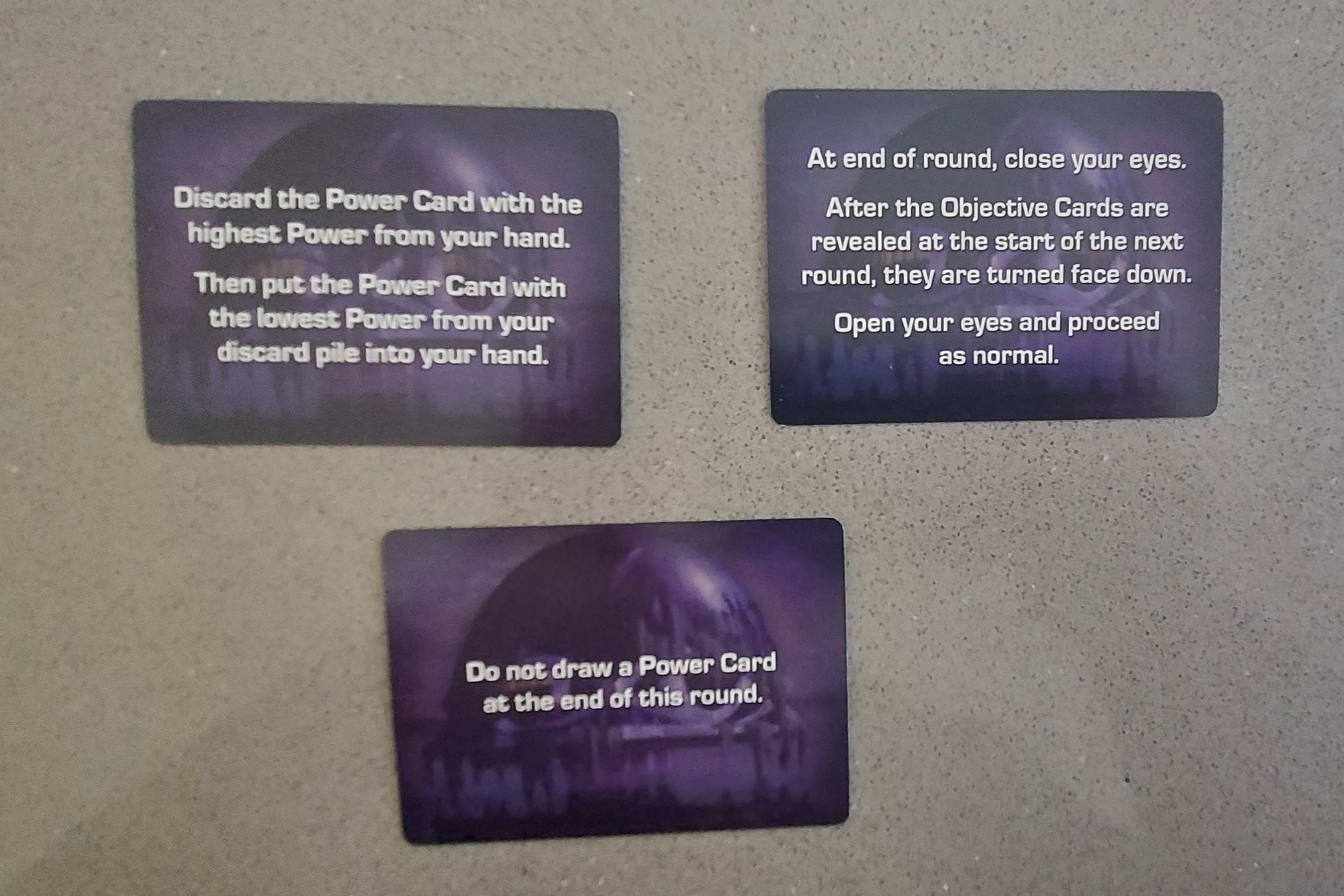
I did mention Challenge cards, and they do quirky little things to your detriment. The didn't get very creative with these -- it's just white text on a purple background:

OVERALL

I really liked this game and can't think of any way that it could've been improved. It wasn't terribly complex, it only took 30 seconds to set up, the cards and box were very good quality, the game didn't last very long, and the designers obviously had knowledge of the Superfriends cartoon and how the characters interacted.

While this game is probably best played with people who grew up watching the cartoon, the two other players I played with had little to knowledge of the Superfriends and enjoyed it regardless. This is one of those games you play when you're killing time -- either on a coffee break, waiting for a plane, or waiting for your dinner to get delivered.

I also think this game would also be great to play with an elementary school student who is learning about addition and subtraction and has moderate reading skills -- it definitely exercises your logical order/sequence thinking.

What could Cryptozoic possibly do to add to this? I don't know... maybe an expansion integrating characters and episodes from The Galactic Guardians? Maybe get Firestorm and Cyborg in there? Darkseid, Desaad, Kalibak and some Parademons? Maybe that scarier-looking T-800 Brainiac? Hard to say: the game seems to perfectly balanced that I'd be hesitant to add something to alter the dynamics. 

Anyways, highly recommended. I hope Cryptozoic does more with the Superfriends IP someday. 


-Justin

Tuesday, June 12, 2018

A look at the 1993 DC Editorial Presentation


It always tickles me when I happen across something I didn't even realize existed.  It's like so many of us feel completely "dialed in" to the comics industry via the internet, that nothing really excites or surprises us anymore.

Then, from the corner of your eye... you see the textbook-sized DC Comics: 1993 The Year of Change Editorial Presentation... on a shelf with a $2.00 price tag on it.  Now, tell me... who could say no to that (besides, of course, the dozens of folks who had already passed it by)?

So, just what is this thing anyway?  Well, it's part Previews Catalog, part State the Union Address... and if you care to join me, together we can take a deeper look into this odd little time capsule from the "boom era" of DC Comics.


Milestone Media

1993 saw the birth of the multi-cultural imprint known as Milestone.  With the mission statement of presenting "exciting heroes in a context of urban reality", we are introduced to the imprint's four titles: Icon, Blood Syndicate, Hardware and of course, Static.


For those unaware, these titles take place in the city of Dakota... sometimes referred to as the "Dakotaverse", much later as an actual city in the DC Universe proper (pre-Flashpoint).  During a gang war between three rival gangs, the secret police use a radioactive "tear gas", which leaves many of the survivors "altered".


Piranha Press

An imprint near and dear to my heart, Mark Nevelow's Piranha Press was DC Comics' first attempt at a true "Mature Readers" line of alternative comics.  It was also the first imprint from DC Comics to allow creator-owned material.  This imprint would run from 1989 until 1994 when it would morph into the more "boutique" brand, Paradox Press.


The big news out of Piranha in 1993 was the launch of its Factoid Book Project... otherwise known as the "Big Book" Series.  The "Big Book" line would actually never hit shelves under the Piranha Press banner... DC would hold off on the release until the Paradox shift was complete.


Worth noting that this very book does announce what would be, the final (though we didn't know that yet) Piranha Press offering... Prince: Three Chains of Gold.


What nobody really knew then, was... the very idea of Piranha Press was about to become redundant, because...


Vertigo

1993 also saw the official launch of DC Comics' Vertigo Imprint!  Bearing a Mature Readers warning... and playing with DC Comics-owned characters (as well as creator-owned work), the writing was very likely on the wall for Mark Nevelow and the gang.


Ongoing DC titles marked with a January, 1993 cover date... including Animal Man, Doom Patrol, Shade the Changing Man, Swamp Thing, Sandman, and Hellblazer were shifted over to the nebulous new imprint to continue their current volumes.  Seeing as though this was the early 1990's, Vertigo even went as far as to announce its first semi-line wide crossover event!  We know it as "The Children's Crusade", however, here it's pitched as "Family Values".


Bloodlines

After two years of using Annuals for crossovers (Armageddon 2001 in 1991, and Eclipso: The Darkness Within in 1992), DC sought to make 1993 the biggest one yet with... Bloodlines.  Interestingly enough... all of the issues announced would come out just as they were announced in this very book!


It's shocking to see such forward-planning and commitment from any given comic book company.  These days it feels as though DC (and Marvel) check the way the wind's blowing before committing to an order at the drive-thru!


Knightfall

One of the biggest events of 1993 for DC (and comics in general) was the "Breaking of the Bat" in Knightfall.  While this book refers to the storyline as Knightfall, it does not elaborate much.  What we do get is the announcement that something big would be coming in Batman #500... a new costume (designed by Joe Quesada)... and the most shocking change in Batman's 50-plus year history.


Reign of the Supermen

Speaking of playing their cards close to the vest... "Supermen" is the watchword for the Superman family of titles.  But, get this... the retailers (who would likely be the only ones getting this book) received the same information as the readers... which is to say, not a whole lot!


All four of the new "Supermen" are introduced, via outlines... without nary a hint as to whether or not any of them are the Real Steel Deal!  This could not happen today.


By the Numbers

Flipping through this time capsule really affords us the opportunity to see, at a glance, where DC Comics' priorities were.  For a little fun let's take a look at the Top Three characters when it comes to who had the most "paginal real estate" in this very book.

Batman - 34 Pages
Lobo - 18 Pages
Superman - 14 Pages

To close out, this was a ton of fun to flip through... and lemme tell ya folks, we've only scratched the surface!  There's a lot of weird stuff we didn't look at (I mean, there are 18 pages on Lobo alone!).  If you enjoyed this piece, please let us know... and we can share a bit more of this massive tome with you. 

-Chris

---

Chris Sheehan writes the very terrific Chris Is On Infinite Earths blog, and was one of the first contributors for DC in the 80s. When he's not writing about the BEST ERA OF DC COMICS ever, you can find him co-hosting the Cosmic Treadmill and Weird Comics History podcasts with Reggie Reggie


Tuesday, October 4, 2016

Hasslein Books' Watching Time: The Unauthorized Watchmen Chronology

When Hasslein Books announced that they were publishing a new book detailing the entire Watchmen chronology, they were kind of enough to allow DC in the 80s a glimpse of their review copy so we could let them know what we thought about it.


My first exposure to Alan Moore and Dave Gibbon's Watchmen was in an issue of Who's Who (update 87, vol 4) I had bought from a flea market and was thumbing through in the back seat of our car on the ride back home. It wasn't even an entry about the Watchmen - it was about their fictional precursors, the Minutemen. I was only eight or nine years old, but that brief Who's Who article told me about teammates attempting to sexually assault other teammates, getting institutionalized or simply winding up murdered. I knew right away that this wasn't the idealistic "safe" DC I had grown up reading, and contained that grim and gritty realism that I started to realize was noticeably absent from comics. From that moment on, tracking down those issues and reading everything I could about it were a high priority on my "to do" list.  (I wouldn't actually read and/or own the entire Watchmen mini-series for another ten years or so, but I assure you that particular Who's Who entry had never left my mind since that fateful car ride.)


I kind of feel that the author, Rich Handley, can relate to my anecdote. Handley explains in his foreword that his entry to the genius of Alan Moore was via Batman (or more accurately, The Killing Joke), and it ultimately led to him sweeping up every Moore comic book publication that he could find. In Handley's own words, "I didn’t need to be hit over the head repeatedly to realize that I’d found a new favorite writer" and later cites Watchmen as his favorite body of Moore work.

The fictional universe introduced to us in 1986's Watchmen mini-series is incredibly engrossing... and criminally short-lived. The twelve issue mini-series fueled our imaginations by teasing us with hints of untold adventures that we'd never be privy to. After the publication of the mini-series there were a few Who's Who entries and several DC Heroes RPG supplements available for fans looking to piece together more of the Watchmen history, but that was pretty much it. Behind the scenes, there were a few attempts at a Watchmen screenplay in the late 80s and early 90s.    

In 2005, the DC Comics Absolute Edition of Watchmen was released - complete with additional background info on characters, notes on the original creation process and essays by Gibbons and Moore.  The Absolute Edition was simply a warm-up for the main event, however, as 2009 saw the theatrical release of the Watchmen film (directed by Zack Snyder) and the creative/merchandising floodgates would soon be re-open again for all things Watchmen (video games, comic book prequels, motion comics, strategy games, and possibly even a TV series).

This is a an exciting time to be a Watchmen fan, and it can be easy to get lost in everything that's been going on. Thankfully, Watching Time: The Unauthorized Watchmen Chronology has you covered.

Weighing in at 350 pages, this is an incredibly comprehensive and detailed guide to everything Watchmen-related since 1986. When I say everything, I mean EVERYTHING: from the creation of the 1986 mini-series up to this summer's 2016 DC Rebirth appearances (Rich Handley explains in his foreword how the DC Rebirth material was just being announced as his manuscript for this book was going to print).

Handley's collection of Watchmen material is all-inclusive and sweeping - not just content to document the film, comics and DC Heroes RPG chronologies, he delves into everything from movie tie-in video games to Andrew Salmon's short fiction. Handley dug deep through really obscure Watchmen material so you wouldn't have to. That alone is worth the price of admission.

I appreciate that the author is quick to point out a few inconsistencies between the different mediums (namely, the original 1986 mini-series and DC Heroes RPG supplements versus the video games and Before Watchmen prequel comics), but he handles it amicably and even goes so far as to point out which sources come directly from Moore himself, should you not consider certain aspects as cannon.

My favorite parts of this book included the chronological history of how the entire Watchmen concept materialized (written by Brian Cronin), the brief chronological summary of events that have occurred in the Watchmen universe, and, of course, the extremely detailed twelve-part timeline chronology of everything significant that has ever happened in the Watchmen universe (comes complete with an abbreviation key so you can quickly look up the source).

This is a black-and-white book with not much as far as images are concerned. Handley is mainly interested in content and you're going to get a lot of it in an easily-digestible format. The book is easy to read, organized in a logical method, and quick to scan through. In short, this is everything you'd want in a chronological reference guide. For visual reference, the last twenty or so pages contain a black-and-white cover gallery of the materials cited in the book.

Who would most enjoy this book? Most obviously, a Watchmen fan (such as myself). Anyone who has been reading and collecting Watchmen material for the past twenty-five years and wants to see how it all "comes together". I see this book happily accompanying the Watchmen reprint trade paperback and Before Watchmen collected editions on your bookshelf. You can find out more about how to order this book directly from the Hasslein Book webpage itself.

Additionally, with Dr. Manhattan making a cameo in DC's Rebirth event, just about anybody who wants to get 'up to speed' on the Watchmen's rich lore will also want to pick this up.

It's a good time indeed to be a Watchmen fan. Watching Time: The Unauthorized Watchmen Chronology just makes it easier to do so.

Thursday, September 29, 2016

Reviewing Cryptozoic's Batman: The Legend trading cards


Earlier this year I went on a "Batman binge" and feverishly visited every non-sports trading card vendor I could in order to pick up whatever Batman-related trading cards I could find. I purchased quite a few sets. It was only in the last few weeks that I actually sat down to take a look at what I'd purchased (I'm funny like that) and realized that the 2013 Batman: The Legend trading cards were, in fact, published by Cryptozoic. I reviewed a Cryptozoic trading card set back in August, and being somewhat impressed with it, decided to really sit down and scrutinize the Batman: The Legend trading cards I had purchased earlier this year. So now that you have some context, I'm just going to take the plunge...
Cryptographic's Batman: The Legend trading card set advertises 63 cards of all-new original art in the base set and three chase card sub-sets (9 Batmobile foil chase cards, 9 Batcave puzzle cards and 8 Circus of Villains poster chase cards), bringing the entire set to 89 cards. (This doesn't count the 49 different Oversized Art redemption cards, the parallel holofoil base card variants, nor the gazillion artist sketch card chases that are also included in this set. Also, there's an exclusive Printing Plate card and I'm not even sure what that means.)

I wouldn't say that Batman is my favorite DC character, but he is my favorite among DC's "Big Three" [Superman, Wonder Woman & Batman] and probably one of the company's most marketable characters (and thus attainable to collect). There is never a shortage of Batman products/publications on the market in this day and age targeted to all different demographics of collectors/fans. A lot has happened to Batman since I last stopped *really* reading the comic in the mid 1990s; new villains, new allies, new 52. I'd still check in from time-to-time to see what was going on, but it was more of a passive interest rather than a "oh boy, I can't wait to see what happens next issue".

Batman has an incredibly rich legacy spanning as far back as the 1940s, so I'd imagine it would be challenging for Cryptozoic to decide on what to focus on in an 89 card set. This set was released (I'm assuming) to coincide with the release of Christopher Nolan's 2012 The Dark Knight Rises film, when excitement about the film was at a fever pitch. A 63 base card set is pretty tight, so I'm kind of curious on what they decided "made the cut" for being set-worthy.

We've had a few notably good non-movie Batman trading card sets in the past two and a half decades [I'm looking at you Batman: Saga of the Dark Knight and Batman Master Series], so the bar will be set pretty high on this one. These aforementioned sets are also both twenty years (or more) old, so it was time for an update.

[I'm not going to through these card-by-card, just a general overview with some highlights.]

The first eleven cards are Batman Ally characters (including Batman himself), and then we dive right into the iconic Bat Villains. I'm partially scanning these for eighties references, and the first one that comes up is card #5 - Jason Todd.


According to the text on the back of the card, Jason Todd's 1988 death at the hands of the Joker is still being honored. Red Hood and the Outlaws is a book that debuted in 2011's New 52 relaunch, so it looks like Jason Todd's history remained intact. The same goes for Oracle (Barbara Gordon), since the text on the back of her card references her being shot by the Joker. Upon a second glance, Barbara Gordon actually has three cards in this set: one of her as Batgirl, one of her as a wheelchair confined Oracle and another of just her 'standing there looking all healthy' as Barbara Gordon. The cards quickly explain that she was paralyzed, but somehow got her legs restored.


The Joker, the Penguin, the Riddler, Two-Face/Harvey Dent, Poison Ivy and Catwoman/Selina Kyle are covered next. Here are a few samples of the card art:


Now that we've got the (arguably) most iconic Batman-associated characters out of the way, the rest of this base set spends it's remaining 42 cards spotlighting every other important character, item or location associated to the Batman mythos. From here until the end of set, it's all kind of random - but it's an interesting assortment of random.

As far as obscure goes, both Bat-Mite and Ace the Bat-Hound each get a card in this set. Bat-Mite was in the New 52. I really don't know if Ace appeared in the New 52, so I'm kind of guessing they included him as a legacy character. I'm always a fan of that stuff.


As mentioned, this base set has a nice assortment of allies and villains. Some of the characters I was (delightfully) surprised to see were The Outsiders, Manhunter (Kate Spencer) and Knightfall Batman:


I really dig that all the base card art is original art. I especially like that they list who drew the card art on the back of the card. This goes a long way, in my opinion, to acknowledging artists and may have me seeking out more of that artist's material. A card that really stood out for me was Jonathan Wayshak's Scarecrow, which had a nice 'mixed media' feel in contrast to all of the other 'clean' illustrations on the majority of the cards.

#30 - Scarecrow (illustrated by Jonathan Wayshak)

The card art is good and the card stock is firm with a glossy finish. There are plenty of full body shots (usually as the character strikes a pose) and the color is very clear. The only artist I was familiar with in the long roster of artists contributing to this base set was Tod Smith (who illustrated DC's Omega Men and Vigilante in the 80s, and you can view more of his art here).

Adam Beechen wrote the copy for the back of the base cards. At first I was going to say that Beechen's text is too short and leaves a lot of unused blank space at the back of the card. Upon further review, I will say that what Beechen does write is very short and concise, giving you the general gist of the character and piquing your interest for more. If you haven't figured it out by now, this set is heavily New 52-centric, so I'm sure one of Beechen's challenges was to keep the card text very broad yet comprehensive enough to not tie down the character to specific era. I would've liked to have seen some sort of 'First appearance:' or 'Significant story-arc:' mention so that I would at least know which comics I should be hunting for if I wanted to read more about this character.

Back of card for #45 - Talon

Overall, this is a very good base set. The original art goes a long way, and in 63 cards they managed to capture a large portion of the most important Batman characters. A few other Bat Allies I would've liked to have seen (in card form): the Creeper, Nemesis, Bat-Cow, Sasha Bordeaux and a few more Batman Inc. members. The Bat villains, who I've always felt were more interesting than Batman himself, were also very well-covered. A few more I would've liked to have seen were Calendar Man, Hugo Strange, Hush, Killer Moth, KGBeast, Mr Zsasz, the Batman of Zur-En-Arrh and David Cain. There are so many interesting Bat villains that Cryptozoic could've made a trading card set based on them alone. As mentioned, 63 cards isn't a lot to work with, so I realize Cryptozoic had to tighten their selection criteria.  

I'd recommend this trading card set to a new Batman fan - someone who was just getting into the comics and needed a fairly modern Who's Who with visuals. For the most part, the art is clean and crisp and the text on the back gives a general overview of the character. A serious Batman collector may overlook this base set (unless they are a completionist like myself), because I feel that the real prizes in this collection are the Artist Sketch cards and the Oversized Art cards. We'll talk about those in a minute, but first let's look at the chases...

The Batmobile foil chase cards were an interesting choice for a chase card sub-set.  The Batmobile is one of Batman's most famous gadgets (moreso than his utility belt, I'd say) and definitely gave James Bond's tricked-out car a run for it's money. And we all know that Batman had a lot of different Batmobiles throughout the ages. You could probably make a trading card series simply based on vehicles Batman has driven throughout his career in crime-fighting - Eaglemoss basically did this with it's Batman Automobilia series.

Batmobile chase card BM-6
What's most interesting about the 9-card chase sub-set is that the first 6 cards are independent (as shown above) and the last 3 form to create a triptych of the Batmobile roaring down the street and slamming into Two-Face's rig (not shown). Not quite sure why Cryptozoic didn't decide to go with the full nine-panel splash page route like they took with the second sub-set.


The Batcave puzzle cards are also foil cards, but these 9 chase cards form to reveal a really nice bird's-eye view of the Batcave.

Batcave chase card TBC-02 
I like puzzles, and I like trading cards, and I like trading cards that join to form 9-piece puzzles (especially if they are shiny). So, I am intrigued with the 9-card Batcave sub-set, which does exactly this. I find it amusing that not all the cards in the sub-set are equally detailed/important and I pity the person who pulls a very nondescript part of the Batcave and has one of those "what the hell am I looking at?" moments. Thankfully, there's a bit of text on the back of the cards. You really need all nine cards to complete the entire picture.

The last chase sub-set in this trading card set are the Circus of Villains Posters chase cards. There are 8 of these, and I really can't figure out why Cryptozoic didn't decide to make it an even 9 cards and fill up an entire card sheet. All the 'classical' Batman villains are here: Joker, Mr. Freeze, Penguin, Killer Croc, Scarecrow, Posion Ivy, Two-Face, Man-Bat. (Well, looks like Catwoman wasn't included in this one.)


These are actually very nice chase cards and have a very nice look to them. The fact that they're aren't a 9 card set doesn't bother me so much since they don't join to form a puzzle or anything. It's just a set of really nice chase cards.

The parallel holofoil base card variants are a good idea, in theory. They are the holofoil variants of the base cards. At an allocation of 1 in every 3 sealed packs, you're bound to pull a few of these if you purchase a sealed box of these cards. The thing is, not everything looks better with a reflective coating, and I should know since I grew up in the 'gimmick era' of comics. I'm personally way happier with the 'regular' non-holofoil base set. Of course, there are exceptions to every rule - I'm keeping a keen eye open for the holofoil variants of my favorite characters from this set [e.g., #36 - The Outsiders, #39 - Bane], because..well... wow.


Of all the nice things I've outlined in this trading card set, the BIG DEAL are the Artist Sketch Cards. Miranda Charsky, Cryptozoic's Brand Manager, issued a press release when this set was released, stating that "We had the privilege of working with over 140 sketch cards artists for the new set, and in addition to being approved by the creative team at DC, I reviewed every single card with our Art Acquisition Manager George Nadeau to give them a final stamp of approval". You're going to want to buy packs and packs of these cards to pick up the Sketch Artist cards. If you happen to complete the base card set and a few chase sub-sets along the way.. well, what's the harm in that? On that note, if you're looking for the 63-card base set, you'll be able to find on relatively cheap, since I imagine collectors bought boxes and boxes of these cards hoping to pull the Artist Sketch and/or Oversized Art Redemption cards and probably have a few non-holofoil base sets sitting around collecting dust.

I took a quick glance at the Sketch Artist list and only one name popped out at me (Tom Nguyen), the rest of these are complete 'unknowns' to me. (That's not saying that they're good or bad, it's just telling you how "out of the loop" I am on rising sketch artist stars.) The one thing that IS obvious is that these Sketch Artists are Batman fans, and have chosen a large diversity of characters to sketch.

Sketch Artist cards are a big 'hit or miss' for me, personally. To quote Orson Welles: “I don’t know anything about art but I know what I like”, and while a lot of the sketch cards are really nice, some are a little too 'cartoony' or anime for my tastes. If I pulled one of those, I'd be trying to quickly trade it for another sketch I'd prefer to own. Of course, this is just my own personal opinion, and I obviously don't feel the way the majority of collectors feel, since sketch cards for this set go for an average of $50 USD for a card - some as high as $175 USD. That being said, the ones that look great do really really look great and the artist's cover a wide range of characters that the base set seemed to have overlooked:

Nightwing sketch card by Brian Kong. Buddy Prince Batzarro sketch card

ELLIOT FERNANDEZ catwoman sketch card Kevin Gentilcore KGBeast skecth card
Like... wow!


Other than a folded up $100 bill, the Oversized Art Redemption card tops my list for "Things I Hope I Am Lucky Enough to Find In a Pack of Trading Cards Someday". The Oversized Art Redemption card is a regular-sized card you can find in a pack of cards that you mail in for 1 of 49 pieces of Oversized Original Art. As of this writing, according to the Cryptozoic site, 12 of the 49 have yet to be claimed. I've had a chance to glance at some of these pieces (which sell for about $130 USD on e-bay) and these look impressive. These are pretty difficult to find on the secondary market. If I ever manage to snag one, it's going in a frame on the wall of my office for all to admire.

Matias Streb Oversized Art Solomon Grundy card
Here's that Solomon Grundy the base set was missing...

Tim Shay Oversized Art Harley Quinn card
Classical pre-New 52 Harley Quinn - just the way I was first introduced to her

Matias Streb Oversized Art Batman card
What a beauty

Cryptozoic was generous enough to let collectors see ALL of the Artist Sketch cards that are available on their Facebook page. It's worth taking a look at.

-Justin

Distribution as follows:

The Batmobile foil chase cards (1:12)
The Batcave chase cards (1:12)
Circus of Villains poster chase cards (1:24)
Artist Sketch cards (1:24)
Parallel holofoil base card (1:3)
Oversized Art Redemption cards (no clue, but there's only 49 of them)
Printing Plate card (1:576)


[Editor's note: Sometimes people around the web comment on these articles, but they only comment on the platform that linked to the article (e.g., Facebook, Google+). I will re-post the really insightful remarks in the comments section under 'Anonymous']

Wednesday, September 7, 2016

Review of Sequart's The British Invasion: Alan Moore, Neil Gaiman, Grant Morrison, and the Invention of the Modern Comic Book Writer by Greg Carpenter

I recently had the privilege of reading an advance copy of Sequart's The British Invasion: Alan Moore, Neil Gaiman, Grant Morrison, and the Invention of the Modern Comic Book Writer by Greg Carpenter.


I'm a big fan of the early 90s Vertigo-era of DC comics, so I read this book with a very critical eye. I feel like I know a lot about this era of comics and it's main players, so when I'm reading a book like this I'm looking for NEW information — either via interviews with the creators discussed in the book, anecdotal stories about said creators or simply new research the author themselves have unearthed.

Here's a little secret about me: I'll usually start reading a book before I'm ready to go to bed. I find reading relaxing, and reading tends to help me fall asleep. I figured it would be the same deal with this book. Much to my dismay, ten pages in and I could not put this book down. So much for sleeping. I nearly powered through three quarters of this book in one sitting.

What really kept me engaged with this book was that it wasn't a dry recounting of the biographies of three of DC's most prolific writers, it was an examination of everything that was going on in that era. Greg Carpenter creates a wonderful balance of 1) providing context as to why said creator is a genius, and then demonstrating it by deconstructing his work and explaining it's significance in relation to that time in history. There's a bit of a background about what the creators were doing with themselves before they hit their stride, and I find this refreshing as it adds a bit of context and allows us to realize that, once upon a time, they struggled just like the rest of us aspiring writers.

This book covers the entire gamut of early Vertigo genius: Swamp Thing, Animal Man, Doom Patrol, Sandman, The Books of Magic, Kid Eternity, Sebastian O, The Mystery Play, Hellblazer, Flex Mentallo, The Invisibles, Black Orchid and The Tragical Comedy or Comical Tragedy of Mr. Punch. (These were almost all of the titles that made me keep collecting Vertigo comics and watching with eager anticipation for any new releases on the horizon.)

Something I really appreciated was that Carpenter gave special attention to said creator's earlier works, as well. Thanks to this book, I will now be hunting down copies (or collected reprints) of Violent Cases, St. Swithin's Day and various issues of the UK's Warrior and 2000 AD magazines.

This book was not simply Vertigo-focused. Yes, it did speak in great detail of Arkham Asylum, The Killing Joke, The Watchmen and Moore's more famous mainstream DC works (ex: Whatever Happened to the Man of Tomorrow?, Superman Annual #11), but the author gave a lot of attention to the earlier, lesser-known works that made these creators the renowned writers they are today. These included Zenith, Marvelman/Miracleman, From Hell, Big NumbersV for Vendetta and the aforementioned Violent Cases. I was previously unaware that Alan Moore had written stories for the Star Wars Marvel UK series — one more thing I'll need to check out. The author even devotes a whole chapter to the 'Dr Who connection' among the three creators (and yes, inevitably, there is one).

The book doesn't just stop at the history of Vertigo — it also delves into what became of the creators after the early 90s. It details Moore's falling out with DC. It examines the Morrison/Moore feud (and yes, inevitably, there is one). This book also covers a lot of smaller press material that may have flown under our collective radars the first time they were published (i.e., Lost Girls, A Small Killing, and Signal to Noise). Later on we read about Moore's contributions to Image Comics and Morrison's reworking of the DCU in Final Crisis.

Interview snippets and anecdotes from Karen Berger were intermittently dispersed throughout the text (in a relevant fashion). The book concludes with the author's interview with Berger in it's entirety. I am quite fascinated with Berger and often feel like she is one of comicdom's 'best kept' secrets. Thankfully, this book succeeds in pointing out how instrumental she was in the creation of the Vertigo imprint.

If I had to make one change to this book, while the cover of the publication was good, I feel that it should've been something more epic. Maybe it's because I kept reading references to Bill Sienkiewicz, but I really think this book was deserving of a painted cover. That's just my opinion, however.

If you're a Vertigo fan, I'd fondly recommend this book. I'd also recommend this book if you're interested in comic book history and are especially interested in what was going on in the comic book industry during the 1980s and 1990s. This book is incredibly well-written and something I can see future essayists citing as a research reference. 


-Justin


Two interviews with the author worth checking out:

For more information about the book (such as ISBN number and where to order it), check out the Sequart page.

Other Sequart articles by Greg Carpenter:


Tuesday, July 19, 2016

Brief review of the 1988 Martian Manhunter mini-series

house ad for 1988 Martian Manhunter mini-series. Property of DC comics.


The Martian Manhunter first appeared in Detective comics #225 (1955) and was created by Joseph Samachson (writer) and Joe Certa (artist). It’s interesting to note that Samachson was an accomplished chemist (PhD from Yale) and wrote for sci-fi pulp magazines (under a different nom-de-plume) before becoming a writer for DC comics in 1942.

The Martian Manhunter began as a combination of DC’s two most popular heroes at the time: he was a nigh-invulnerable flying extraterrestrial (like Superman) and a world-class crime-solving detective (like Batman). He even became a founding member of the Justice League of America in 1960 and had a prominent role in the JLA until 1968 when Batman and Superman became more actively involved with the team. Because, honestly, two nigh-invulnerable flying aliens on your team is two too many.

The Martian Manhunter laid low from 1968 until 1984 and only occasionally appeared when a DC character had an adventure in space. He made his big return in the pages of Justice League of America in 1984 and has pretty much been a key member of the Justice League throughout the 80s. He was even popular enough to merit an action figure of himself in the 1985 Super Powers Collection toy line.

Justice League of America v1 #228 (1984)

After Crisis On Infinite Earths, DC took the opportunity to revamp origins/past history of most major characters in order to fix continuity issues. In 1988 it was the Martian Manhunter’s turn. It should be noted that J.M. DeMatteis writing this mini-series was a good fit, as he had been co-plotting/writing Justice League of America stories with Keith Giffen since the Justice League relaunch in 1987, so if anyone had a good understanding of the Martian Manhunter it would be Dematteis.

Making major changes to a comic book character with a lot of history is always tricky, as you don’t want to do anything too drastic that will upset the long-time fans (ex: John Byrne’s Superman). In this particular instance, however, DeMatteis nailed it and the mini-series was well-received.

Changes to Martian Manhunter (as per the mini-series):
  • His real name isn’t J'onn J'onzz 
  • He is the last martian. All the others were wiped out thousands of years ago by a plague. 
  • Mars is actually a dead planet. 
  • His real form is a green cone-head creature. 
  • All of his personality and memories were implanted into him by Dr. Erdel 
  • Dr Erdel never died, it was all an elaborate trick. 
  • Fire (previously his only weakness) isn’t deadly to the Martian Manhunter - it's revealed that the danger is all psychosomatic.
One of the reasons this revamp worked so well is because the character of the Martian Manhunter was never strongly defined to begin with, so there was lots of room for elaboration. Crisis on Infinite Earths essentially retconned Superman’s early involvement with the Justice League of America and it would as appear as if the Martian Manhunter was meant to fill that continuity hole (one nigh-invulnerable flying alien can substitute for the other). This leads to a few continuity problems (mainly anything to do with Martians invading earth pre-Crisis) but I’m going to overlook that since DeMatteis did an excellent job regardless.

As a Giffen/DeMatteis-era Justice League fan, I really enjoyed this four-issue mini-series. As a matter of fact, this mini is a direct conclusion to the events the happened in Justice League Annual #1 (1987). The Justice League International do make an appearance, but they only play second banana since the main focus is on the Martian Manhunter. I did not enjoy the art (but maybe you did/might). Mark Badger was the penciller and I found his illustrations too abstract/psychedelic for this type of story. I guess in my mind’s eye Kevin Maguire was the regular Justice League penciller and the only artist fit to do a Justice League spin-off mini-series such as this one.

Mark Badger art from Martian Manhunter mini-series (1988). Property of DC comics. Mark Badger art from Martian Manhunter mini-series (1988). Property of DC comics.


Michel Fiffe (creator of COPRA) interviewed Mark Badger in early 2010. Fiffe was kind of enough to share an unpublished excerpt from the interview with us about Badger's work on the Martian Manhunter mini-series:

Michel Fiffe: "You had worked on the Martian Manhunter mini-series with J.M. DeMatteis. That seems to be the story where you began loosening up. The entire series works really well as one piece, actually, not just as a string of pages telling a story but as a visual whole. Was there a complete script or did you visualize the entire thing without outside direction?"
Mark Badger: "Plotting of Martian Manhunter was basically done in the basement of 666 5th Ave with Andy Helfer and DeMatteis over pastrami sandwiches. There was no grand plan, it was just screwing around and trying to do something fun. Comics hadn’t become big biz yet where writers and editors mastermind these crossovers to death. I think full scripts really do hurt the visual inventiveness of comics because in a movie, you can extend the time, and storytelling can be carried by sound and suggestion in a way that comics just can’t. On one hand, I understand artists no longer think in terms of storytelling but that’s because editors hire artists who don't think of storytelling. And then no one has the ability to teach anymore. Teaching demands not just saying “this is the right way to do something” but a loop of feedback where you assess what the person is doing to see if they understand the concept and then re-phrasing it and evaluating how you said it. Jim Shooter was a good basics teacher. He laid out a fundamental set of rules but he really had no way to talk about anything after those basics. So at one point, Marvel was buying all the white Zip-a-tone in NYC to cover up blacks in the background to provide depth in their comics. But the idea of atmospheric perspective conflicts with the idea of using black for composition ad spotting a figure against a black backdrop so they stand out. They’re both Renaissance ideas in composition and sometimes you need to have done the craft to juggle them when appropriate."
"I picked up from Walter Simonson, who laid stories out on a typing page with 24 boxes first, using words and maybe thumbnails. I stole that. So I was always thinking of the whole story first, not the one image of the story I can sell. When I started to learn how to code it, was able to see the overall structure of the project that made me successful, more than any math skills. (I spent 8th grade algebra drawing Conan after all, so I should never be able to code.) But at Parsons, we always thought in terms of the overall work and the project, not just the one painting. They were constantly pushing you to have this approach because you were building a body of work not one image to sell. Sometimes I get jealous of people who can think of cool drawings and that slick “I’m a tuff guy” illustration look to all their characters."
"I based the new Martian Manhunter on a David Smith sculpture. I figured if you’re a character capable of morphing into shapes, why in god’s name would you look like a body builder? I just felt like the ability to change shapes meant you would make beautiful Art Nouveau and abstraction, not guns. If you manipulate form, wouldn’t you be fascinated in what you can make? Then I had been reading about grid systems for graphic design, so I made up a small grid and then overlayed that on the Kirby six panel grid to split up the pages. So that drove the layout. Then there was a Roy Lichtenstein show of abstractions at the Museum of Modern Art (MOMA) while I was working on the Manhunter. So at the time I would go there look at the Lichtensteins, go up to the Henri Matisse room and look at the swimming pool cut outs and then go turn in pages."
"At some point I had been looking at one of the more generic artists at Marvel because they sent us all the comics in those days. I couldn’t understand what the heck the drawing was, it had no relation to the human form but it was a comic. When you looked at comic book drawing in those days it was really weird and comic booky, not the photo realism of today. I thought: man if you can draw that weird, I can draw any shape I want and it will work as a figure. Boy, was I dense! Comics drawing is built on a long tradition. Saying that Matisse is a justifiable part of that tradition is weird. Matisse’s approach to form is so much based at looking at the world and not drawing icons. Matisse would actually just let his drawing be based on the emotion of drawing. I think there was a show of Matisse drawings at MOMA that where charcoal line drawings, not just one line but grey pages where he had changed & changed & changed the drawing to finally get to one line. SO I was looking at those and thinking this is proper drawing. In comics, that’s not proper drawing and I didn’t understand the distinction. So that’s all the stuff I was looking at and trying to pour into my comics."
[If you want to credit any of the interview above, please credit Michel Fiffe]


Two great sources if you're looking for more info on the Martian Manhunter:

You also might enjoy Mark Belkin's interview with J.M. DeMatteis (he briefly mentions Martian Manhunter, but talks about a lot of the other DC projects he worked on during the 80s.)


This article first published on the DC in the 80s tumblr in Aug 2013.