Interviews Reviews Guest Stars Fanzine Misc
Showing posts with label Vigilante. Show all posts

Thursday, January 6, 2022

Our favorite Peacemaker covers

Well, we're just a few short days away from the new Peacemaker live-action series premiering on HBO Max. This a milestone event for me -- I've been a Peacemaker fan since I first learned about him while flipping through the pages of Who's Who: Update '87. A lot has changed since I was 9 years old: I don't collect single comics like I used to (opting instead for TPBs, hardcover reprint volumes or digital media) because I just don't have the storage space like I used to, but I will make an exception for comics with iconic covers (which usually end up getting framed and mounted on my office wall). 

As a Peacemaker fan, here is a subjective list of 'must-have' Peacemaker covers (or let's at least gaze adoringly at them):  


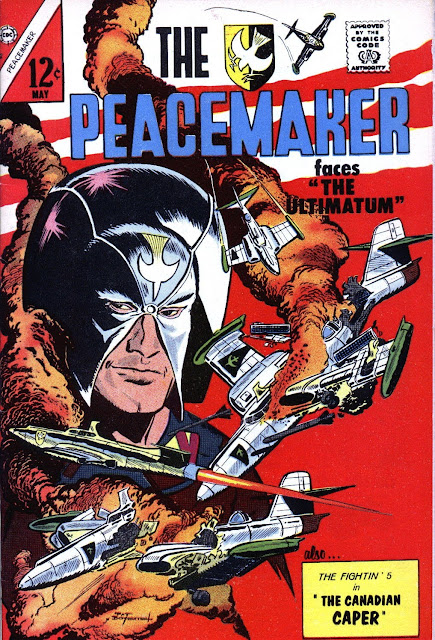
1. The Peacemaker #1 & 2 (1967)

Peacemaker's first ever appearance was in Fightin' 5 #40 -- a comic book published by Charlton Comics in 1966. He received his own Charlton Comics solo title in 1967. The Peacemaker #1 is noteworthy since it's his first cover appearance on a comic book; hence it's a very iconic cover to fans of the character. He's running, he's holding a gun, there's aircraft and armed vehicles moving all around him -- it's going to be a good time. 

Because most casual comic collectors only target the first issue of a series, issue #2 is often overlooked.  In my humble opinion, the cover to The Peacemaker #2 is far superior to the cover of the first issue (keeping in mind they were both done by the same artist). Sure, it's just a headshot, but the details of his faceplate and helmet have been improved, there's highly-detailed aircraft crashing and shooting at each other, and the red background really make the foreground items 'pop'. Thankfully, if you're looking to collect these issues, Modern Comics reprinted them in 1978 and they are substantially cheaper than the 1967 Charlton Comics originals.
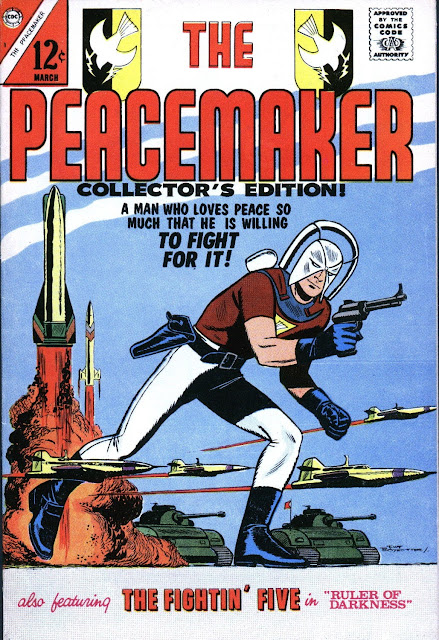
The Peacemaker #1 cover illustrated by co-creator Pat Boyette


The Peacemaker #2 cover also illustrated by Pat Boyette


2. Vigilante #36 (1986)

Without a doubt, 1985's Crisis On Infinite Earths #6 is Peacemaker's first appearance in the DCU... but it's a single panel of Peacemaker yelling in the rain. Not very exciting. So, while COIE #6 is technically Peacemaker's first appearance, we really get a sense of who/what he is in 1986's Vigilante #36. This is actually a really great issue on it's own merits. Written by Paul Kupperberg, pencilled by Denys Cowan and inked by Kyle Baker, we are introduced to Peacemaker: an unhinged government black ops agent who hears voices in his helmet and systematically neutralizes a crew of plane-jacking terrorists. Mike Grell (The Warlord, Green Arrow: Longbow Hunters) illustrated this dynamic cover, and this issue delivers exactly what the cover promises. This is how you make an entrance.
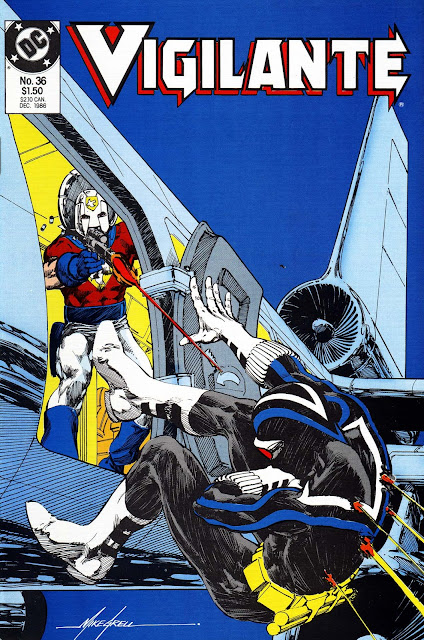

Vigilante #36 cover illustrated by Mike Grell


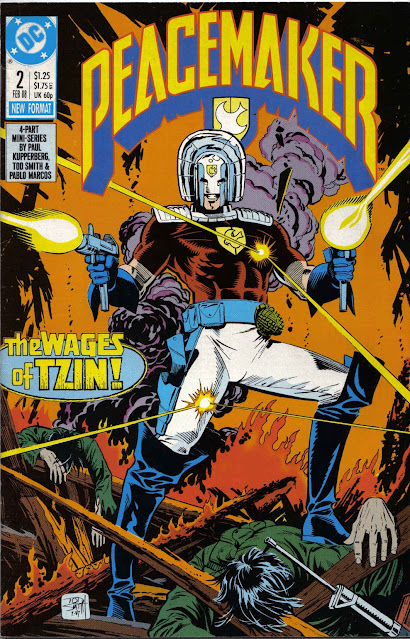
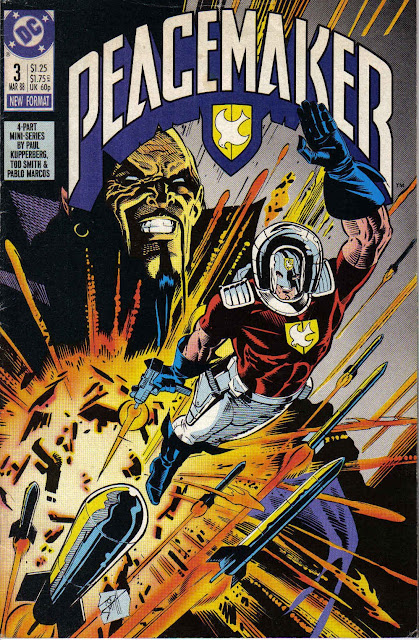
3. Peacemaker #2 & #3 (1988)

After his big debut in Vigilante, Peacemaker got his own solo 4-issue mini-series in 1988 written by Paul Kupperberg. I've actually reviewed this mini back in 2017 and, upon a quick re-read of the review, it still holds up. On a personal note, I cannot stand the cover of the first issue of this mini-series: it's a very large close-up of Peacemaker's face, who -- for some reason -- has a large, exaggerated chin. It's as if Jay Leno was wearing the Peacemaker helmet. [I'm not posting the cover -- you can go look it up yourself.] Instead, I will focus on my two favorite covers from this mini: issue #2 and #3. Issue #2 has Peacemaker posing heroically, guns blazing in each hand as enemy bullets bounce off his chest. I don't think anything can make this more 'action hero' other than a large American flag waving in the wind behind him. Issue #3 has Peacemaker getting 'the last shot in' as he flies away heroically while Doctor Tzin-Tzin's large, superimposed head watches on in rage -- a very dynamic image fitting for a action film poster. All four covers of the mini were illustrated by Tod Smith

Cover of Peacemaker #2 illustrated by Tod Smith


Cover of Peacemaker #3 illustrated by Tod Smith


4. Suicide Squad #28 (1989)

The Janus Directive was a 1989 cross-over event that ended up becoming a huge fracas between the Suicide Squad, the Checkmate Organization, Task Force X, Peacemaker, the Captain Atom Project, The Force of July, Manhunter and... possibly Firestorm? [It's been a while since I read it.] Anyways, Peacemaker is featured prominently on a few covers of this 11-issue cross-over, and my favorite is Suicide Squad #28 (part 4 of the event) which moves at a fever pace and has a bunch of well-deserved slugfests. This Karl Kesel-illustrated cover is really striking -- Peacemaker has both Duchess and Major Force in his target sights, but who is he aiming at? A really great cover for a really great cross-over event proving once again that Peacemaker usually looks best when holding some sort of firearm.
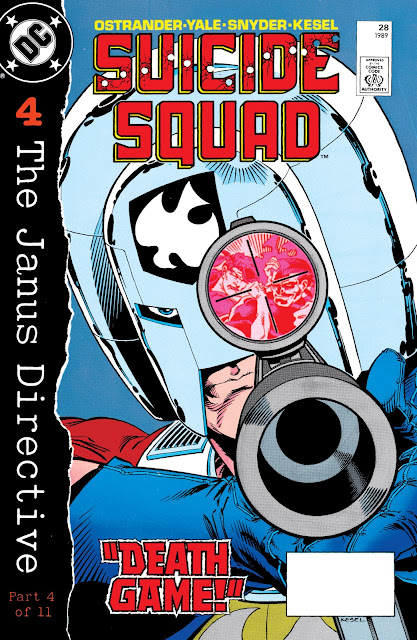
Cover of Suicide Squad #28 illustrated by Karl Kesel.


5. Showcase '93 #6 (1993)

It's 1993 and DC has decided to give the superhero anthology comic another kick at the can. Showcase '93 was a twelve-issue maxi-series meant to spotlight DC characters who had fallen by the wayside, with a healthy dose of Batman Family thrown in (to wit, issues #7 - 8 were Batman: Knightfall tie-ins). To DC fans who were more interested in the non-mainstream characters, Showcase '93 brought us some really entertaining stuff -- most notably a 6-part Peacemaker story (written by Mike Baron) in which he teams up with Deathstroke, KatanaDeadshot, and Dr. Light to take down Kobra. This cover was drawn by Mike Zeck. In the 80s, Zeck drew a ton of covers for Marvel's Captain America and G.I. Joe: A Real American Hero comics. In the early 90s, Zeck was drawing Deathstoke, the Terminator covers. Zeck's illustration of Peacemaker on this cover captures the character's smug, self-important look that would be evident for a man who believes he is defending peace by killing for it. The blue hue is a really nice touch, as well.
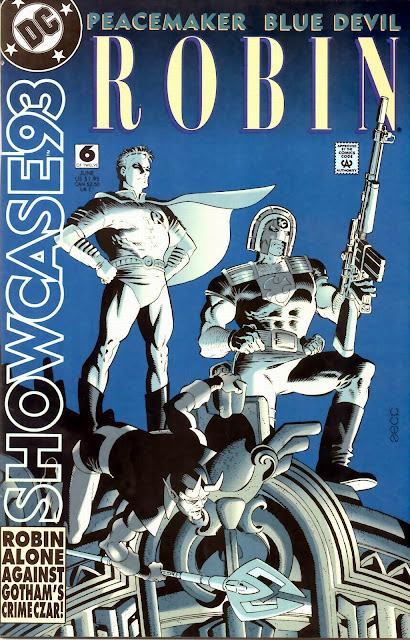

Cover illustrated by Mike Zeck.
Note: Robin, Blue Devil and Peacemaker do NOT appear in a story together.


6. Eclipso #11 (1993)

After 1992's Eclipso: The Darkness Within cross-over event, Eclipso received an ongoing series (written by Keith Giffen and Robert Loren Flemming) detailing his quest to finish killing off mankind. After Eclipso takes over a small Latin American country, Amanda Waller assembles a team of 'fringe' DCU heroes to take down Eclipso. Peacemaker is one of the heroes recruited for Waller's squad (aptly named 'The Shadow Fighters'). I originally thought this was a Bart Sears cover. It is not. This cover was pencilled by Audwynn Jermaine Newman and inked by Ray Kryssing. [Sears pencilled the first three issues of this series before moving on to another project, hence my confusion.] This cover stands out to me simply for the fact that Peacemaker is front & centre, he's jacked and carrying ridiculously oversized firearms, all while being flanked by the rest of the Shadow Fighters. This is DC comics encapsulating the 'extreme 90s' in one cover: Peacemaker is the action hero we NEED. Too bad The Shadow Fighters only lasted three issues.
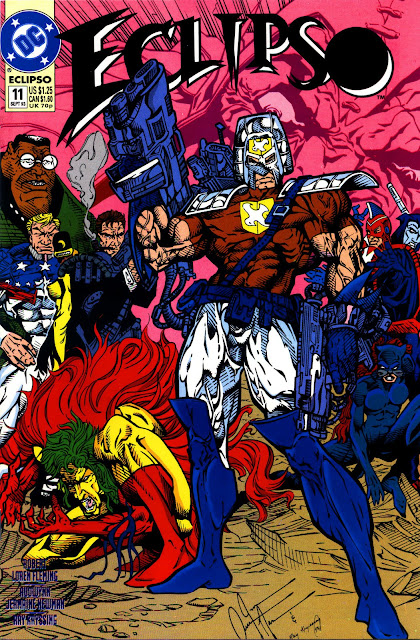
  

Cover of Eclipso #11 pencilled by Audwynn Jermaine Newman and inked by Ray Kryssing


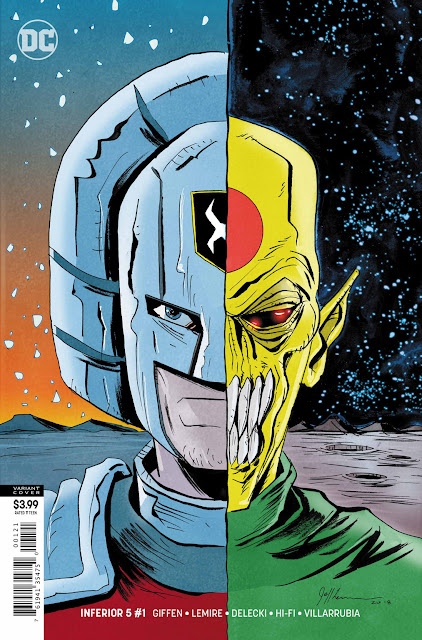
7. Inferior Five #1 - Jeff Lemire variant cover (2019)

Keith Giffen and Jeff Lemire's limited series about the Inferior Five joining forces with Peacemaker was meant to be a twelve-issue maxi-series, but was cut down to 6 issues due to COVID. In fact, issue #5 and #6 were only released digitally. I like this variant cover for two reasons: Lemire illustrated it, and it's got a Dominator on it (these were one of the alien races trying to invade earth in DC's 1988 Invasion! cross-over event). Really, it's a throwback to the era of DC comics that I loved reading. Lemire also grew up reading DC comics in the 80s, and our co-editor, Mark Belkin, interviewed him about his love for that era


Well, that's it, folks! Can't wait to see what John Cena and HBO Max has in store for us.

-Justin


Tuesday, November 14, 2017

Reviewing the 1988 Peacemaker mini-series

While the 1983 Vigilante ongoing series kept most of us on the edge of our seats (let's not even mention the ending), it was during writer Paul Kupperberg's tenure that new and not-so-new characters (ex: Harry Stein, Valentina Vostok/Negative Woman, Black Thorn, Harvey Bullock, The Agency, etc) would be introduced to the title in preparation for the upcoming Kupperverse Paul was gradually building. Most surprising -- to old school Charlton Comics fans, anyways -- would've been the very dramatic re-introduction of Peacemaker to the modern DC Universe.

Vigilante #36 (1986). Mike Grell cover. This would've been an instant 'buy' for me if I had seen it on the shelves.

Then


Created by Joe Gill and Pat Boyette, Peacemaker first appeared in 1966's Fightin' 5 v1 #40 published by Charlton Comics. In an 8-page back-up feature, the reader is introduced to Christopher Smith: an American peace diplomat... who moonlights as Peacemaker: a man who loves peace so much that he's willing to fight for it. Fun Fact: a 'Peacemaker' is also another name used for the Colt Single Action Army revolver and was the standard US military service revolver in the late 1800s.


Panels from Fightin' 5 v1 #40 (1966).
Fightin' 5 was cancelled after issue #41. Peacemaker then headlined his own 1967 ongoing series -- which lasted a total of 5 issues. Christopher Smith was depicted as a suave peace envoy (with a direct line to the White House) who used tools of diplomacy to resolve global conflicts before they could escalate. When that failed, he became the Peacemaker. This was a last resort, of course. Smith HATES war and violence.

Peacemaker #4 (1967). Charlton comics.

Typically, the threats came from a communist country wielding an atomic-powered whatever, but this was during the mid-to-late sixties, and the Cold War was all anybody was talking about anyways. Peacemaker's weapons played a bit more on the sci-fi side: jetpacks, a helmet with a laser on it, some sort of gizmo that can scramble enemy missile commands, and more that I'm forgetting -- all of these were Smith's own inventions. Try to image if James Bond secretly slipped into a costume to battle villains and you've got Peacemaker.

Peacemaker #4 (1967). Charlton comics.

A bit more of Peacemaker's history was expounded on in his 4th issue: he operates out of a Chateau (location never specified), his father was an army officer turned statesman, his mother was a laboratory researchist, he's a brilliant inventor who has helped the United States on numerous occasions... and his major motivation for all this?

Peacemaker #4 (1967). Charlton comics. What an altruistic guy!

Surprisingly, for such a fondly-remembered character, Peacemaker only appeared in eight Chartlon Comics issues -- yet was still considered to be among the Charlton Action-Heroes line-up. I could've sworn he was a member of Americomics' Sentinels of Justice in 1983 with the rest of the Action-Heroes, but apparently he didn't make the cut.

I was hoping to discover that Paul Kupperberg was one of the original writers for Peacemaker and this would've all been tied into a neat lil' serendipitous bow -- but alas, that is not the case. For anyone wondering: Kupperberg had indeed written for Charlton Comics... but it was in 1976...and it was only for supernatural anthology titles (i.e., Haunted, Ghostly Haunts, Ghost Manor).


Now (well,... the mid-to-late eighties)


If you had only started reading comics in the early 80s, Peacemaker would've been a totally NEW character to you. Prior to this, you might've spotted him in a few panels of the Crisis on Infinite Earths maxi-series, but the three-issue story arc in Vigilante #36 - 38 allowed Kupperberg a chance to flesh out this relatively obscure character to a brand new audience -- and what we got was a completely different Peacemaker from the version Charlton Comics fans grew up reading. He still has an arsenal of advanced weaponry, but now he's a little... 'unhinged'. He's a 'counter-terrorism freelancer' who loves peace enough to KILL for it. He has no hesitation blowing off a terrorist's head at point-blank range. Collateral damage is not an issue to him, he'll even fire on allies if it means getting the job done -- he's pragmatic like that.

panels from Vigilante #36 (1986)
In his first post-Crisis appearance, Peacemaker has gone AWOL and intercepts a hostage situation facilitated by Arab terrorists. His employer (the Agency) worries that he's a liability and wants him terminated. The machinations of these circumstances leads to an impromptu team-up with Adrian Chase. Absent is the debonair persona of Christopher Smith, and instead we get a disheveled civil servant who's apparently constantly talking to himself. Kupperberg makes a point to demonstrate what a loose-cannon Peacemaker is, and we are treated to gratuitous displays of Christopher Smith dispensing hot lead and pro-Americana slogans. Remember: Vigilante was a direct market title -- meaning that it was not available on newsstands and could only be obtained if you went to a comic book shop or ordered a subscription -- so the creative team could get away with a little more violence and mature content than would usually be found in a DC title.

panels from Vigilante #36 (1986)

This story arc must've been popular, because Peacemaker returned for another three-issue story arc in Vigilante #41 - 43. There's a lot more emphasis on just how mentally unstable the Peacemaker is -- he's having full-on conversations with his helmet, and is convinced there's some sort of conspiracy against him (which is his main driving reason to return to New York City and kill members of the Agency).

panel from Vigilante #41 (1987).
We get a bit more insight into Peacemaker's relationship with his helmet -- he's guided by the voices of the souls he executed and this seems to drive him on his quest for vengeance. After a narrow defeat, the story arc concludes with Peacemaker being detained.

Kupperberg's re-invention of Peacemaker as a 'take-no-prisoners patriotic killing-machine' was kind of an extreme parody of the blockbuster Hollywood action heroes of the time combined with a healthy dose of Reagan Era American flag-waving patriotism mixed in. During the 1980s, the United States' foreign policy was largely centered around winning the Cold War and ending communism, and the courageous muscle-bound American soldier single-handedly mowing down all of America's enemies with a large assault rifle (think: Sylvester Stallone in Rambo, etc) had pretty much become the people's hero. Kupperberg kept Vigilante grounded in reality and based many of his storylines on current events -- plane hijackings were the terrorist operation du jour (there were eight international plane hijacking between 1984 and 1985) -- and the infamous Karachi Pan Am Flight 73 hijacking occurred the same month that Vigilante #36 was printed.

Vigilante #42 (1987). Again with the "commies". sigh.


Which bring us to our feature presentation:

Peacemaker #1 (1988). Cover by Tod Smith.
If you were hoping that this 1988 mini-series would be the continuing adventures of a seriously damaged anti-hero, you'd be sorely disappointed. [And, admittedly, that would've made a great mini-series.]

Writer Paul Kupperberg and illustrator Tod Smith rejoin forces (this time with inks by Pablo Marcos) to bring us a new chapter in the life of Christopher Smith and picks up right after we left off in Vigilante #43.  While his appearances in Vigilante made Peacemaker out to be a morally reprehensible character, this mini-series paints him as a tragic hero who emotionally feels the toll of each life he didn't save from terrorism.

panel from Peacemaker #1 (1988). Pencils by Tod Smith, inks by Pablo Marcos.

What about his deranged extremist behavior in the pages of Vigilante? That's all explained away in two panels:

panels from Peacemaker #1 (1988). Pencils by Tod Smith, inks by Pablo Marcos.

I'm just going to re-iterate that the Christopher Smith/Peacemaker in this mini-series is a VERY different man from the one we saw in Vigilante; he runs something called the Pax Institute [some sort of humanitarian organization?], he feels guilt about not stopping terrorism fast enough, he lives like a billionaire in the Swiss Alps, he doesn't want to take human lives if he can help it, and those deceased souls he collects in his helmet that talk to him? That's done with. Instead, he's got a different type of psychological demon to confront. In a way, this is more like the Charlton Comics version of the character -- but he's still got residual mental issues.

panels from Peacemaker #3 (1988). Pencils by Tod Smith, inks by Pablo Marcos.

Seeing as how Peacemaker's modus operandi is stopping terrorism, this mini-series revolves around him trying to foil a large-scale international terrorist plot being spearheaded by none other than Doctor Tzin-Tzin -- all while battling his own personal demons, of course. [In case you were wondering, Doctor Tzin-Tzin appeared in the mid-sixties as a Batman villain, and was more or less played up as a Fu Manchu knock-off. Last seen in a 1977 Batman story.]  This is reminiscent of Peacemaker's earlier Charlton adventures in which he dealt with international threats.

panel from Peacemaker #1 (1988). Doctor Tzin-Tzin!

Kupperberg goes to great care to add details about Peacemaker's elaborately revised origin by including correspondences between various high-ranking officials at the end of each issue. These are actually pretty long and tedious reads, but they reveal how Christopher Smith became an anti-terrorist commando, we learn of something called PROJECT: PEACEMAKER and we get the full details on his support staff.

It was obvious that this mini was a pilot to see how an ongoing series would fare, and since an ongoing didn't happen we can only assume it didn't generate enough interest. [As far as I know, it was never reprinted, either.] To be honest, I had a bit of trouble maintaining interest in this mini -- it's heavy with international politics and seems extremely topical for the time it was written. Kupperberg is no stranger to writing about international political intrigue (see: Checkmate!), and -- from an 80s historical revisionist perspective -- rehashing the Cold War is kinda cool, but I just couldn't get into it and the plot kinda confused me.

The art was okay -- lots of action sequences and the pacing was steady. The biggest surprise in this mini (for me, anyways) was the inclusion of Doctor Tzin-Tzin as the main antagonist -- mainly because he was a villain in one of the first Batman comics I owned. By 1988, I'm not sure if Tzin-Tzin was considered to be an offensive racial stereotype or just one of those Z-list DCU villains everyone had forgotten about, but it was entertaining to see this long-forgotten Batman villain appear in a modern story.

Batman v1 #285 (1977). Jim Aparo/Tatjana Wood cover

It kind of boggles my mind that the SAME WRITER could revamp a character so dramatically. I'd understand if it was a new writer who decided to undo everything Kupperberg had previously done, but frankly I thought the 'psycho' Peacemaker as seen in Vigilante would've made for a much more interesting character to read about. Don't get me wrong -- I still love the idea of Peacemaker, but this mini left thirty-something year old me a little underwhelmed. I'm sure 10 year-old me would've purchased it, regardless.

I've dwelled on it a bit more and decided that the reason I wasn't so keen on this mini was because Peacemaker seemed isolated from the rest of the DCU. Other than an obscure Batman villain (last seen in the late seventies) and an appearance from Harry Stein, there was no real connection to the DC universe -- no mention of Superman, the Teen Titans or anything, really. I realize that Kupperberg was trying to build a foundation for his own universe of characters, but there was no need for Peacemaker to exist in a vacuum. Maybe he could have had other Kupperverse chararcters appear? I don't think Peacemaker was interesting enough on his own to keep an ongoing series going. As we saw, Peacemaker works MUCH better when he's accompanied with other established heroes (see: Janus Directive and Eclipso series)

The Vigilante was not MY first introduction to Peacemaker -- it was from an old, tattered copy of Who's Who that my parents let me buy at a flea market one Sunday afternoon. I would've been around nine or ten years old at the time and probably didn't read his bio unless it was to check if he was a 'good guy' or 'bad guy'. To be quite frank with you, it was adoration at first sight. How could a 10 year old who played with G.I. Joes not be drawn in by a gun-wielding super-soldier with a radar dish for a helmet? And his radar dish helmet emits a sonic wave attack? And he flies around with a jetpack? Damn. Needless to say, I have a fondness for this character.

This wasn't the end of Peacemaker, however. He would re-appear in Checkmate! and appear sporadically across the DCU shortly thereafter.


A few 80s moments:


It wouldn't be a Paul Kupperberg mini-series without a Ronald Reagan appearance:

panel from Peacemaker #4 (1988)


Or how about that Berlin Wall? (cue up Scorpions' "Winds of Change")

panels from Peacemaker #4 (1988).


Tuesday, November 8, 2016

Paul Kupperberg talks about the 1988 Checkmate! ongoing series

Paul Kupperberg was a busy man in the 1980s. He wrote most of the Arion, Lord of Atlantis ongoing series, the last 24 issues of Vigilante, the first 18 issues of Doom Patrol v2, the entire Supergirl v2 ongoing series, so many Superman-related stories that we can't list them all here, and a run of Green Lantern Corps back-up tales in Green Lantern v1. (Not to mention other projects he touched on.) Most importantly, Kupperberg wrote all 33 issues of 1988's Checkmate! ongoing series. Checkmate! was a little unconventional for a DC book - it was a mix of covert operations and espionage, it re-used characters from Vigilante and Doom Patrol v2, and didn't really interact with the rest of the DCU. It was a NEW FORMAT book and kind of crept below reader's radars because it was only available in comic book shops. I had never even heard of it until about a decade ago. Needless to say, it acquired a cult following and those who like it, like it a lot.


This is an aggregate of two different interviews with Paul Kupperberg. The first, by Aaron "Head" Moss, was recorded on 2016 in his Task Force X: Episode 19 podcast. The Task Force X podcast mainly concerns itself with John Ostrander's Suicide Squad and Kupperberg's Checkmate! comics. If you're into either of those, I'd recommend you check his podcast out.

On with the first interview:

[as per usual, I've mangled the continuity of this interview so it makes logical sense to the reader -editor]


Aaron "Head" Moss: After Vigilante ended, shortly thereafter, Checkmate! started up with a couple of the characters from the Vigilante book. Who's idea was it - who came up with the idea of Checkmate!?... Was it your idea to continue it? Or was it...?

Paul Kupperberg: The whole idea was that "we'll end Vigilante and come up with something to replace it on your schedule". I was kind of looking around and saw that DC didn't really have a central spy agency at the time. I'd been playing around with those kind of ideas - the whole espionage idea - in Vigilante. [We] just decided to take it to the next step and take all the people involved in the espionage end of what was going on in Vigilante and transfer them into Checkmate into an actual sanctioned group. It came under Amanda Waller's command - she was running Suicide Squad/Task Force X.

Moss: You had Black Thorn, Harry Stein, Harvey [Bullock], seems like everyone that was directly involved with the end of Vigilante came over to Checkmate!. Looking in different places I'm seeing that you're credited with it, I see that John Byrne is credited with help creating it because they first appeared in Action Comics #598 (1988).

Kupperberg: The genesis was: I wrote the proposal. John [Byrne] is a friend of mine. We asked him "would you mind if we exploited your name by having you [develop] a character", he said "no no, not at all, do I get lunch out of it?" So yeah, we bought him lunch, and at lunch we sat down and looked over the proposal. We just talked about the 'look' of the knight costumes. He did this sketch in a sketch book and that was it. Steve Erwin took that (and the proposal) and designed the headquarters and the characters and all that stuff. [You can read about Erwin's recollection of it here. -editor]

Moss: So the [Checkmate] knight costume... that was you? Or you and John [Byrne] that came up with the idea for the Knight costume?

Kupperberg: It was mostly John [Byrne]. Some of it is kind of self-evident: you're doing a knight costume, so you're going to need someone with some kind of helmet-thing going on. He's also a spy, so you're going to want to keep it dark. The gauntlet and the staff that expanded. So, y'know, kind of riffing off of the whole 'Knight' theme.

A Checkmate Knight in action. Checkmate! v1 #1 (1988)
Moss: Out of all the Checkmate! stories was there a favorite storyline you had in that?  Was there anything that stands out that you look back and go "Damn, I did a good job on that".

Kupperberg: There was a bunch of back-ups I remember - Randy Duburk drew a few of them - those were pretty good. That was later on in the series.

Checkmate v1 #33 - Randy Duburk art

Especially at the beginning, I like the first few issues a lot. I was really pushing it and trying to be ambitious and tell these big stories. And I think I was very successful in accomplishing what I set out to do. Whether or not anybody liked it, that's a whole other story.

Moss: There was that cross-over with Suicide Squad: the Janus Directive. How closely did you and John Ostrander work on the title? Was it just a cross-over?

Kupperberg: It was pretty much a cross-over - as I recall the idea of that cross-over was mostly John [Ostrander]'s. I guess he worked on it with his editor. Johnathon Peterson was my editor. I think Bob Greenberger was editing Suicide Squad at the time.

As I recall I wasn't involved too deeply in the plotting of the overall story arc. I was responsible for the stories in Checkmate!. It was mostly a Suicide Squad story, it seemed to me. I think it started there and ended there as well.


Moss: It crossed over with Firestorm v2, which was written by John [Ostrander], Captain Atom v1 and a few other titles John [Ostrander] was writing.

It seemed mostly like a John Ostrander storyline. But I know that Checkmate! was involved because Suicide Squad and Checkmate, as I said, are different sides of the same coin. I wasn't sure how involved you were with the cross-over...if John [Ostrander] was like "This is what I want you to do" and you went [off] and did your own little thing with it.

Kupperberg: Yeah, that was pretty much it - to my recollection. Yeah.

Moss: So the series ended. Before it ended, did you tell the stories you wanted to tell? Were there other stories that you wanted to?

Kupperberg: Oh sure, there's always more stories to tell - except in the case of something like Vigilante where obviously we exhausted - you often hear "we're cancelling this title because we think we've ran out of stories to tell with this character". No.  If you have, then you've got a problem. Because there's always more stories to tell about any character. No, it was a matter of sales. What'd it last? 33 issues? Not too bad.

Moss: Were there any stories that you wanted to tell but DC editorial told you 'no'. Or were you pretty much given free reign on it?

Kupperberg: I go into these things knowing the parameters I'm working. I'm not going to try to shove a story down their throats when it's clearly inappropriate to the book. We were a regular non-labelled DCU title, so those were the stories I was going to tell. Vigilante, when we got the mature label, I went ahead and pushed the limits a little. I don't try to do rape stories in Superman. Not appropriate.


Moss:  Was there any characters you wanted to include in this Checkmate! comic that editorial told you 'no'. You said you knew you were getting into and you wrote to that title. So I wasn't sure if there were any characters you wanted to use as a guest appearance or anything that DC editorial said 'no we can't do that' or was there [anyone] you asked for and they said 'go for it'? 

Kupperberg: I don't think I used that many other DCU characters in the title. Again, I was trying to keep it reality-based. Even with the Janus Directive, nothing wrong with the stories or anything, but they're my least favorite of the whole run. Just because, again, I was trying to keep it 'in the reality', and once you bring in superheroes reality flies out the window. No matter how hard you try - I know everybody thinks "our heroes reflect the real world". But they DON'T. They CAN'T. You're not constrained by reality. A death doesn't have any emotional impact because you know they're coming back next month. If somebody's in a corner, you know they're going to pull the ultimate nullifier out of their ass and send Galactus packing. Stan [Lee] and Jack [Kirby], the greatest run of any comic book ever - the first 100 issues of Fantastic Four v1 - smack dab in the middle you have the Galactus epic. They're at the height of their power - the greatest team on the greatest run of a comic ever - and they're forced to pull the ultimate nullifier to send Galactus on his way. So it doesn't matter how good it gets, you're hemmed in by the lack of reality. You gotta go there. Once you bring superheroes in, as soon as someone can fly, you're screwed. Then anything goes.

Moss: If asked, would you be willing to come back to Checkmate!? Or do you have any more Checkmate! stories hidden in your mind somewhere?

Kupperberg: I would absolutely love to get my hands on the characters and on the concept again. No, I don't have any stories at the moment. My job is to come up with stories when I have assignments for these things. Stories are not the problem.

---

The Task Force X podcast also interviewed Kupperberg about his work on the Vigilante series and why the series ended. You can read the interview here.

Aaron "Head" Moss, a major G.I. Joe enthusiast, also co-hosts the G.I. Joe: A Real American Headcast and has been a guest on our 1991 G.I. Joe Impel trading card set review. He also hosts the Starman/Manhunter Adventure Hour which covers both the 'Will Payton' Starman ongoing series and the 'Mark Shaw' Manhunter ongoing series (circa late 1980s).

----

In an April 2nd, 2014 interview on VOC Nation's Compton After Dark podcast show, host Dean Compton spoke with Paul Kupperberg:

Dean: In your Checkmate! v1 series for DC [comics] you dealt with a lot of issues that were making the headlines at the time: Americans providing weapons to rebel Quracians so they can provide a diversion while America does covert stuff (Iran-Contra affair), some Britains side with aliens to overthrow government (I think that was Irish, actually), America/Russia teams up just as the Berlin Wall is being destroyed. Curious if you're using this as a platform to covertly state your disapproval of current affairs, or if you're just trying to tell an engaging story?

Kupperberg: A little bit of both. A good story is number one. And if you can sneak a little message in there, what the hell, as long as it doesn't hurt the story. I was not a big fan of Ronald Reagan or his policies and still cringe when I hear him referred to as one of the greatest presidents of all time. There's that little thing called 'verisimilitude' - you read a story and even if you're not thinking "oh that's Iran-Contra" in the back of your mind you're going "that sounds familiar" and it kind of makes the story more interesting and more engaging - I hope.

US President Ronald Reagan 1982

Dean: I recommend it [Checkmate!] to everybody... you can ask [co-host] Ryan. I'm pretty annoying about recommending that and Suicide Squad as contemporary pieces that really told a great story of [what] was really disillusionment of whatever existed as a social contract between the American government and the American people, not just as far as welfare programs, but also as far as surveillance programs - of course that's a different story. We can talk about COINTELPRO and etc going far back but...

There was definitely a feeling, during the Reagan era, that any promises that had been made as far as social liberties and social security were out the window now, and you were going to work harder and do what authoritarians said for less and like it... and if you didn't like it we were going to treat you like we treated the Air Traffic Controllers.

Kupperberg: And look where it's led us, to the wonderful [things] we have today. [laughs]

[Dean's question was directly related to an article DC in the 80s wrote several years ago examining the Checkmate! ongoing series. I want to personally thank Dean for pronouncing my last name correctly (sounds like 'Frank-cooer' when said in English).]

---

You can listen to the full podcast here. This is a fantastic episode to listen to if you are a fan of Charlton Comics and/or the Charlton Arrow. Dean had gathered an All-Star ensemble of guests (Paul Kupperberg, Mort Todd, Roger McKenzie, and Fester Faceplant) who delve through everything from the history of Charlton comics, their favorite memories about Charlton comics, the Charlton Action Heroes, a few hilarious anecdotes and the creation of the Charlton Arrow. The energy on this podcast is electric and I strongly recommend a listen.

Dean Compton (and Emily Scott) also manage The Unspoken Decade - a comic book blog that examines the 1990s in comics. It's one of my favorite sites to visit and looks back at all of my old favorites. Look for more collaboration between Dean Compton and DC in the 80s in the future.

-Justin

Thursday, June 23, 2016

Throwback Thursday - A really really brief summary of 1983's Vigilante ongoing series

[Everyday is Throwback Thursday when you moderate a webzine that examines comic books from 20+ years ago, however, this was originally written 3 years ago when we first started reviewing DC comics from the 80s on our tumblr. We just figured that with all of the recent hype about Vigilante slated to appear in the CW's next season of the Arrow, now would be a good time to post this. It's kind of humbling to look back on old articles and spot all of the errors/inaccuracies/generalized statements you've made. Remember, sometimes you can't move forward without looking back at how you started. Someday we promise to post the in-depth review this excellent ongoing series deserves - if it's the last thing we ever do. -J]


Vigilante house ad (circa 1983). Property of DC comics.


First, I want to say that this Vigilante has no relation to DC’s golden age Vigilante that appeared in 1941 (cowboy who rides a motorcycle).

I did a lot of research on Vigilante before I posted this, and found there were not that many reviews that thoroughly examine this series.After digging out my old back issues I have come to the conclusion that this may be THE definitive comic book series of the 1980s - I even created a new hash tag just for this entry.

Created by Marv Wolfman and George Perez, the Vigilante was a character introduced in the pages of the New Teen Titans - which was DC’s "it" book of the 1980s. The origin of how the Vigilante came to be is a multi-issue sub-plot that concludes in the New Teen Titans Annual #2 (1983). From then on, the Vigilante gets his own series.

Despite being a spin-off of the New Teen Titans, this series is very much a stand-alone book. One of Wolfman’s main goals in creating this series was to keep it as realistic as possible, which explains the minimal interference from other established DC characters. I’m going to presume that keeping the series grim and violent kept it as close to realistic as possible (observe the newspaper headlines showing in the house ad).

It was a 'Direct Edition' comic (so it never wound up on newsstands) and did not carry the Comics Code Authority seal - which is fitting because the Vigilante shot and killed criminals. The ‘antihero’ was still a relatively new concept in the early 80s, and the fans were squeamish. This series was mired in controversy since the get-go. Fans complained about the cold-blooded killing and the Vigilante took a vow of "no killing" after issue #1. Fans then complained he was too soft, so the writers hardened him up again. At some point fans complained the Vigilante lost his edge and he became a super-hero for a while. Critics panned it for it’s blatant 'implied’ sex scenes. Wolfman wrote and edited this series for the first year, from then on Paul Kupperberg took over writing chores (presumably because Wolfman was busy with Crisis On Infinite Earths and other projects, but I’d be surprised if Wolfman didn’t quit because the readers were too fickle). Wolfman stayed on as editor and Kupperberg stayed on as writer to plot out one of the best whodunnits I’d ever read.

In my opinion, this series really hits it’s stride after Mike Gold becomes the editor (issue #35) and allows Kupperberg the freedom to write stories that would involve as many 80s action/crime film tropes as possible (yes, the protagonist gets arrested and imprisoned and has to fight his way out of jail). By issue #39 a “suggested for mature readers” label is added and the series gets way more extreme with graphic violence, implied sexual abuse, vulgar language, images of drug use, and nudity.

What really makes this series stand out is that it covers a lot of social issues that would never be brought up in a mainstream comic (ex: racial profiling, drug addiction, homelessness, immigration, inflation/economic downturn/jobs being sent over seas, child kidnapping, rape, pedophilia, the war on drugs, corruption in the government/police/law, homosexuality, terrorism, religious extremists, how vigilantism affects society, consequences of killing, innocence, etc…). Which in my opinion was one of the major hallmark of comic books in the 80s: raising awareness of what was going on in our culture/society rather than brushing over the subject and creating a false sense of security. This is NOT a comfortable book.

A few things worth mentioning:
  • Alan Moore was a guest writer for issues #17 and #18
  • Very subtle Crisis on Infinite Earths tie-in in issue #22
  • John Byrne contributed a cover for issue #35
  • Mike Grell contributed covers for issues #36, #37, and #38

Vigilante lasted until 1987 with 50 issues and 2 annuals. The adventures of the Vigilante’s supporting cast is continued in Checkmate v1 (1988).

I’ve had the first half of this series since I was a teen and had trouble tracking down the rest of the series until recently. Unfortunately, someone spoiled the ending of this series before I had a chance to finish reading it. I won’t do the same to you. Pick it up, now.


As of this writing, this series has not been reprinted by DC yet, so if you want it you’re going to have to go digging in back-issue bins. Rumor has it that it’s really difficult to find issue #50 - not due to it being highly sought after, but because sales were so bad near the end of the series that retailers were stocking very low numbers of this title.

Vigilante v1 #50 (1988)


Fun Fact: Apparently Wolfman was not pleased with the way the series ended, but had no say in it.


Sunday, March 6, 2016

The DC fan art of Denny Fincke

Stunning commissions of 80's era DC Comics characters by Denny Fincke (writer/illustrator of Twit Troo Of The Moon and Anti-Star):


Check out the rest of his online portfolio via his ComicArtFans.com gallery.


Denny took a few minutes from his busy schedule to chat with us about his work:

DCinthe80s: I'm noticing a lot of Golden Age characters in your portfolio (ex: Rex Tyler Hourman, Alan Scott Green Lantern, Jay Garrick Flash, Ted Knight Starman, Al Pratt Atom, etc). I'm going to guess you were a fan of the Golden Age Justice Society of America. Were you a big fan of Roy Thomas' All-Star Squadron title from the 80s?

Denny Fincke: I fell into comics in the 70's.  I was reading all sorts of comics: DC, Gold Key, Harvey and just a few Marvel (they seemed a bit dark for me at the time). What really made me into a DC Comics fan was Justice League of America #100-102 (1972).  This was a three part story (rare at the time) involving the JLA, JSA and the Seven Soldiers of Victory and it blew my mind!  After that I was a comics fan for life.  At the same time, DC was also publishing 100-page Super Spectaculars with plenty of Golden Age reprint stories so I was discovering all this wonderful vintage material.  That fed into my love for the JSA characters.  But for some reason I did not follow through on All-Star Squadron.  Lately I've been thinking of going back and exploring it.


DC80s: I'm also noticing a lot of Legion of Super-Heroes love in your works. Were you a fan of the Levitz/Giffen era? What about the 5 Year Later story line (LoSH v4 1989)?

Denny: I did like the Giffen/Levitz, but again my formative comic years were in the 70's so the Cockrum/Grell/Bates issues were my favorite.  As a kid who wanted to be  a comic artist one day, and Grell and Cockrum heavily influenced me. Again in the 70s DC would reprint 60s Legions tales so I was also exposed to the LSH history and the art of Curt Swan. The older I get the more I appreciate him.  His work on World's Finest is also amazing.  I enjoy the Giffen/Levitz run but I haven't read it in a while so it's hard for me to comment on it. But I will say that it was the last block of LSH comics to genuinely entertain me.


DC80s: You were scoping out the Paul Kupperberg/Vigilante interview and casually mentioned that the cover of Vigilante #49 was your one and only DC job. Did you want to tell us about that? Also, how old were you at the time?

Cover of Vigilante #49 (1988)

Denny: I met Paul [Kupperberg] in a comic shop in Brooklyn in 1986 and he was trying to do a comic called Shadow Play with Now Comics and I did some pages for that. Unfortunately the book fell through for a variety of reasons. During that time he helped me get the Vigilante cover.  I believe Mike Gold was the editor at the time.  I was very lucky to have Dick Giordano as the inker because I thought the layout was good but I'm sure at the time my pencils were unrefined.  I was in my early twenties.


DC80s: Do you have any anecdotes about trying to 'break into' DC comics?

Denny: Wow, breaking into comics is not easy and it truly never happened for me.  I ended up working in animation. I've done many conventions and have sold many commissions of DC and Marvel characters but I always feel a bit like a fraud because, besides the Vigilante cover, I never worked for the big two.  But I do conventions for the love of it. I get a thrill when someone comes to my table and asks for a commission of an obscure character.  At my last con someone asked me for a sketch of Karnak.  I always liked that character but had never drawn him. Now someone wanted to pay me to do it. So great.


DC80s: Who were your big influences in regards to art?

Denny: I'm a huge George Perez fan and I loved everything he worked on especially Teen Titans.  I was also influenced by John Byrne and would buy anything he did whether it was Marvel or DC.

 
DC80s: What are your stand-out comic runs from the 80s?

Denny: The Giffen/Levitz Legion, Teen Titans, Paul [Kupperberg]'s run on Doom Patrol, [Kevin] Maguire's JLA, anything Byrne did.  His X-Men work is amazing.  He also did a short run on Champions that I loved (but that's creeping back into the 70s).  John Buscema's Avengers.  There's probably more but these are the standouts. Watchmen was great of course, but I'm not a big Dark Knight fan.


DC80s: Tell us a bit about your creator-owned projects Anti-star and Twit Troo of the Moon...

Denny: Anti-star came from sample Green Lantern pages that I did.  I had started to create a Green Lantern story to send to DC but never sent it in. A couple of years later I still liked the layouts and over time changed GL to Anti-Star and it grew from there.

cover of Anti-Star #3


But I love all cartooning including newspaper strips.  I love Charles Schultz as much as I love George Perez.  I'm also a Calvin and Hobbes and Doonesbury fan.  At a certain point doing Anti-Star I thought that I needed to do something a little bit lighter in tone. I was working full-time and it was harder to get highly detailed superhero pages finished.  I thought with a comic strip that I could post online, I could get more immediate artist satisfaction.  Twit Troo of the Moon arose from some stream of conscious sketches I did while on vacation in England.  For the past few years TTOTM has been my main creative endeavor although lately I've been going back and coloring some Anti-Star pages. 

---

Thank you, Denny!

Tuesday, March 1, 2016

Paul Kupperberg tells us why the 1983 Vigilante ongoing series ended


Disclaimer: This following article spoils the ending of the 1983 - 1988 Vigilante ongoing series. If you haven't read this series yet, track it down, read it and revisit this article later. It will be worth it.


Aaron Moss of the Task Force X podcast (which is part of the HeadCast Network of podcasts) had a chance to interview writer-extraordinaire Paul Kupperberg about his work on the 1983 Vigilante ongoing series. This interview was first posted on Feb 17, 2016.

(I don't transcribe things very often, but took the liberty of omitting any awkward pauses, y'know's and um's. Anything written in square brackets ('[' ']') is my own addition to something I couldn't make out clearly or wanted to provide context for.)

Without further ado:

---

Aaron Moss: Vigilante. You wrote the last half or so of that series - actually you had a little bit more than that - so, who's idea was it to end that title? Was that your idea? Was it a natural stopping point for you? Or was it editorial saying "let's get rid of this character"?

Paul Kupperberg: No, it was actually a natural stopping point. We had reached the point with the character that there was no place else to go. We could continue telling the stories, but if the guy [Adrian Chase] kept going it really would've just been false - y'know, it just would've been total bullshit.

And to stick another guy in that costume, well we'd already done that two or three times. And, no matter who wears the costume afterwards, it's not the real guy. That applies for all characters - are you listening DC and Marvel?

So we just came to the point - it's like "you know what? the only logical thing for this guy to do is to put a gun to his head and after that the only logical thing to do is to just end the book".


Moss: For those listening who are not familiar, Vigilante was kind of like DC's [version of Marvel comics'] Punisher, but - I don't want to say 'more realistic' - but it was more realistic. It was [about] a guy that took the [war on] crime into his own hands after his family was killed and instead of doing it for a hundred years, eventually, like any normal person, the weight of what he's done wore down on him and eventually it just got too much for him mentally and, as [a result] of that, at the last issue of the series he nibbled on the end of a gun.   

[...]


Kupperberg: The difference between Vigilante and Punisher, like you say, was realistic. Punisher always lived and played in a superhero world. Vigilante lived in the superhero world, but I tried not to have - once I took over - I tried not to play in the superhero world too much. I wanted to keep it to people who, even if they may wear a mask or a costume, were at least pretty grounded in reality - or as real as it can get.

My natural tendency is to go toward the realistic, so Vigilante worked well for me.


---

Later in the interview, Kupperberg revealed that he is very pleased that Adrian Chase has not been brought back into the DCU. Explaining that Adrian Chase being resurrected would've taken away from the realism of the character/series.


Adrian Chase: as seen in Purgatory in 1999's Day of Judgement mini-series


Kupperberg also goes on to talk about how sales of comic books aren't as high as they used to be and how it's affecting the comic book industry, how comic book movies and actual comic books are two different things entirely, challenges of writing for real characters vs superhero characters, the 'so-called' stigma of writing for comic books, and a few more items of interest. You can listen to the full podcast here.

The Headcast also loves the 80s: they produce podcasts such as GI Joe: A Real American Headcast and the Starman/Manhunter Adventure Hour.


Thank you Aaron for the excellent interview and for permission to post this transcript!